

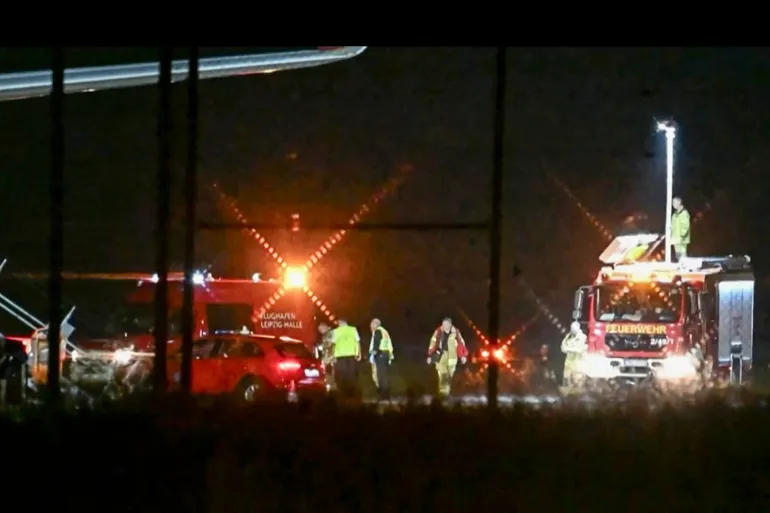
The German government has formally accused Russia of orchestrating an attempted drone attack against Leipzig/Halle Airport last month. Interior Minister Alexander Dobrindt announced on Tuesday that the incident, which involved an explosives-laden drone, aligns with a broader pattern of Russian hybrid operations across Europe. Investigators have reportedly uncovered evidence confirming that the individuals operating the drone were acting on behalf of Russian state entities.
The drone was discovered near a Ukrainian cargo plane at the airport on the evening of August 4 and was subsequently defused by authorities. Minister Dobrindt, speaking alongside Foreign Minister Johann Wadephul, stated that the conclusion of Russian responsibility is based on a combination of police investigations, identified offense patterns, and intelligence findings. He emphasized that the government does not view this as an isolated event but rather as part of a systematic effort to destabilize European security.
In a direct response to the incident, Minister Wadephul confirmed that Germany is taking immediate countermeasures. These include the expulsion of the Russian ambassador, the closure of the Russian consulate general in Bonn, and the shuttering of the Russian House cultural center in Berlin. Furthermore, Germany intends to leverage the European Union framework to pursue additional sanctions and travel restrictions against Russian nationals, while increasing pressure on the so-called Russian shadow fleet.
The Russian Ministry of Foreign Affairs, through spokeswoman Maria Zakharova, has signaled that Moscow intends to retaliate against what it characterized as anti-Russian actions by Berlin. This accusation marks a significant escalation in tensions, reflecting a shift in Germany’s policy toward Moscow since Chancellor Friedrich Merz assumed office, characterized by increased military support for Ukraine and a more assertive stance on the use of long-range weaponry.
International reactions have been swift, with European and NATO leaders expressing solidarity with Germany. European Commission President Ursula von der Leyen stated that the bloc remains united in its resolve to counter Russian aggression, noting that foreign ministers are preparing further sanctions for their upcoming meeting in the Republic of Ireland. NATO Secretary General Mark Rutte welcomed Germany’s decisive actions, asserting that the evidence of Russian involvement is clear and that such intimidation tactics will ultimately fail.
French Foreign Minister Jean-Noel Barrot warned that if the gravity of these events is confirmed, there will be inevitable consequences, particularly regarding potential sanctions. Meanwhile, UK Prime Minister Andy Burnham expressed full solidarity with the German government. These developments occur against a backdrop of rising concern across Europe regarding Russian espionage and sabotage, particularly as Ukraine continues to successfully target Russian infrastructure.
Leipzig/Halle Airport serves as a critical hub for international freight and is vital for supporting Ukraine, frequently hosting Antonov transport aircraft. It also houses the NATO Strategic Airlift International Solution (SALIS), which facilitates the daily delivery of equipment to alliance battle groups along the eastern flank. This incident follows a series of recent security challenges, including a terror probe opened by Poland into a fire at a factory supplying drone parts to Ukraine, and previous EU sanctions targeting Russian hackers and military officers involved in cyber-espionage campaigns. The report also notes that the findings were announced as several European countries that are providing Ukraine with support as it defends itself against Russia’s four-and-a-half-year invasion have reported an increase in sabotage attacks and attempts that they blame on Russia. The report also notes that on Monday, Germany criticised Washington for welcoming Russia’s finance minister to a Group of 20 (G20) meeting in the United States, warning against any normalisation of relations while the war in Ukraine continues. The report also notes that we will deter anyone who seeks to undermine our freedom and security,” European Commission President Ursula von der Leyen wrote on social media.