

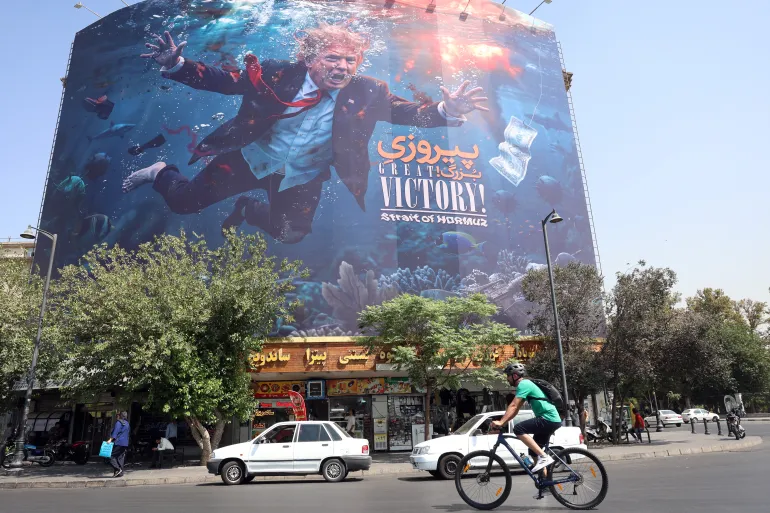
Following a month of relative quiet, the conflict between the United States and Iran has entered a volatile new phase. President Donald Trump recently signaled a shift in approach, warning that the U.S. would “hit them hard” in response to ongoing regional hostilities. This declaration followed a direct exchange of fire: Iran launched missile attacks on U.S. military sites in Jordan, which came shortly after American forces struck Iranian targets on Larak Island in the Strait of Hormuz.
The U.S. military operation on Larak Island, located near the port of Bandar Abbas, was aimed at two rocket launchers that Washington claimed the Islamic Revolutionary Guard Corps (IRGC) intended to use for deploying sea mines. Iranian media reported that three individuals were killed during the engagement. In retaliation, Iran fired missiles at two airbases in Jordan that host U.S. assets. Jordan confirmed that its defense systems successfully intercepted eight of the incoming missiles.
Reports suggest the White House may be moving toward a “no war, no peace” strategy. Under this framework, the U.S. intends to carry out periodic, targeted strikes against Iranian assets to maintain control over regional shipping lanes without committing to a sustained, full-scale military campaign. President Trump downplayed the risk of total war, telling reporters at the White House that the Strait of Hormuz remains in “extremely good shape” and asserting that Iran’s military, leadership, and financial systems have been significantly degraded.
The current instability follows a series of failed diplomatic efforts. In June, Tehran and Washington signed a memorandum of understanding (MoU) intended to establish a 60-day ceasefire and facilitate broader peace talks. However, the agreement collapsed within weeks due to ambiguous language regarding control of the Strait of Hormuz, with both sides trading blame for the breakdown. Since the failure of the MoU, Iran has largely ceased direct diplomatic engagement with the U.S., communicating only through intermediaries like Oman.
Economic pressure has become a central pillar of the U.S. strategy. Treasury Secretary Scott Bessent recently announced an aggressive campaign targeting Iran’s revenue streams, particularly oil exports. The administration has sanctioned 60 entities accused of facilitating Iranian oil sales and warned international partners of potential secondary sanctions. Bessent argued that Iran is “lashing out kinetically because they are losing economically,” a claim Iranian Central Bank Governor Abdolnaser Hemmati dismissed as incorrect, insisting that the country maintains sufficient foreign currency reserves.
The regional situation remains precarious as the war enters its seventh month. Iranian President Masoud Pezeshkian, speaking at a Shanghai Cooperation Organisation summit in Bishkek, Kyrgyzstan, stated that Iran would be willing to cease fire if the U.S. reciprocated and fulfilled its commitments under the June interim deal. Meanwhile, analysts warn that the U.S. strategy of sporadic warfare may be unsustainable. Trita Parsi of the Quincy Institute noted that periodic bombing risks trapping the U.S. in a “forever war” without a clear path to a resolution.
Domestic pressure is also mounting for the Trump administration, with approval ratings dipping to 33 percent amid rising fuel costs and the prolonged nature of the conflict. Furthermore, tensions are complicated by Israel’s stance; Prime Minister Benjamin Netanyahu has continued to emphasize his determination to prevent Iran from acquiring nuclear weapons, despite a lack of current evidence that Tehran is pursuing such a program. Israel has remained largely obstructive toward the June MoU, refusing to withdraw from southern Lebanon despite ceasefire stipulations.
Observers like Mohammad Eslami, a research fellow at the University of Tehran, suggest that the U.S. approach is rooted in miscalculations regarding the duration and complexity of the conflict. As both nations continue to demonstrate a willingness to respond militarily to perceived threats, the risk of accidental escalation remains high. For now, the administration appears to be prioritizing the protection of oil tankers and regional influence through a strategy of managed, persistent conflict rather than a definitive diplomatic or military victory. The report also notes that however, and largely fell apart because of disagreements arising from its vague wording, that deal has since expired. The report also notes that “That doesn’t mean we won’t smack them. The report also notes that we’ll see what happens,” he told reporters at the White House. The report also notes that followed by a ceasefire which was later extended, it began with a full-blown military campaign that lasted for 40 days. The report also notes that especially related to who had overall control of the Strait of Hormuz, caused it to collapse within weeks, with the US and Iran blaming each other for violating its terms, the woolly wording of the MoU. The report also notes that with Tehran again retaliating against US military assets and other infrastructure in neighbouring Gulf countries, that led to a renewal of US attacks on Iran in July.