

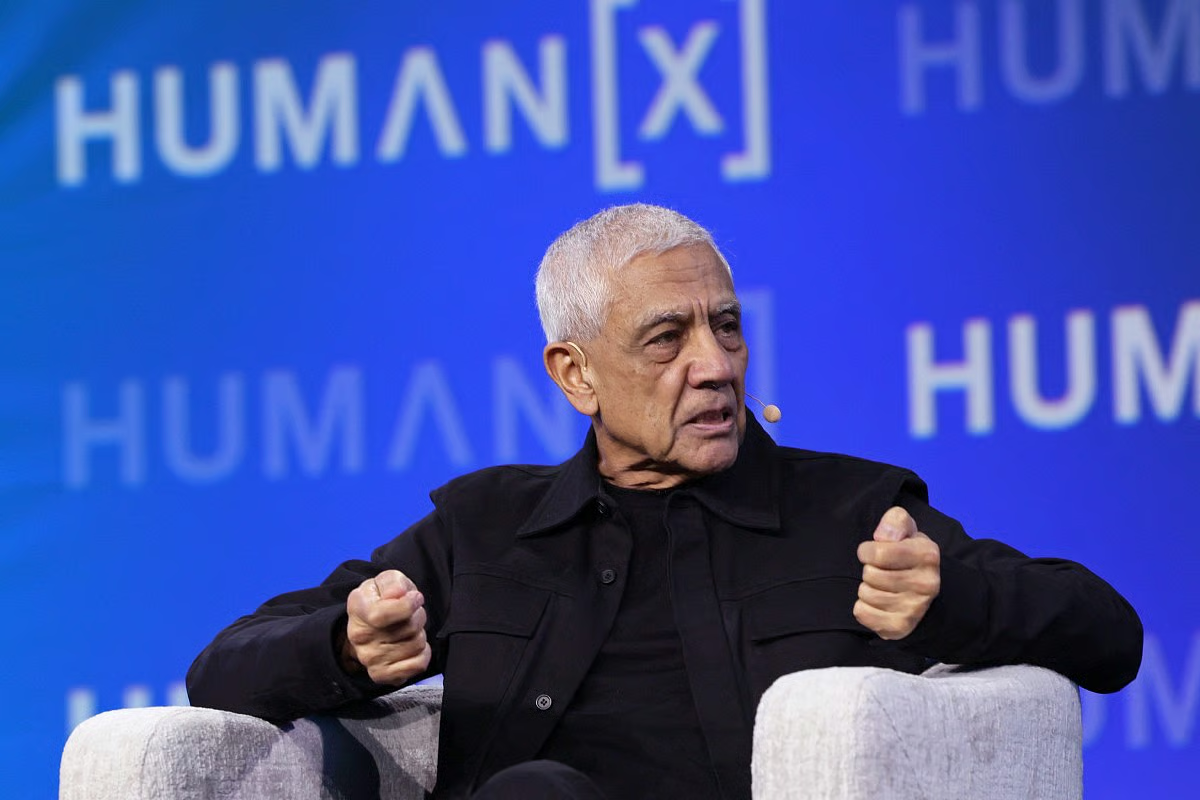
Vinod Khosla, the 71-year-old Indian-American entrepreneur and venture capitalist, has long been recognized as a contrarian visionary. While tech media outlets have occasionally labeled him as abrasive or polarizing, his career is defined by a high-conviction approach to technology investment. Born on January 28, 1955, in Pune, India, Khosla moved to the United States at age 21 to pursue studies at Carnegie Mellon University, eventually rising to prominence as a co-founder of Sun Microsystems and a leading figure in the venture capital industry.
A Legacy of Technological Innovation
- Sun Microsystems: Co-founded with Scott McNealy, Andy Bechtolsheim, and Bill Joy, the company pioneered networked computing and influential technologies like SPARC processors and NFS.
- Transition to Venture Capital: After serving as Sun’s first chairman and CEO, Khosla joined Kleiner Perkins in 1986, where he built a reputation for supporting unconventional founders.
- Investment Philosophy: His career is anchored in the strategy of backing transformative technologies long before they become mainstream or obvious to the broader market.
In 2004, Khosla founded Khosla Ventures, shifting his focus toward early-stage, science-driven ventures. The firm’s portfolio is diverse, spanning artificial intelligence, robotics, healthcare, climate technology, energy, biotechnology, and financial software. His most notable recent success involves OpenAI; Khosla Ventures was the first outside firm to invest in the organization, reportedly committing $50 million in 2019, a move that proved extraordinarily lucrative as OpenAI grew into a global AI leader.
AI Predictions and the Era of Abundance
- Vision for AI: Khosla argues that AI will move beyond simple chatbots to provide universal, low-cost access to essential services like healthcare and education.
- Controversial Forecasts: In 2012, he predicted that machines would replace 80% of medical doctors. By 2026, he expanded this view, suggesting that AI could radically transform or eliminate a vast number of traditional jobs by 2030.
- Economic Outlook: Despite the potential for job displacement, Khosla maintains that these technological shifts will ultimately usher in an era of abundance by making services more accessible and affordable.
- Climate Strategy: He advocates for technological breakthroughs over regulatory measures to solve global energy and climate challenges.
The Seattle Seahawks Acquisition
In a major departure from his tech-focused career, Khosla has entered the world of professional sports. On August 26, 2026, NFL owners unanimously approved the sale of the Seattle Seahawks to the Khosla family for $9.612 billion. This transaction marks the most expensive NFL franchise sale in history, far exceeding the $194 million Paul Allen paid for the team in 1997. Following Allen’s death in 2018, the franchise remained under his estate before the final agreement with the Khosla family—which includes Vinod, his wife Neeru, and their son Neal—was reached. The sale is expected to close in early September 2026, arriving just as the team celebrates its second Super Bowl victory. The report also notes that overly aggressive on deal terms, and blunt in public commentary, he is celebrated for massive early bets — including being the first institutional investor in OpenAI — yet criticised by some for being abrasive. The report also notes that he has spent more than four decades betting on technologies that many investors initially considered too risky — from computer networking and internet infrastructure to clean energy, fusion and artificial intelligence. The report also notes that now the Indian-born Silicon Valley billionaire is entering an entirely different arena: professional football. The report also notes that but the Seahawks deal is only the latest chapter in a remarkable journey that began in Pune, India, and passed through IIT Delhi, Carnegie Mellon, Stanford and Silicon Valley. The report also notes that khosla’s biggest headline in 2026 is not about AI or venture capital. The report also notes that sun helped popularise the idea of powerful computers connected through networks rather than relying solely on standalone personal computers. The report also notes that khosla served as Sun’s first chairman and CEO before leaving in 1984 to pursue venture capital.
Financial Standing and Career Impact
- Net Worth: As of August 25, 2026, Forbes estimated Khosla’s net worth at approximately $13.4 billion, placing him among the wealthiest individuals globally.
- Sun Microsystems Legacy: The company was eventually acquired by Oracle Corporation for $7.4 billion in 2010, following intense competition from Linux and x86 hardware and challenges in software monetization.
- Professional Scope: Beyond his current AI and sports interests, Khosla continues to influence sectors ranging from clean energy to fusion, maintaining his reputation as a high-conviction investor.