

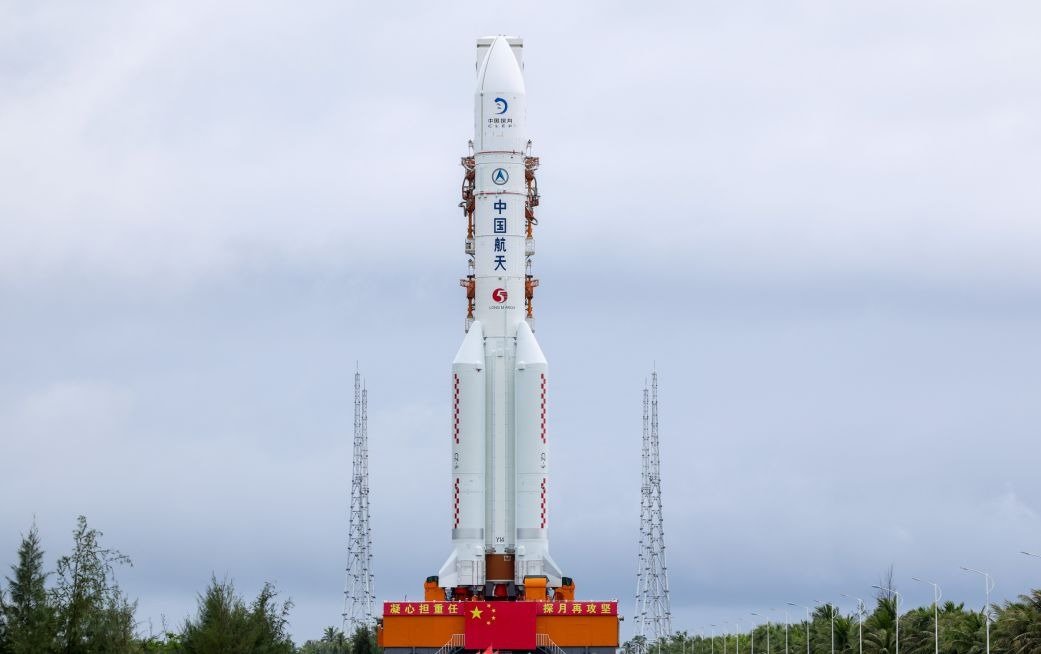
The highly anticipated launch of China’s Chang’e-7 mission, a robotic endeavor designed to explore the lunar south pole for water ice, has been officially postponed. The China Manned Space Engineering Office stated that the mission “cannot take place during the planned window this year.” While the spacecraft was originally scheduled for liftoff as early as Sunday evening or Monday morning Beijing time, officials have not provided a new timeline for the attempt.
State media outlets indicated that the decision followed an assessment based on the “principle of prudence, reliability and absolute mission success,” noting briefly that the “lunar probe does not meet launch conditions.” This mission is considered a significant milestone, as no previous lunar project has directly analyzed water on the moon’s surface.
The lunar south pole has become a focal point of intense international competition, with both the United States and China vying to establish a presence there. The region is believed to hold vast quantities of frozen water within its shadowed craters, a resource that could be converted into breathable air, drinking water, or rocket fuel, making it essential for future deep-space exploration and potential lunar bases.
While the US has utilized remote sensors on orbiting satellites to estimate the extent of water ice, it has yet to successfully drill for the resource. A 2025 attempt by the Texas-based firm Intuitive Machines to deploy a water-hunting drill failed when the lander tipped over on the rugged terrain of the south pole.
The delay of Chang’e-7 may temporarily alter the competitive landscape of the ongoing space race. The US has several missions targeting the same lunar region over the next year. Astrobotic Technologies, based in Pittsburgh, is preparing to launch its Griffin lander as early as late 2026. Additionally, Blue Origin plans to send two robotic landers to the moon next year, one of which may carry NASA’s VIPER rover, a specialized prospecting robot designed to locate lunar resources.
Yuqi Qian, a lunar geologist at the University of Hong Kong, noted that the Chang’e-7 mission represents a strategic shift in China’s lunar program from basic exploration to active resource utilization. He added that the mission could provide critical data to help determine if water ice exists in sufficient quantities for practical use, effectively sharpening the focus for future exploration efforts. The report also notes that but Chang’e-7’s launch delay could put this chapter of the space race — as US officials have referred to the standoff with China — back on competitive footing. The report also notes that and Chang’e-7 could help make “important progress on this question, sharpening and focusing experiments for furth, whether water ice is present in sufficient amounts to be useful for these purposes is not currently known. The report also notes that it’s not clear how soon China may be able to attempt to get the mission off the ground.