

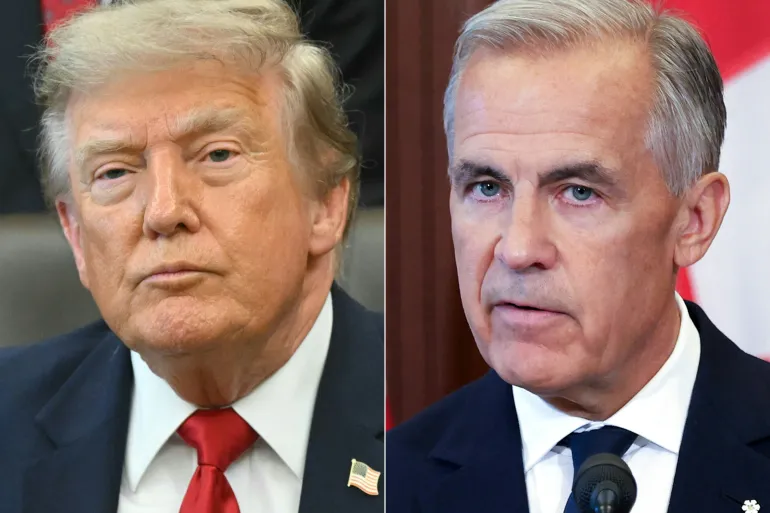
Canadian Prime Minister Mark Carney has pledged to match Washington’s new tariffs “dollar for dollar” following the breakdown of intense trade negotiations between the two North American neighbors. This retaliatory move comes in response to US President Donald Trump’s decision to impose a 50 percent levy on $20 billion worth of Canadian goods, which accounts for approximately 5.5 percent of Canada’s total exports. The escalation marks a significant departure from the historically stable trade relationship between the two nations.
The diplomatic rift deepened on Saturday in Ottawa, where Carney stated that talks with the US collapsed late Friday after the Trump administration presented conditions he deemed unacceptable. Carney criticized the American proposal as “uneconomic” and “unfair,” arguing that it undermined Canada’s economic benefits and questioned the reliability of any potential agreement. Among the contentious demands were restrictions on Canada’s ability to pursue independent trade deals, which Ottawa views as a violation of its national sovereignty.
Furthermore, Carney reported that US negotiators issued threats concerning the French language and “Quebec culture,” a move that proved particularly inflammatory. Summarizing the failed discussions, the Prime Minister remarked, “In short, they asked too much, and they offered too little.” In response, President Trump took to his platform, Truth Social, to claim that Canada seeks the benefits of being a US state without the associated status, reiterating previous rhetoric regarding the potential annexation of its northern neighbor. Trump also accused Canada of long-standing discriminatory tariff practices against American farmers.
The US tariffs, which are being applied alongside existing duties on steel, lumber, and automobiles, target more than 500 product categories. Affected goods range from alcohol—including popular brands of whisky and beer—to dairy products, electronics such as smartphones and cameras, and various wood products like furniture and plywood. Additionally, the levies impact athletic equipment, including hockey gear, and a wide array of seasonal consumer goods, potentially complicating the future of the US-Mexico-Canada Agreement.
In retaliation, Ottawa has announced that its own countermeasures, set to take effect on September 8, will focus on US steel, dairy, appliances, farm equipment, pulp, paper, and electronics. While the Canadian government has promised to release a specific list of targeted items shortly, the broader economic impact remains a primary concern for analysts.
Economic experts warn that the trade war will likely lead to increased costs for businesses and higher prices for consumers on both sides of the border. David Mercer, reporting from Calgary, noted that the resulting economic pressure could force some small and medium-sized enterprises into bankruptcy. Julian Karaguesian, a trade expert at McGill University, suggested that the tariffs would effectively price hundreds of Canadian products out of the US market. While some industries, such as alcohol and furniture, face significant disruption, others argue the overall impact on the $382 billion Canadian export market may be limited.
To mitigate the fallout, Carney is actively pursuing trade diversification, seeking to strengthen relationships with partners in Asia and Europe to reduce Canada’s heavy reliance on the US market. Currently, approximately 73 percent of Canadian exports, totaling $409 billion last year, are destined for the United States. Diversification remains a substantial challenge given this deep economic integration.
On the American side, the Business Roundtable—representing 200 major US corporate CEOs—has warned that these tariffs risk inflating costs for families and businesses alike. Trade specialist Steven Okun emphasized that the measures are “politically painful” for both nations. He noted that previous blanket tariff policies have failed to boost US trade or investment, instead contributing to domestic inflation. Okun suggested that while targeted tariffs can sometimes be effective, the current broad-based approach is likely to cause widespread economic friction. The report also notes that trump first imposed tariffs on key imports from Canada early in his second term last year. The report also notes that and how will it impact the two Western economies, so what prompted this latest escalation. The report also notes that “We’re the partner of choice in many respects for countries around the world, and the Americans wanted to restrict that. The report also notes that in a speech later in the day, Carney suggested that last-minute changes at the bargaining table had prompted him to recall his negotiators from Washington, DC, to Ottawa. The report also notes that dairy products from milk and cream to lactose syrup. The report also notes that cheese, however, is not on the list even though Trump said a reason for the tariffs is Canada’s “discrimination” against US cheeses, The Washington Post reported. The report also notes that at gyms and in swimming pools, other sports supplies targeted include those used in golf. The report also notes that including toys, clothing, Christmas decorations, jewellery, makeup and perfumes, seasonal holiday products and gifts.