

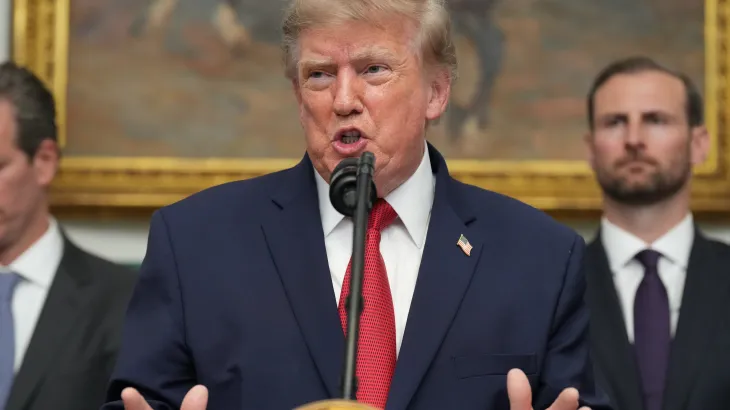
US President Donald Trump has issued a stark warning to international partners, threatening what he described as the “most crushing economic operation ever taken against any country” if they continue to facilitate trade with Iran. The announcement, delivered via a Truth Social post on Wednesday, comes as diplomatic efforts to resolve the five-month conflict between Washington and Tehran remain at a standstill.
Trump accused the Iranian leadership of failing to capitalize on opportunities for a negotiated deal. Consequently, he vowed to subject the nation to “economic warfare and isolation on an unprecedented scale.” His directive explicitly targeted any foreign financial institutions, businesses, government entities, or infrastructure—including airports—that provide a “lifeline” to Tehran. He characterized the impending measures as an “ECONOMIC D-DAY,” demanding that allies assist in isolating the Iranian state.
The administration’s latest rhetoric builds upon the existing “Operation Economic Fury,” a pressure campaign initiated in April. The US has already implemented extensive sanctions targeting Iran’s energy exports, shipping lanes, and financial sectors. These measures include a naval blockade of Iranian ports and active efforts to penalize brokers, tankers, and companies suspected of assisting in the sale of Iranian oil abroad.
Washington-based analysts suggest that the vague nature of the threat reflects a degree of frustration within the administration. Observers noted that the President provided no specific details regarding new mechanisms, raising questions about what additional pressures can be applied beyond the current sanctions regime. Some experts suggest the messaging may be aimed at a domestic audience skeptical of the ongoing conflict, rather than representing a concrete shift in policy.
Potential secondary sanctions could target nations such as Iraq, Türkiye, and China. Nader Habibi, a professor of Middle East economics at Brandeis University, highlighted that China remains a critical focus, specifically regarding financial institutions that support independent “teapot” refineries—the final group still purchasing Iranian oil. However, Habibi noted that Beijing has previously warned its entities against complying with US sanctions, and current trade negotiations between Washington and Beijing complicate the enforcement landscape.
Enforcing restrictions along Iran’s overland borders with Türkiye, Iraq, and Central Asian nations presents further logistical hurdles. According to Habibi, achieving total compliance would require the active cooperation of those respective governments, which remains uncertain.
Industry experts, including Brett Erickson of Obsidian Risk Advisor, pointed out that the very fact these measures were not implemented earlier suggests they carry significant risks and potential international fallout. Erickson emphasized that targeting Chinese banks would be the most consequential lever available to the administration, though he cautioned that such a move would be a drastic escalation—effectively “crossing the Rubicon”—and might still fail to alter the trajectory of the war.
Ultimately, the effectiveness of these threats depends on whether the administration can produce rapid results. As the situation develops, the global market remains on watch to see if the United States will identify specific institutions or countries as targets for these promised economic consequences. The report also notes that swap lines, cash transfers, exchange houses, ship registries, front companies — it all needs to stop NOW, oil smuggling. The report also notes that “I think the first question is: What economic pressures can he exert on Iran that are not already being exerted?” he said, adding that there was no clear answer because Trump had given no indication of what measures he planned to take. The report also notes that “Is this, to the Iranians, another shouting threat. The report also notes that but perhaps his target audience is an American public that continues to oppose this ongoing conflict.