

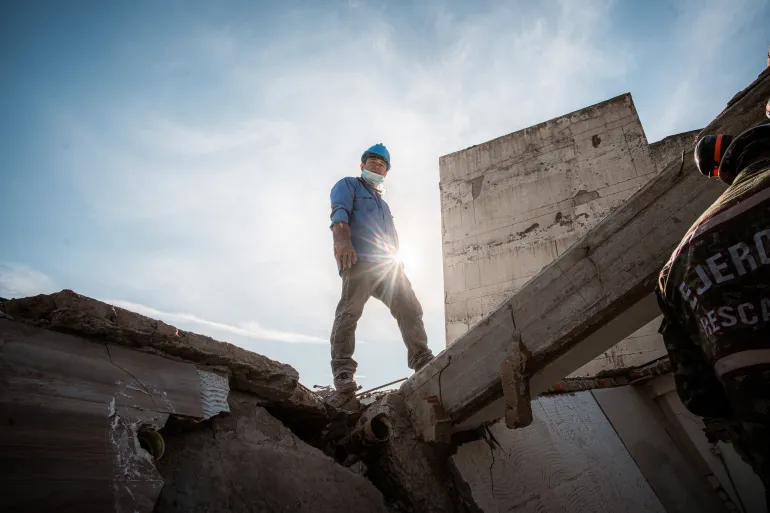
One week after a powerful magnitude 7.4 earthquake struck western Colombia, the nation is shifting its focus from frantic rescue efforts to the daunting task of recovery. While search teams continue to work in some areas, the window for finding survivors has narrowed significantly, prompting a transition toward providing shelter, essential aid, and planning for long-term reconstruction.
The disaster has left a trail of destruction across 15 of Colombia’s 32 provinces. Official reports confirm at least 289 deaths and 4,187 injuries. The physical toll on infrastructure is immense: 127,557 homes have been damaged, with 26,945 completely destroyed. Furthermore, the quake impacted 285 health centers, 2,838 schools, 407 roads, 92 water systems, 44 bridges, and five airports.
The earthquake originated in San Jose del Palmar, a rural town in the Pacific region, before devastating major urban centers including Pereira, Quibdo, and Cali. Emergency responders have successfully saved 354 lives during the past week of intense operations. However, the number of missing persons remains a point of contention; while government figures report 143 people unaccounted for, an unofficial database, Colombia Te Busca, suggests the number could exceed 3,000.
Sergeant Joel Bustamente of the Bogota Fire Department, who has been leading operations in Cali, described the past week as grueling. He noted that the priority has shifted from rescue to recovery, demolition, and reconstruction. In specific locations, such as the seven-storey Vanessa Building in Cali, search efforts have been suspended entirely in favor of body recovery, according to Enrique Zapata of the health NGO SARES.
Despite the grim outlook, some volunteers like Maximiliano Herrera maintain hope, noting that survival windows can occasionally extend up to 15 days. International aid has bolstered local efforts, with teams arriving from the United States, Israel, and Mexico. Financial support has also begun to arrive, including a 2 million euro ($2.3m) pledge from the European Union and $15.5m from the United States.
For the more than 120,000 displaced families, the immediate priority is housing. Egido Sanz, country director for ActionAid, emphasized that shelter and refuge are the most urgent medium-term needs. In cities like Cali, authorities have repurposed stadiums and community centers to serve as temporary shelters and aid distribution hubs. Veronica Echeverry, a shelter manager in Cali, noted that while these facilities are vital, many displaced residents from wealthier neighborhoods have opted to stay with family and friends.
The situation is significantly more dire in Choco, the country’s poorest department and the epicenter of the quake. Already plagued by armed conflict, drug trafficking, and illegal mining, the region is struggling to cope with the added devastation. In the provincial capital of Quibdo, residents report a lack of national institutional support for temporary housing. Yilson Marmolejo, a local resident, expressed frustration over the slow government response, while many remote areas remain difficult to access by anything other than river.
The economic impact is equally severe for individual business owners. Nestor Martinez, a 65-year-old shop owner in Buenaventura, estimated his losses at 350 million pesos ($111,000) after his store was ravaged by the tremors. Without business insurance, many like Martinez face the difficult challenge of rebuilding their livelihoods from scratch.
President Abelardo de la Espriella has pledged a reconstruction fund to address the damage, which the finance minister estimates will cost at least $6.4 billion. While the president declared an economic emergency to facilitate funding, he has opted to secure a $450 million credit line from the World Bank rather than implement new taxes. His administration has faced criticism for its handling of the disaster, including the decision to limit international aid to specific ideologically aligned nations and a perceived lack of coordination with the outgoing government. The report also notes that however, is entering a new phase as rescue teams wind down operations and aid organisations begin focusing on housing those made homeless by the earthquake and providing basic necessities, the disaster response. The report also notes that schools, hospitals, and businesses, the full scale of the devastation continues to be assessed, while official data reveals vast destruction of homes. The report also notes that “It has been a gruelling week, with little time to rest, as we’ve been focused on searching for, locating, and rescuing potential victims,” said Sergeant Joel Bustamente, who is leading the Bogota Fire Department’s deployment in Cali. The report also notes that others still hope, while the chances of finding life under the rubble drop sharply after the first 72 hours following an earthquake. The report also notes that receiving and distributing donations of food, water, hygiene supplies and clothes, the refuge doubles as an aid collection point. The report also notes that today, only two people are staying at the shelter, which has 11 beds. The report also notes that in places like Choco – Colombia’s poorest department – the earthquake has hit especially hard due to existing challenges. The report also notes that “It is a crisis that comes on top of another major crisis that already existed,” said ActionAid’s Sanz.