

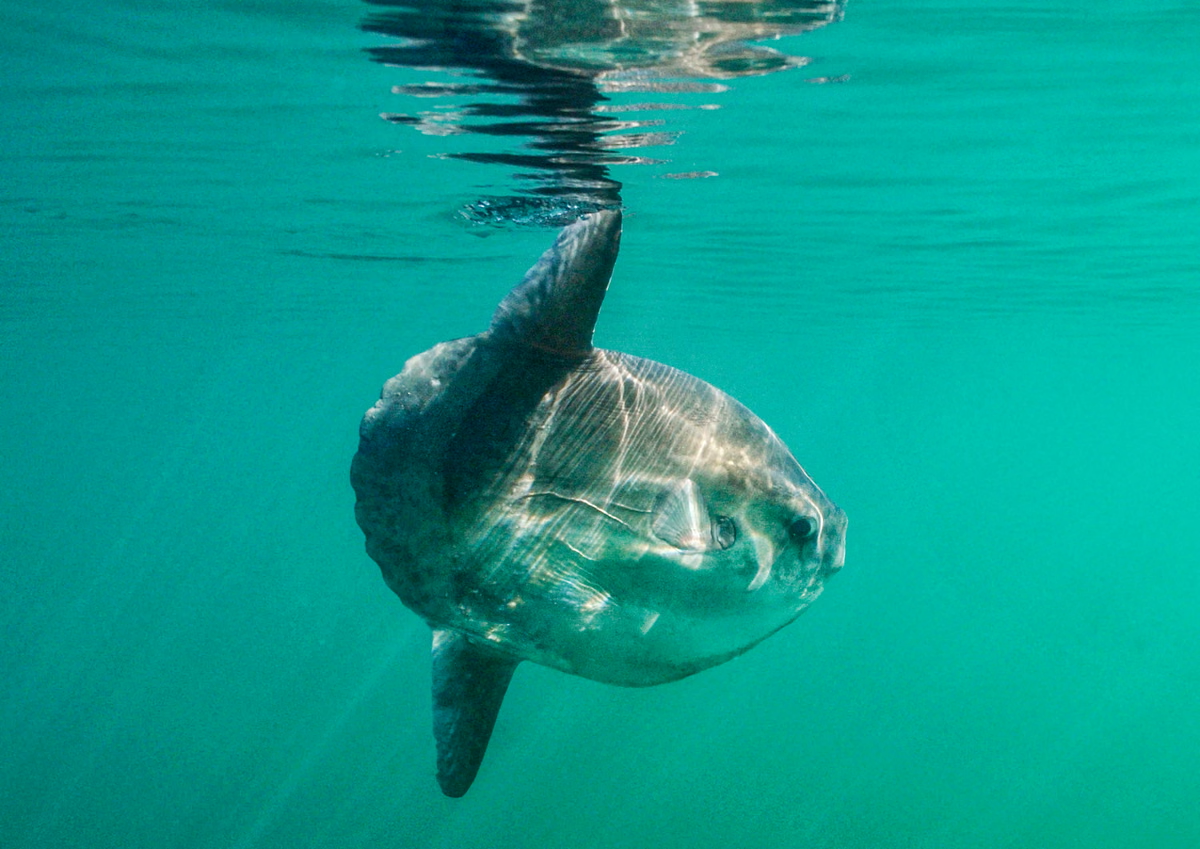
Brighton-based charter boat skipper Kurt Lander recently spotted a pair of sunfish in the middle of the Channel shipping lane. Initially mistaking the movement for a person waving, he observed the large fish flapping their fins while lying on their sides. According to Lander, this behavior is a visual attraction intended to encourage birds to remove parasites from their bodies. While he has encountered the species before, their increased presence off British shores this summer is likely linked to a persistent marine heatwave.
The Met Office classified last year as an exceptional period for sea temperatures, with certain British waters experiencing heatwave conditions for approximately 75% of the year. Data from 2026 indicates that this trend is continuing. These elevated temperatures are triggering significant shifts in marine biodiversity, forcing some species to migrate toward cooler northern waters while others, including new invasive arrivals, appear along the coastline. Tragically, some marine life is also succumbing to the intense solar exposure.
Lander reports a stark decline in his traditional catches, noting that he used to land hundreds of cod annually, whereas now he might catch only one or two during the summer months. Dr. Zoe Jacobs, a senior researcher at the National Oceanography Centre in Southampton, confirms that cold-water species are increasingly absent from southern coastlines, having shifted their ranges toward Scotland. It remains unclear whether these changes are temporary or permanent.
Conversely, warmer-water species such as bass, comber, and triggerfish are becoming more common. The State of the South-West Seas report from last year also highlighted the success of sardines and anchovies in these rising temperatures. In Falmouth, diver Gio Reale has observed the impact of these shifts firsthand, noting that his preferred small spotted catshark has been absent for weeks. These sharks typically favor temperatures between 16C and 17C, but the water has consistently reached 20C this summer, likely driving them into deeper, cooler zones.
While some species vanish, others thrive; common octopuses have appeared in significant numbers in Devon and Cornwall since early 2025. This influx has created challenges for local crab and lobster fishers, as the octopuses easily access traps to prey on the trapped crustaceans. Some vessels have adapted by targeting the abundant octopus, which in turn serves as a food source for predators like Risso’s dolphins, leading to more frequent sightings.
Warmer seas also influence jellyfish populations, though experts like Jacobs caution that interpreting these trends is complex, as increased beach attendance can lead to higher reporting rates. While native moon, compass, and barrel jellyfish are seasonal staples, the arrival of Mediterranean mauve stingers would signal a more concerning shift driven by warming. Other exotic arrivals include the smalltooth sand tiger shark and the hair curler sea slug, the latter of which was first documented in 2025.
Ecologists are also monitoring the potential threat posed by the sea squirt Didemnum pseudovexillum, which closely resembles the invasive carpet sea squirt known for smothering seabeds. The broader environmental impact is significant, as marine heatwaves have historically caused extensive loss of kelp and seagrass in regions like Australia and the US. In the UK, approximately 92% of seagrass meadows have been lost since the 1930s, with Sussex potentially losing over 96% of its kelp forests.
Chris Williams, founder of the Hastings Kelp Project, emphasizes that this degradation is often hidden from view. His own research is hampered by the heat; his laboratory chillers have struggled to maintain tank temperatures below 12C, the threshold preferred by kelp. Despite these challenges, restoration efforts continue, including the Seagrass Ocean Rescue project, which aims to restore 15% of UK seagrass meadows by 2030.
The warming trend also risks triggering harmful algal blooms that can carry pathogens dangerous to both wildlife and humans. Jacobs warns that the UK is currently unprepared for the potential beach closures that might be required to manage such risks. Furthermore, the long-term impact on fisheries remains uncertain, as repeated heatwaves may have decimated eggs and juveniles even if adult fish survived.
Jacobs suggests that the future of cod and mackerel fisheries in the region may be in jeopardy, describing the current situation as a new normal driven by successive years of extreme heat. As fossil fuel emissions continue to raise baseline temperatures, she warns that these extremes will only become more severe, forcing the industry to potentially pivot toward warmer-water species. The report also notes that with some parts of British waters seeing heatwave conditions for three-quarters of the year, and 2026 is already showing more of the same, last year was labelled “exceptional” by the Met Office. The report also notes that “Temporarily or permanently, we don’t know,” she says. The report also notes that these small sharks – which grow no bigger than a metre and are spattered with delicate freckles – prefer water temperatures of about 16-17C (61-63F). The report also notes that they are now thriving in Scotland, shifting their range to cooler seas farther north. The report also notes that “Everyone’s complaining, ‘oh, they’re taking all our crabs’,” says Reale. The report also notes that “But obviously, for the octopus, that’s just a really easy meal. The report also notes that you can just get into a trap where the crabs can’t go anywhere and eat them.”. The report also notes that and hair curler sea slugs, usually found in the Caribbean and Mediterranean, were first recorded in 2025, a few smalltooth sand tiger sharks – an “exceptionally rare visitor” in local waters – have washed up on UK beaches in recent years.