

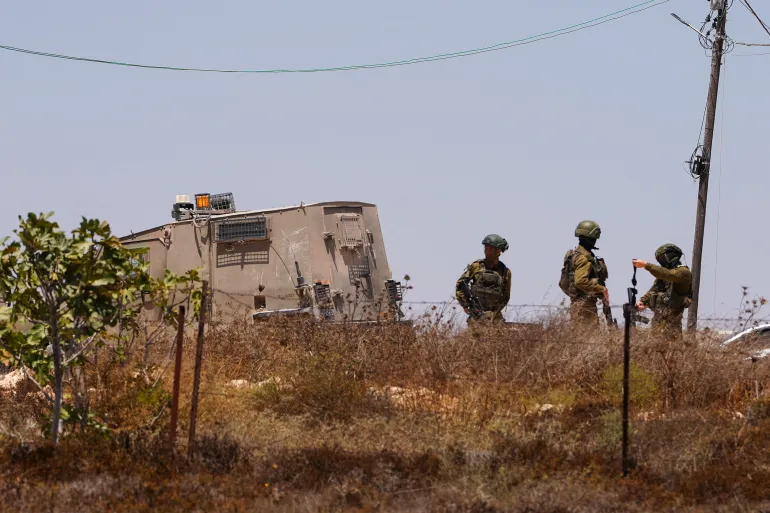
As the blockade enters its second week, 15 Palestinians, including two children, remain confined within three residences in the Ras al-Ain district of Qusra, located south of Nablus. These families are effectively cut off from basic necessities, including food, water, and electricity, while surrounded by armed Israeli settlers and military units. The United Nations has reported that the residents are currently “trapped inside their homes in a state of terror, unable to attend to their basic needs and without access to water or electricity.”
The humanitarian situation worsened on Sunday when Israeli forces intercepted a UNICEF aid convoy attempting to reach the area. Although two vehicles were permitted to deliver food, military personnel blocked and turned away a water tanker, further exacerbating the resource crisis. This followed an incident the previous day where settlers assaulted municipal workers and a bulldozer operator who were attempting to repair damaged utility lines. Qusra Mayor Abdel Azim Wadi confirmed the ongoing struggle, stating, “We were unable to restore electricity and water to the three besieged homes in the town.” Wadi further remarked that the treatment of these families has been stripped of basic human rights, describing the conditions as inhumane.
Reporting from the scene, Al Jazeera’s Laith Jaar observed that the Israeli military is actively facilitating the settler presence, moving through the area to assist in the displacement of Palestinians. According to Jaar, the coordination between the military and settlers is creating a continuous siege that tightens the stranglehold on the local population. The Israeli army has reportedly converted a nearby home into a military barracks and declared the vicinity a closed military zone, effectively barring international activists and members of the Israeli group Peace Now from entering. Paradoxically, the military has declined to enforce nine eviction orders against the illegal outpost established by the Hilltop Youth militia in Area B, which serves as the base for the settlers conducting the siege.
Despite the intense pressure, the trapped residents remain defiant. Qusai Abu Reida, one of the besieged individuals, expressed a firm commitment to staying in his home. “We will remain steadfast and we will remain patient, meaning even if they cut off our food, nourishment, and medicine, and meaning even if we drink water and salt, we made a pact with ourselves and our neighbors Youssef and Rizq that we will not leave here except as martyrs,” he stated. He emphasized that the home represents the legacy of his ancestors and that he refuses to surrender it.
Political analysts, including Mustafa Barghouti, Secretary-General of the Palestinian National Initiative, argue that the siege of Qusra is a calculated strategy rather than an isolated event. Barghouti explained that the tactical objective is to seize thousands of dunams of land and forcibly displace the residents through terror, while the strategic goal serves as a warning to other West Bank villages that similar actions could be replicated elsewhere. This assessment is supported by Amnesty International’s Erika Guevara Rosas, who described the events as a “relentless escalation” of a well-documented pattern of settler violence backed by the State of Israel. The Wall and Settlement Resistance Commission reports that this systemic violence coincides with a rapid expansion campaign, noting that settlers have established over 300 outposts since October 2023, while the Israeli government has advanced plans for 104 new settlements. The report also notes that stating, “But the strategic goal is a message to all the villages of the West Bank that this that is happening in Qus, he warned that the true danger lies in the precedent being set for the rest of the occupied territory. The report also notes that he affirmed, “It is impossible for us to leave this house, as this is our effort and the effort of the land of our ancestors, meaning we will not take it lightly and give it to them.”. The report also notes that stating, “But the strategic goal is a message to all the villages of the West Bank that this that is happening in Qusra will happen in other places.”, he warned that the true danger lies in the precedent being set for the rest of the occupied territory. The report also notes that erika Guevara Rosas, Amnesty International’s Senior Director for Research, Advocacy, Policy and Campaigns, echoed this assessment.