

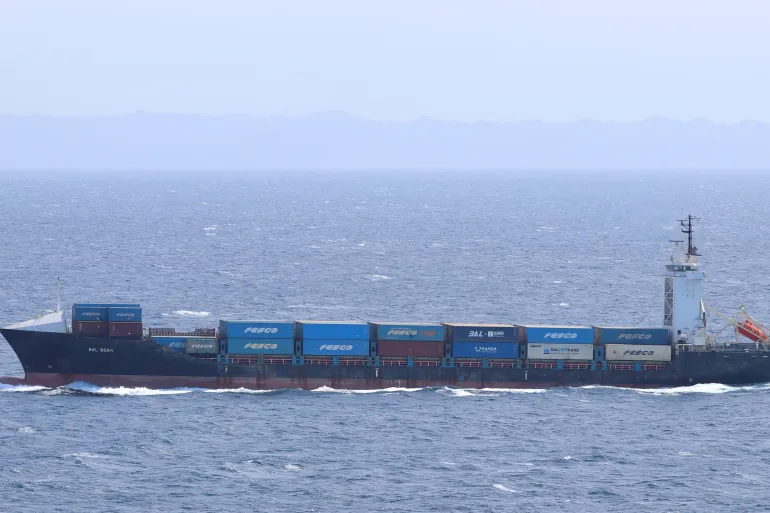
The United States military confirmed on Tuesday that it engaged a cargo vessel in the Gulf of Oman, accusing the ship of attempting to breach the ongoing blockade of Iranian ports. According to US Central Command (CENTCOM), a Navy helicopter launched two Hellfire missiles at the Panama-flagged vessel, identified as the Vela Nova, after the crew reportedly disregarded multiple warnings from American forces.
The strike specifically targeted the ship’s engine room, successfully disabling its steering gear. CENTCOM did not disclose whether any crew members sustained injuries during the operation. This incident is part of a broader enforcement effort; the military reported that since the blockade began, US forces have disabled 55 commercial vessels, incapacitated three ships deemed non-compliant, and boarded two others.
The attack occurs during a period of relative stability in the US-Israeli conflict with Iran, following a 13-day escalation in July that saw a ceasefire agreement—part of a June memorandum of understanding—effectively collapse. The US has since re-established its naval blockade, while Iran has reasserted control over the Strait of Hormuz, a critical maritime corridor that previously handled 20 percent of global fossil fuel trade.
Diplomatic progress remains stagnant. On Monday, President Donald Trump escalated tensions by demanding reparations from Iran for 50 years of alleged damages. Tehran has countered by insisting that any comprehensive deal must include a $300 billion reconstruction fund, a provision that was initially outlined in the June agreement.
Amid the stalemate, Iran is pursuing independent talks with Oman to establish alternative shipping routes through the Strait of Hormuz. Mohsen Rezaei, secretary of Iran’s Supreme National Security Council, told the Tasnim news agency that the strait will remain closed until the United States alters its behavior and meets Iranian conditions. He clarified that these negotiations with Oman are distinct from the status of the strait.
The regional situation remains volatile due to ongoing attacks by Yemen-based Houthi forces targeting vessels in the Bab al-Mandeb Strait. In a push for broader mediation, Pakistan’s Interior Minister Mohsin Naqvi traveled to Tehran on Tuesday to hold discussions with Iranian officials regarding the ongoing war.
Efforts to return to an agreement have so far yielded little progress, with Trump on Monday appearing to up the ante as he called for reparations from Iran for “50 years” of damage.
Iran, for its part, has largely focused its diplomatic efforts on direct talks with Oman to determine new shipping lines in the Strait of Hormuz, an arterial waterway through which 20 percent of the world’s maritime foss
blockade against Iran by sailing toward an Iranian port”.
Both of those conditions had been lifted as part of the June MoU, which was meant to launch renewed negotiations on a more lasting peace, as well as the future of crippling sanctions on Iran and its nuclear programme.