

Donald Trump’s Board of Peace, established in January to oversee the reconstruction of Gaza, has issued its first construction contract within the devastated territory. The project involves the creation of a rudimentary 150-person military outpost designed to house Moroccan troops, according to a source familiar with the matter.
The contract has been awarded to Arkel International, a Louisiana-based firm with a history of working alongside the US government in regions such as Iraq. While the contract has not yet been finalized, it marks the first tangible step in the Board of Peace’s operational phase.
The Board of Peace is chaired by President Trump and includes leadership from his son-in-law, Jared Kushner, and associate Steve Witkoff. In an official email, a spokesperson stated that the board and the National Committee for the Administration of Gaza—a group of Palestinian technocrats—are in the final stages of preparing several contract awards, though none have been finalized.
The official clarified that one prospective contract concerns facilities to support the international stabilization force (ISF), which is intended to assist in implementing security and governance arrangements. They added, “This contract will be one of many that are essential for the future of Gaza.”
The planned base is compact, measuring 100 metres by 120 metres, and is intended to accommodate a contingent of Moroccan troops rotating from a base in Israel. The site is located within the 60% of Gaza’s territory currently under direct Israeli military control, positioned approximately one mile from the Israeli border with a designated “quick extraction route” in the event of an attack.
Earlier planning documents reviewed by indicate that this 150-person outpost represents the first phase of a larger project to establish a 5,000-person military base for the ISF. Initial specifications for the first phase include tents, cots, chemical toilets, and handwashing stations, described as the minimum requirements for habitability.
The deployment of Moroccan troops remains subject to the finalization of the ISF’s legal framework, and the timeline for their arrival is currently unclear. This development follows Trump’s February 2025 announcement that the US would “take over” and “own” Gaza, a claim that exceeded the actual scope of the agreement that established the Board of Peace.
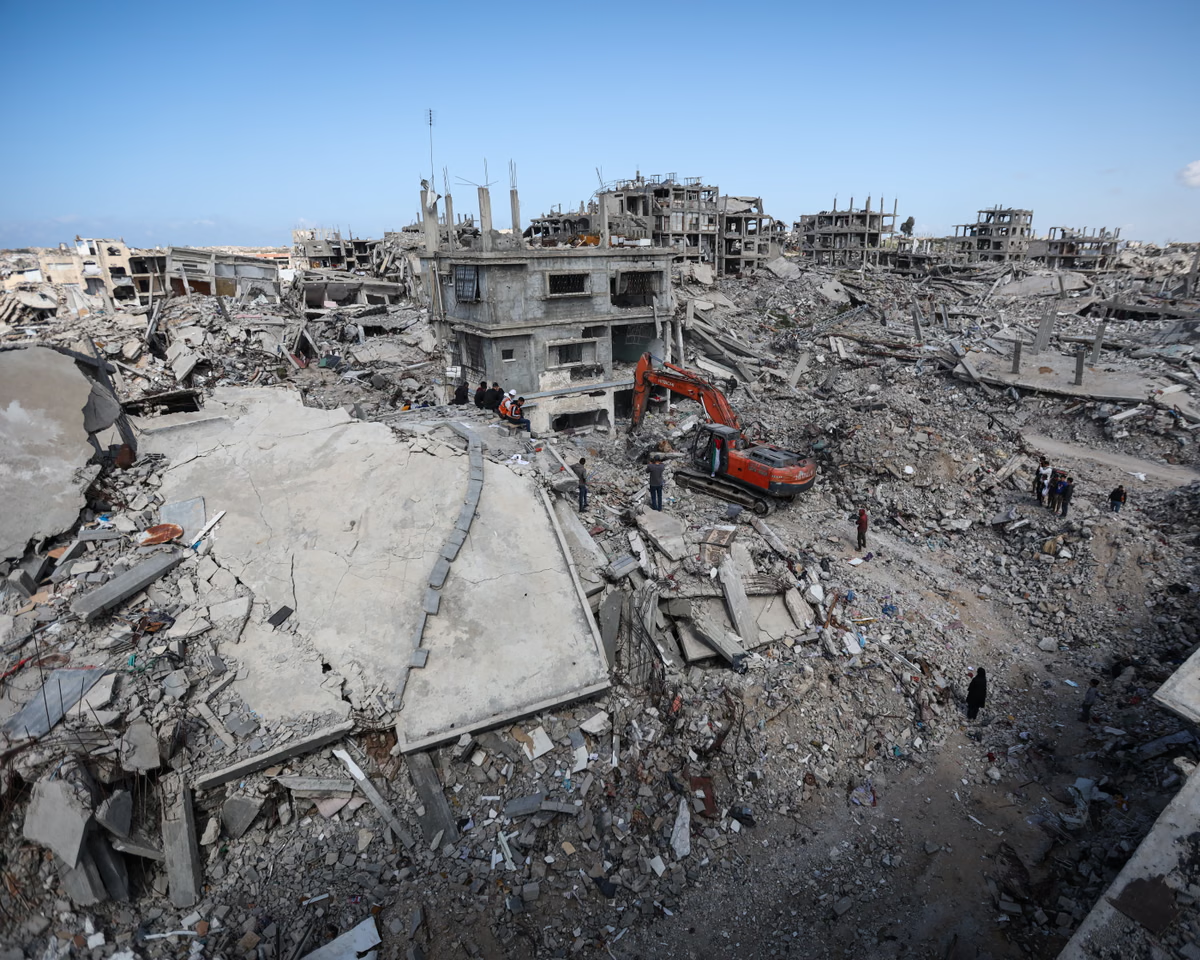
During the board’s inaugural meeting in January, Kushner presented a “master plan” for “New Gaza,” featuring an expansive waterfront city with mixed-use towers, which he described as a potential destination for industry and hope. However, the reality on the ground remains stark, with at least 80% of Gaza’s buildings damaged or destroyed. Ten months after the ceasefire, the majority of the territory’s 2 million residents continue to live in makeshift, unsanitary camps.
The project arrives amid ongoing regional tensions. Trump recently claimed that Hamas had agreed to disarm, a statement met with skepticism and followed by increased Israeli airstrikes in the region. Furthermore, the board’s original, ambitious reconstruction blueprint has reportedly been scaled back to a smaller pilot project in the southern portion of the strip. The report also notes that it would lie in the 60% of Gaza’s territory that the Israeli army directly controls. The report also notes that and there have been varying reports on which country would provide these troops, the UN resolution authorising the Board of Peace had approved establishing an “international stabilisation force” for Gaza. The report also notes that this base would have included “vehicle fighting positions” and a perimeter berm – or raised defensive bank – and would have rudimentary facilities suitable for short-term deployments.