

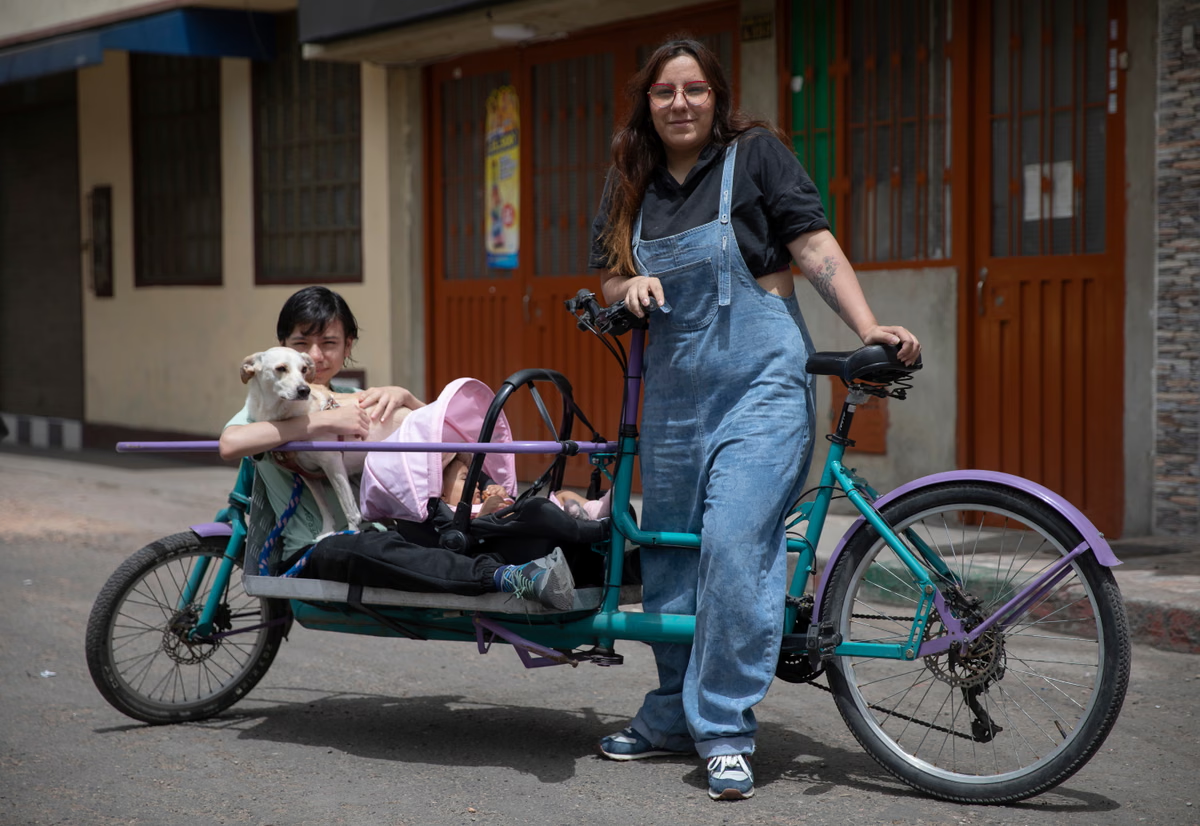
Eliana González navigates the streets of Bogotá using a specially adapted cargo bike, a vehicle that allows her to transport her two children and pet safely while managing daily errands like school runs and grocery shopping. For González, this mode of transport is both a practical solution and a personal commitment to environmental stewardship, as she notes, “For me, my cargo bike is a way to carry my children safely and comfortably without polluting the environment.”
Bogotá is widely recognized as a leader in urban cycling, with its 10 million residents generating nearly 900,000 bicycle trips daily—the highest volume in Latin America. Despite this success, city officials have identified a significant gender gap. According to the city’s 2023 mobility survey, women accounted for only 28% of these daily trips. To address this, the local government has set a target to reach gender parity in cycling by 2039. Claudia Díaz, the city’s secretary of mobility, emphasized the ambition of this initiative, stating, “Our goal is to move from a [nearly] 30–70 split to 50–50 parity.”
Closing this gap is viewed as a critical strategy for the city’s environmental goals. Transportation remains the primary source of greenhouse gas emissions in Bogotá, and officials believe that increasing female participation in cycling is essential to achieving carbon neutrality by 2050. “The challenge we face is how to increase the number of cycling trips,” Díaz explained. “The more we increase the number of cycling trips, the more environmental benefits we see for our city.”
Experts argue that gender equality in transit is vital for the success of sustainable infrastructure. Dana Yanocha, a senior manager at the Institute for Transportation and Development Policy, noted that the full benefits of sustainable systems—including cleaner air and reduced congestion—cannot be realized if only half the population utilizes them. She added that increasing women’s participation remains a global challenge, particularly in the global south, where women often represent less than 10% of daily cyclists in many cities.
In 2021, Bogotá introduced a landmark cycling policy that specifically integrated a gender perspective. Research conducted by the C40 Cities Finance Facility revealed that approximately 60% of women in the city avoid cycling due to fears of theft or assault, while 40% cite concerns regarding traffic safety. Additionally, nearly one-third of surveyed women reported that they never learned how to ride a bicycle.
To combat these barriers, the city has expanded its protected bike lane network to 425 miles (683.9km), the largest in Latin America. Efforts to improve the cycling environment include repairing damaged lanes, enhancing street lighting, and increasing police presence along high-traffic corridors. “By improving infrastructure, we can help women feel that riding a bike is a viable option for them,” Díaz said.
Education is also a central pillar of the city’s strategy. Sergio Prieto, who oversees the Bogotá Bike School, reports that the program trains roughly 40,000 residents annually, with women making up about 80% of participants. Prieto noted that many older women attend the school because they were historically discouraged from cycling. “Many older women come here because they were never allowed to ride a bicycle as girls,” he said. “They were told bikes were for men, that women shouldn’t be riding them. Here, those barriers and stereotypes are left behind.”
Community-led initiatives are also driving change. In 2018, González founded Mamacitas en Bici to support mothers who cycle. Her work highlights that women’s travel in Bogotá is frequently tied to caregiving responsibilities. Despite facing social stigma and criticism for cycling with her children, González has built a community that helps mothers customize bikes for safety and organizes group rides.
Reflecting on her mission, González emphasized the importance of creating secure spaces for women to navigate the city. She views cycling as a tool for both personal independence and collective environmental action. “We still have so many green spaces in our city, and I want to do my part to help protect them,” she said. “If I get around by bicycle, I’m contributing to that environmental effort.” The report also notes that the Colombian city of 10 million people records nearly 900,000 bicycle trips each day – more than any other city in Latin America, widely regarded as a global cycling success story. The report also notes that city officials are working towards another milestone: achieving gender parity in cycling by 2039. The report also notes that in 2021, Bogotá adopted a new cycling public policy, the first of its kind in Colombia, that incorporated a gender perspective.