

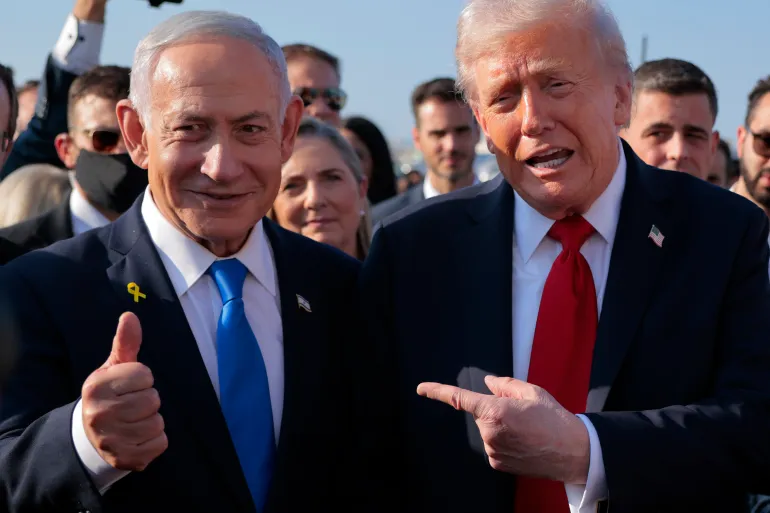
Israeli Prime Minister Benjamin Netanyahu has formally rejected United States President Donald Trump’s 15-point plan for Gaza, declaring that Israeli forces will not withdraw until Hamas is “genuinely disarmed.” During a recent cabinet meeting, Netanyahu emphasized that the militant group must surrender all of its weapons before any troop pull-back can be considered, dismissing specific elements of the proposal as unacceptable to his government.
“Israel rejects the 15-point document,” he stated, stressing that the military will continue to thwart threats against its forces and citizens. The Israeli leader, who is expected to face a tough national election in October this year with successive surveys showing he is on course to lose, maintained that Hamas must give up all of its weaponry to ensure security. “They have ideas; some of them are acceptable to us, and some are not, and we know how to stand our ground on these matters,” he added.
On July 30, the US-led Board of Peace proposed this 15-point roadmap for Gaza, detailing a phased, conditional framework for disarmament and reconstruction in the war-torn coastal enclave. The plan mandates that Hamas disarm in exchange for a full Israeli military withdrawal and the transition of governance to an independent Palestinian National Committee. United Nations Security Council (UNSC) Resolution 2803 designates the Board of Peace, created by Trump in October with him serving as its lifetime chair, as the body responsible for overseeing the implementation of this peace plan.
Trump had previously suggested that the agreement would be implemented in stages, with Israeli forces withdrawing as the disarmament process advanced. However, the Board of Peace clarified earlier this week that a full Israeli withdrawal from Gaza will only take place after the total disarmament of Hamas is complete. Now, the full rejection here puts the sequencing and the steps to complete that into serious question.
A member of Hamas’s negotiating delegation last month told Al Jazeera that the group’s implementation of the agreement will be dependent on Israel fulfilling its commitments. Despite the framework, significant challenges remain, as Hamas hinges its compliance on an end to Israel’s military actions. Israel has killed more than 73,300 Palestinians in Gaza since its war began in October 2023. Furthermore, since agreeing to a US-mediated “ceasefire” with Hamas in October 2025, Israel has continued to carry out strikes on Gaza, killing more than 1,200 additional Palestinians, according to the Gaza Health Ministry.
The Israeli army “will not carry out any withdrawal until Hamas is genuinely disarmed and will continue to thwart threats against our forces and our citizens,” the prime minister reiterated. Netanyahu added that Israel is currently engaging with Washington to address its specific concerns regarding the plan’s structure. “We are talking about real disarmament, not fictitious disarmament,” he said, signaling that his administration remains skeptical of the current terms.
Al Jazeera’s Nour Odeh, reporting from the occupied West Bank, noted that discussions around the 15-point plan, including Hamas’s disarmament and Israel’s potential withdrawal, are now effectively stalled. “It seems that Netanyahu, so close to elections, has hit the reset button, saying that none of that will happen under his watch,” she reported. This development creates a significant diplomatic hurdle for the Board of Peace and the international mediators who have been working for months to find a viable path forward.
James Perry, the former chief of The Associated Press in Europe, Africa, and the Middle East, told Al Jazeera that the rejection is a setback for the diplomatic process. “But even if there is an idea that there is a declarative agreement to disarm, it is something that should be welcomed so clearly,” Perry noted. He emphasized that the current impasse highlights the deep-seated mistrust between the parties involved.
Much of Israeli society has backed the ongoing war on Gaza following the October 7 attack on southern Israel, as well as the concurrent conflicts in Lebanon and Iran. Alon Pinkas, a former Israeli diplomat, suggests that Netanyahu believes he needs a “forever war” to maintain his political standing. “This Israeli rejection of the Gaza plan should be viewed entirely in the context of the upcoming Israeli election on October 27,” Pinkas told Al Jazeera.
Pinkas argued that Netanyahu performed a calculation that the rejection is “risk-free.” He suggested that the prime minister believes he can defy Trump because the former president may not prioritize the issue, or because the sequencing of the disarmament process provides a convenient excuse for delay. “He thinks he can get away with it because Hamas hasn’t disarmed yet,” Pinkas added. “And this is all about the forever war and the election.”
Al Jazeera’s Hani Mahmoud, reporting from Gaza City, highlighted the dire situation on the ground as the diplomatic stalemate continues. The lack of a clear path toward reconstruction or a sustainable ceasefire leaves the civilian population in a state of extreme uncertainty. The rejection of the 15-point plan effectively leaves the future of the enclave in limbo, with no immediate prospect for a cessation of hostilities or a transition to stable governance.
As the October election approaches, the political rhetoric in Israel is expected to intensify. Netanyahu’s decision to reject the US-led proposal appears designed to appeal to his right-wing base, which remains largely opposed to any concessions that could be perceived as weakening Israel’s security posture. Whether this strategy will succeed at the ballot box remains to be seen, but the immediate consequence is a deepening of the crisis in Gaza and a significant strain on the US-Israel diplomatic relationship.
Political analyst and former adviser to the Palestinian negotiations team Xavier Abu Eid says the Board of Peace and UNSC Resolution 2803 were accepted late last year because it was argued at that time that they were the
“But it was very clear from the very beginning that the 20-point plan of President Trump and the 15-point disarmament and implementation plan that followed were more about meeting Israeli interests than the Palestinian r
So, certainly, this remains a position,” he said, adding that Trump is unlikely to be happy with Netanyahu’s rejection.
Political analyst and former adviser to the Palestinian negotiations team Xavier Abu Eid says the Board of Peace and UNSC Resolution 2803 were accepted late last year because it was argued at that time that they were the only way to end the Israeli genocide in Gaza.
“But it was very clear from the very beginning that the 20-point plan of President Trump and the 15-point disarmament and implementation plan that followed were more about meeting Israeli interests than the Palestinian right to self-determination,” he told Al Jazeera.
“But at the same time, Trump has never even pretended to push any sort of accountability measures for Netanyahu violating even their own agreements,” the analyst said.