

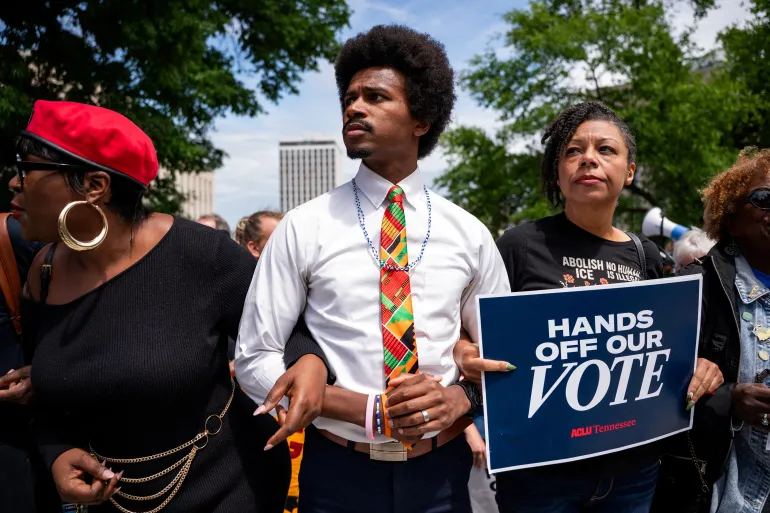
Thursday’s primary in Tennessee served as the inaugural test for the state’s newly redrawn congressional map, which was finalized in May. Tennessee is one of approximately 10 states that have reconfigured their electoral boundaries since 2025, a strategic move aimed at securing partisan advantages for the 2026 United States midterm elections. This electoral cycle is widely viewed as a referendum on President Donald Trump’s second term, and the Republican leadership has actively championed these redistricting efforts as part of a national strategy to maintain firm control over Congress.
The significance of these maps cannot be overstated, as each district represents a single seat in the House of Representatives. With the Republican majority currently razor-thin, the chamber remains highly vulnerable to a shift toward Democratic control. Tennessee’s specific redistricting effort followed a critical April ruling by the US Supreme Court that weakened federal protections for minority voters under the Voting Rights Act. This judicial shift provided the legal opening for Republican lawmakers to dismantle the state’s only majority-Black district in Memphis, a long-standing Democratic stronghold.
Republicans currently hold eight of Tennessee’s nine congressional seats and are aiming for a clean sweep in November. Thursday’s primaries were essential in finalizing the candidates for the general election. Among the notable results, Senator Marsha Blackburn defeated US Representative John Rose to secure the Republican nomination for governor. Blackburn is vying to succeed Governor Bill Lee, who is ineligible for re-election due to term limits. In the November general election, she will face Memphis City Council member Jerri Green, the Democratic primary victor. If successful, Blackburn would become the first female governor in Tennessee history.
Blackburn enters the race with a significant partisan advantage in a state that has become a reliable Republican bastion. The GOP has held the governor’s office since 2011 and has maintained an unbroken winning streak in US Senate elections since 1994. Meanwhile, one of the most significant upsets of the evening occurred in District 5, a sprawling region encompassing both rural areas and portions of Nashville. Former Tennessee Agriculture Commissioner Charlie Hatcher defeated the Trump-endorsed incumbent, Representative Andy Ogles.
Ogles, who has represented the 5th District since 2023, faced widespread condemnation from across the political spectrum for his rhetoric regarding the Muslim community. In a March social media post, Ogles stated, “Muslims don’t belong in American society. Pluralism is a lie.” These remarks were widely denounced as discriminatory. Ogles’s defeat marks the second time this week that a Trump-endorsed candidate has lost a primary. Hatcher, a fifth-generation dairy farmer, campaigned on his support for Trump and will now face Democrat Chaz Molder in the November general election.
In House District 6, which spans from Nashville to the Kentucky border, the absence of an incumbent created a highly competitive race. Representative Rose chose to vacate his seat to pursue the gubernatorial nomination, which he ultimately lost to Blackburn. State Representative Johnny Garrett emerged as the winner of the Republican primary, defeating Rose’s former chief of staff, Van Hilleary. Garrett is set to face Navy veteran Mike Croley, who secured the Democratic nomination after a five-way primary contest.
Much of the controversy surrounding the May redistricting effort centered on House District 9. Previously anchored in the Democratic stronghold of Memphis, the district was the state’s only majority-Black constituency. Republican lawmakers effectively dismantled the district, triggering a chain reaction of boundary changes that also impacted District 5. The new District 9 now spans approximately 320 kilometers, or 200 miles, stretching eastward from Memphis through rural territory toward Nashville. According to estimates from The Associated Press, the district now tilts Republican, with 71 percent of the voters being new to the area.
In this redrawn District 9, the Democratic nominee is Justin Pearson, who gained national prominence in 2023 after being expelled from the Tennessee House for protesting in favor of gun control measures, only to be subsequently re-elected by his constituents. During his victory speech, Pearson noted that the primary occurred exactly 61 years after the signing of the Voting Rights Act. He used the platform to criticize the Supreme Court’s recent decision to erode protections for Black and minority voters and condemned the state’s redistricting process.
“It’s a blatant attempt to keep people like us out of power and an attempt to make us quit. But tonight, we’re one step closer to Washington, DC,” Pearson declared to his supporters. His campaign highlights the tension between the state’s shifting demographics and the legislative efforts to consolidate Republican power. The race in District 9 is expected to be a focal point of the November midterms, serving as a direct challenge to the map’s new partisan configuration.
The broader political landscape in Tennessee remains heavily influenced by the Republican Party’s dominance. Senator Bill Hagerty, who was first elected in 2020, continues to be heavily favored in the state, underscoring the uphill battle Democrats face in statewide contests. As the November election approaches, the focus will shift to whether the newly drawn districts will successfully insulate Republican incumbents or if Democratic challengers like Pearson and Green can mobilize enough support to overcome the structural disadvantages created by the map.
The outcome of these races will ultimately determine the composition of Tennessee’s congressional delegation and contribute to the national balance of power in the House. With the primary results now finalized, both parties are pivoting to the general election, where the impact of the 2026 redistricting will be fully realized. The state’s political future rests on whether voters accept the new boundaries or choose to push back against the partisan shifts that defined this election cycle.
As the campaign season intensifies, the rhetoric surrounding the redistricting process is likely to remain a central theme. The legal and political battles over these maps reflect a larger national debate regarding voting rights, representation, and the influence of partisan gerrymandering in American democracy. Tennessee stands at the center of this debate, with the results of the 2026 midterms poised to set the tone for the state’s political direction for the remainder of the decade.
One of the biggest upsets of the night came in District 5, a sprawling area that includes rural areas as well as part of Nashville.