

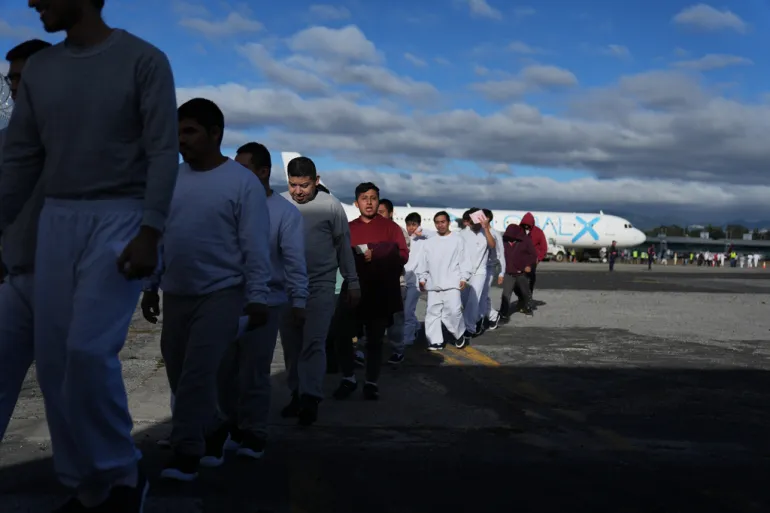
The United States has transferred approximately 2,300 Mexican nationals to Guatemala this year, a move that has drawn sharp objections from the Mexican government. Guatemalan President Bernardo Arevalo confirmed on Wednesday that his nation has processed 2,284 Mexican citizens who were deported from the US, noting that these individuals arrive on flights alongside returning Guatemalan nationals.
Arevalo explained that the arrangement functions as a transit process, with the goal of returning these individuals to Mexican territory within 24 hours of their arrival in Guatemala. The costs associated with these rapid repatriations are covered by either the US or Mexican governments, according to the Guatemalan president.
This practice is part of a broader, aggressive deportation strategy under President Donald Trump, who has increasingly utilized third-country removals for migrants and asylum seekers. While the administration justifies these actions as a necessary deterrent to prevent migrants from re-entering the US, the policy has sparked significant diplomatic friction. Mexico’s Ministry of Foreign Affairs stated on Thursday that it has formally expressed its opposition to the practice, emphasizing that every Mexican citizen maintains the right to enter their home country.
The situation has extended beyond Guatemala, with reports indicating that some Mexican nationals have also been transported to Honduras. Arturo Trejo, a deported Mexican man, told Telemundo that he was given no information about his destination before being placed on a flight to Honduras. The US Department of Homeland Security defended its actions, stating it is utilizing all lawful options to execute the largest deportation operation in history, as promised by President Trump.
Human rights advocates warn that these third-country removals serve as an intimidation tactic rather than a standard enforcement measure. Ana Maria Mendez, Central America director at the rights group WOLA, described the policy as part of a severe migration agenda designed to instill fear in migrants at any cost. This tension persists despite the deep economic ties between the two nations, which recorded a cross-border trade exchange of approximately $964.1 billion in 2025.
Since President Trump returned to office, the Mexican government has struggled to balance cooperation on immigration enforcement with the need to protect its citizens from alleged abuses. Concerns have mounted regarding the treatment of detainees, with reports of excessive violence during immigration raids. Statistics show that at least 15 Mexican nationals have died in the custody of Immigration and Customs Enforcement (ICE) since the current administration took office, with an additional three deaths occurring during enforcement operations.
In response to these fatalities and broader concerns about detention conditions, Mexico has filed complaints with US state prosecutors. The Mexican government has publicly denounced the conditions within ICE detention centers as incompatible with international human rights standards and continues to push for regular access for its consular officials to monitor the welfare of detained citizens. The report also notes that “They are arriving on planes carrying Guatemalan returnees,” Arevalo said in a news conference. The report also notes that “In coordination with the Mexican government, what we have done is bring them through in transit so that we can return them to Mexican territory within 24 hours of their arrival in the country.”. The report also notes that largely, the Trump administration has justified such deportations by saying that the immigrants in question are unable to return to their home countries. The report also notes that which has consistently accepted deportations from the US, but that is not the case with Mexico. The report also notes that the US and Mexico have long had a close relationship, as neighbours.