

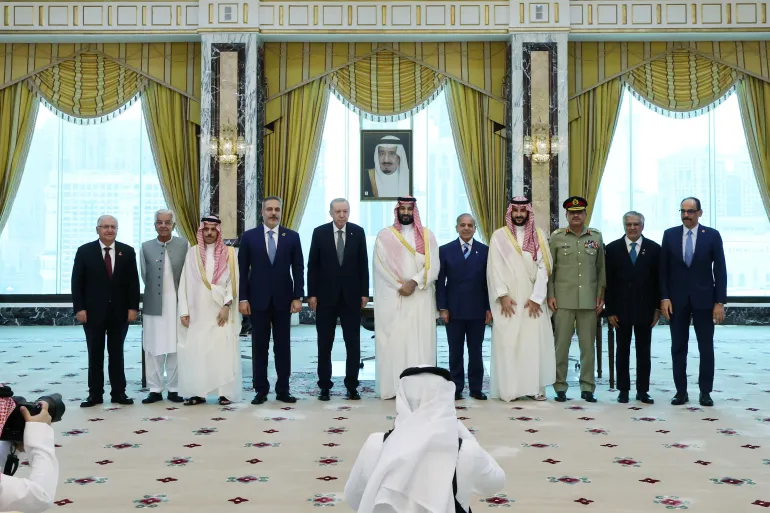
Turkiye, Saudi Arabia, and Pakistan have officially signed a significant joint defence pact, known as the Mecca Joint Deterrence Agreement. The treaty was finalized in the Saudi holy city of Mecca on Friday, with signatures from Turkish President Recep Tayyip Erdogan, Saudi Crown Prince and Prime Minister Mohammed bin Salman, and Pakistani Prime Minister Shehbaz Sharif. The agreement establishes a framework for collective deterrence, stipulating that an armed attack against any one of the three signatories will be treated as an act of aggression against all members. This move is intended to provide a robust, unified response to regional threats.
In a formal statement, the Pakistani Ministry of Foreign Affairs described the agreement as being “guided by the longstanding historical ties among the three states, based on the enduring bonds of brotherhood and Islamic solidarity that unite them.” The ministry emphasized that the pact reflects a shared commitment to strengthening collective security and promoting regional peace. The deal was finalized shortly after Prime Minister Shehbaz Sharif, accompanied by powerful army chief Asim Munir, arrived in Saudi Arabia to perform the Umrah pilgrimage, while President Erdogan traveled to the kingdom specifically for these high-level discussions.
Here’s what we know about what this pact contains: The agreement leverages the unique strengths of each nation, including Turkiye’s advanced defence-industrial capabilities, Saudi Arabia’s financial muscle and regional influence, and Pakistan’s extensive military experience and strategic deterrent. The core objective is capacity building, allowing these nations to reform their policies so they no longer need to rely on external powers for security. This trilateral framework is designed to provide a cohesive, independent security architecture that can withstand the volatility currently gripping the Middle East.
The defence agreement has been in the making for some time, with negotiations gaining significant momentum following the October 7, 2023, Hamas attack on Israel and the subsequent war in Gaza. As the conflict expanded, these nations sought a more formal mechanism to protect their interests. While Turkiye and Pakistan have not been directly impacted by regional tensions thus far, Saudi Arabia—which hosts critical US military assets and infrastructure—has frequently come under attack from Iran and its regional proxies, including the Houthis in Yemen. Tehran has also targeted other Gulf nations and Jordan, which similarly host US military assets, heightening the sense of urgency for this alliance.
The three nations have been particularly concerned about the impact of Iran’s war and Israel’s growing influence and military strikes across the region. Reporting from Ankara, Al Jazeera’s Resul Serdar noted that officials believe escalating regional tensions have forced these countries to align. “Post-October 7 has changed the region dramatically, with the Israeli actions and expansionism. And now there is the crisis in the Strait of Hormuz and ongoing attacks on Iran, as well as Iran’s response to the regional countries,” Serdar explained. He added that several layers of necessity have converged, compelling these three major powers to sign this binding agreement.
The path to this agreement included several key diplomatic milestones. On March 19, the foreign ministers of the three nations met in Riyadh during an Islamic summit to discuss the parameters of a joint security framework. This followed an earlier mutual defence agreement signed between Pakistan and Saudi Arabia in September 2025, which was prompted by an Israeli attack on the Qatari capital, Doha, on September 9, 2025. These nations have also consistently condemned the notion of a so-called “Greater Israel,” viewing it as a direct threat to regional sovereignty.
Yasmine Farouk, project director for the Gulf and Arabian Peninsula at the International Crisis Group, noted in a July 20 report that closer defence ties between Turkiye, Pakistan, Saudi Arabia, and Egypt reflect a hard-won realization among these states. She observed that while many officials reached this conclusion before the US and Israel launched their assault on Iran in late February, the subsequent Iranian retaliation—including missile and drone strikes on Gulf Arab states and the closure of the Strait of Hormuz—lent the initiative fresh and urgent impetus.
However, the alliance has drawn scrutiny from Western and Israeli observers. Farouk noted that several Israeli and US officials have characterized these nations’ joint security dynamics as an “anti-Israel or anti-Israel/UAE bloc of Sunni states.” In February, during a conference in Jerusalem, former Israeli Prime Minister Naftali Bennett alleged that Turkiye is “the new Iran,” claiming that Ankara is attempting to turn Saudi Arabia against Israel and build a hostile Sunni axis with Pakistan.
Ozgur Unluhisarcikli, managing director of the German Marshall Fund’s South and Wider Europe office, highlights that the three countries share a broadly state-centric view of regional stability. Despite their internal differences, they tend to prioritize strong central governments and regional autonomy. This trilateral deal is understood to build on existing bilateral pacts, effectively creating a layered security network that spans from the Mediterranean to the Arabian Sea.
The agreement also addresses the shifting geopolitical landscape where traditional alliances are being tested. By formalizing their cooperation, the three nations are signaling a shift away from reliance on Western security umbrellas. The focus on “collective deterrence” suggests that the signatories are preparing for a long-term period of instability, where the ability to project power and defend borders independently becomes paramount.
As the region navigates the fallout from the ongoing war on Iran and the broader Israeli-Palestinian conflict, the Mecca Joint Deterrence Agreement serves as a strategic hedge. It provides a platform for military coordination, intelligence sharing, and joint training exercises, all of which are intended to deter future aggression. The pact is not merely a symbolic gesture but a functional military arrangement designed to adapt to the rapidly evolving threats in the Middle East.
Ultimately, the success of this agreement will depend on the signatories’ ability to maintain their unity despite external pressures. With the US and Israel closely monitoring the development of this bloc, the coming months will likely see increased diplomatic friction. Nevertheless, for Turkiye, Saudi Arabia, and Pakistan, the Mecca agreement represents a decisive step toward asserting their collective agency in a region defined by shifting alliances and persistent conflict.
Negotiations began soon after the October 7, 2023 Hamas attack on Israel and the onset of the subsequent Israeli genocide in Gaza, and gained pace amid the US and Israel’s ongoing war on Iran.
Murat Aslan, an associate professor of international politics at Hasan Kalyoncu University in Gaziantep, Turkiye, told Al Jazeera the pact can also be expected to cover “capacity building”.
“We know that Saudi Arabia is dependent on importing their defence products, weapons or equipment, especially from the United States for decades, and we know that it’s not cost-effective and they need to build their own
Israel has occupied roughly one-fifth of Lebanon as it allegedly targets strongholds of the Lebanese armed group, Hezbollah, which is also backed by Iran.
Meanwhile, Iran-backed groups in Iraq have been accused of carrying out drone attacks in Saudi Arabia and have, themselves, come under fire from US and Israeli attacks.
While Turkiye has NATO’s second-largest military, Saudi Arabia is the world’s top oil exporter, and Pakistan is the only Muslim nation with nuclear weapons.
“We know that Saudi Arabia is dependent on importing their defence products, weapons or equipment, especially from the United States for decades, and we know that it’s not cost-effective and they need to build their own defence sector inside Saudi Arabia,” Aslan said.
“The three of them combined now present a force that will take this region towards a different security architecture than the one in place over the last few decades, especially in the wake of the Iran war,” he said.
“Saudis must know that a paper agreement with Türkiye and Pakistan will not bring them security, just as years of one-sided dependence on the Americans did not bring them security,” he wrote.
“We are closely following the Israeli administration’s attempts to dynamite the (US-Iran) deal … The current war-addicted Israeli government must not be allowed to drown our geography in the smell of gunpowder and blood again,” he said.
The Turkish leader has repeatedly accused Israel of trying to undermine the US-Iran Memorandum of Understanding, which was signed on June 17 to halt fighting and allow time for negotiations.
For its part, Pakistan has condemned Israel’s genocidal war on Gaza, where more than 71,000 people have been killed in attacks since October 2023, including more than 1,000 since a supposed US-brokered ceasefire was announced last year.