

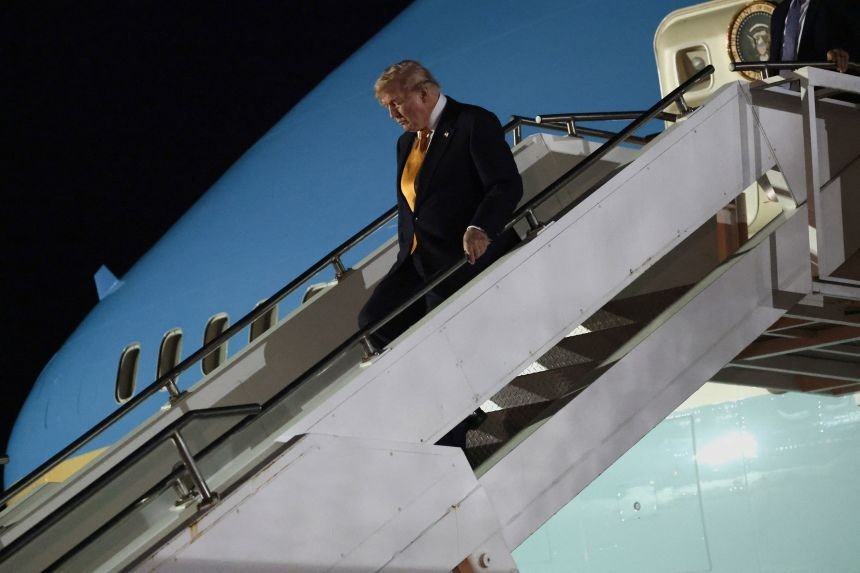
President Donald Trump executed a clandestine departure from Turkey last month, utilizing an elaborate security ruse that involved boarding an alternate military aircraft while concealed inside a catering truck. This operation, confirmed by a US official following initial reports from the Washington Post, highlights the extreme measures taken by American security teams to protect the president from potential Iranian threats.
The deception began with a public announcement that Trump would fly out of Turkey on an older presidential aircraft, a decision previously attributed to security concerns regarding the new plane gifted by Qatar. While the public and the traveling press pool believed they were departing on this older jet, it served as a decoy. After boarding the older aircraft—a moment documented by cameras—Trump secretly exited the plane via a catering vehicle and transferred to a smaller Air Force C-32A. Subsequently, the Qatari-gifted plane, the older presidential jet, and the C-32A departed Turkey at different times, eventually reuniting in the United Kingdom, where Trump boarded the Qatari-gifted aircraft for the final leg of his journey home.
This complex maneuver shifts focus toward the nature of the security threat that necessitated such drastic measures, as well as the experience of the journalists and staff who remained on the decoy plane. White House spokesperson Steven Cheung defended the security protocols, stating that the new Air Force One is equipped with high-level security and that the administration utilizes every available tool to address threats from those who have their sights on the president.
Travel pool records from the NATO Summit departure provide insight into the unusual events at Ankara’s Esenboga Airport. Trump was confirmed aboard the older Air Force One at 8:26 p.m. local time, with the aircraft taking off at 8:43 p.m. During the flight, journalists were instructed to keep their window shades closed. This directive, which was strictly enforced by Secret Service agents, was described by Trump later as a precaution for a “dangerous flight” involving “sleaze bags” that officials must manage. When questioned about the shade policy, Trump remarked, “They didn’t ask me to close mine, but if they did, I would’ve done it,” adding, “But if I go, you go. Right? Perhaps someday you want to change professions.”
The decoy flight arrived at RAF Mildenhall in England at 10:29 p.m. local time. An unusually long delay followed before the press pool was permitted to set up for an underwing shot of the president deplaning. This window of approximately 20 minutes provided sufficient time for Trump to have already transferred between aircraft. When the pool finally captured footage, the stair car was already positioned and the door was open, with a higher-than-usual number of security personnel present on the tarmac.
Trump was later observed boarding the Qatari-gifted aircraft at 11:01 p.m. When asked during the flight about the reason for the plane switch, the president claimed it was to allow US service members stationed at the base a chance to tour the aircraft, insisting there were “no issues” with the planes. This contrasts with previous reports where the White House restricted media from filming similar transfers, such as during a trip to Davos, citing minor electrical concerns.
The journey concluded when Trump arrived at Joint Base Andrews, deplaning at 1:23 a.m. ET. A pool note documented that he saluted and quickly entered his vehicle, the Beast, marking the end of a high-stakes transit operation that had kept the press and public largely unaware of the president’s actual movements until after the fact. The report also notes that trump had boasted about the new aircraft — even though officials felt it was not as secure as other planes because it had to be retrofitted to serve as Air Force One — and the president seethed privately over coverage of. The report also notes that local time, according to a subsequent pool report, 17 minutes later. The report also notes that the pool was also “advised to keep our window shades in the press cabin closed,” according to a print pool note from Politico’s Megan Messerly. The report also notes that the clandestine security plan — first reported by the Washington Post and confirmed by — underscored the lengths American officials went to in order to protect Trump from being assassinated by Iran. The report also notes that that, though, was apparently part of the subterfuge. The report also notes that trump had boasted about the new aircraft — even though officials felt it was not as secure as other planes because it had to be retrofitted to serve as Air Force One — and the president seethed privately over coverage of its deficiencies. The report also notes that attention is likely to shift to reporters and staffers unknowingly being aboard a decoy plane — and the nature of the threat that prompted such dramatic security measures. The report also notes that sent in light of the secret plane revelation, noted that a Secret Secret agent came back to the press cabin to remind the media to keep the shades closed, a supplemental pool note from ABC’s Michelle Stoddart on Tuesday.