

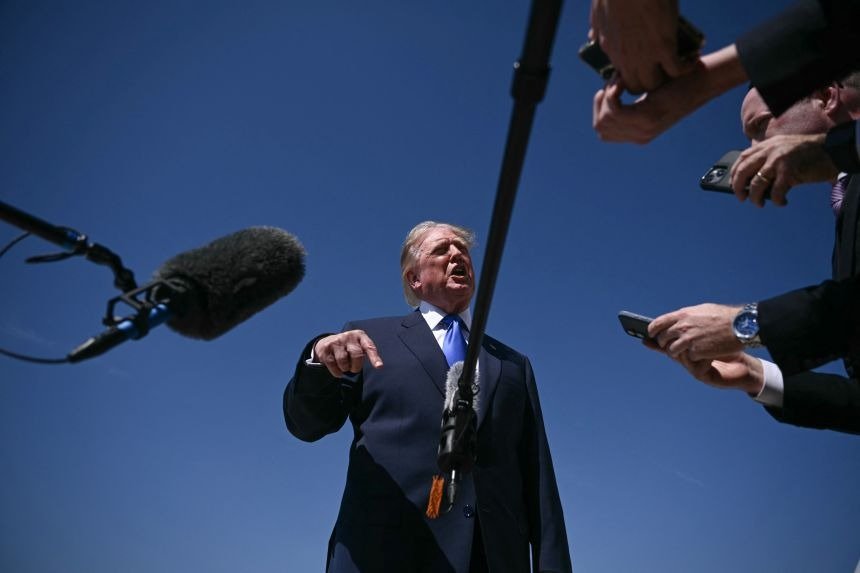
President Donald Trump stated on Wednesday that he anticipates Iran will cease its military operations following the upcoming US midterm elections. While he remains optimistic about a post-election resolution to the conflict, he acknowledged that American consumers should not expect immediate relief from rising fuel costs.
Speaking while traveling to a GOP midterm convention in Dallas, Trump suggested that Iran is intentionally prolonging hostilities to influence the domestic political landscape. He claimed the regime is desperate to secure a favorable outcome in the elections, stating, “They’re desperate to try and affect the election so that we can get a nice weak group of people in there and leave them alone and let them have their nuclear weapon.”
Despite the current volatility, Trump maintained that Iran is nearing a state of collapse and will likely seek to end the fighting “immediately after the election.” He asserted that the regime’s resources are exhausted, adding, “They can’t hold out any longer.” He further argued that the American public remains committed to the broader offensive, noting, “I think it’s very easy to explain to America, all you have to do is say: ‘Will you let Iran have a nuclear weapon?’ And the answer is no.”
The administration’s outlook comes as global oil benchmarks have surged back above $100 per barrel. This increase is largely attributed to intensified fighting in Iran, which has significantly disrupted crude oil transit through the Strait of Hormuz. Roughly six months into the conflict, the waterway—which previously facilitated about one-fifth of global daily oil shipments—remains a critical bottleneck.
Domestic economic pressure is mounting as fuel prices continue to climb. According to AAA data, the national average gas price reached $4.22 per gallon on Wednesday, following a single-day spike of 7.3 cents. Diesel prices have also reached record highs, averaging $5.94 per gallon. These figures contrast with earlier projections from Treasury Secretary Scott Bessent, who had previously suggested that gas prices might return to the $3-per-gallon range by Labor Day.
The administration’s initial timeline for the conflict, which estimated a duration of four to six weeks, has been significantly exceeded as Iran successfully disrupted maritime traffic. In response, the Treasury Department recently initiated a new strategy to exert economic pressure on the regime, threatening sanctions against any nations that maintain business ties with Tehran.
Despite these efforts, the administration continues to face challenges in securing the Strait of Hormuz, as tankers remain hesitant to navigate the area while Iran maintains its capability to engage passing vessels. Trump, however, dismissed concerns regarding the political impact of these high energy costs, emphasizing the strategic necessity of the ongoing confrontation. The report also notes that driven by stepped-up fighting in Iran in recent days that has further jeopardized the flow of crude through the Strait of Hormu, trump’s remarks come as the global benchmark oil price has topped $100 a barrel once again.