

A recent incident in a small town south of Sydney highlighted the growing confusion surrounding increasingly realistic sex dolls. Two citizens discovered what they believed to be a mangled human body inside a suitcase and alerted local authorities. Police initially treated the scene as a major incident, but forensic analysis later confirmed the object was a sex doll featuring fake bruises. Because the doll appeared mature, police investigations into the matter were subsequently closed.
The sex doll industry is experiencing significant economic growth. A 2026 market analysis valued the global sector at US$6.6 billion in 2025, with projections indicating the market will more than double to US$13.4 billion by 2033. This expansion is driven by technological advancements that allow for highly lifelike, customizable companions.
Johannes Fuss, chair of forensic psychiatry and sex research at the University of Duisburg-Essen, suggests that the objectification inherent in these products cannot be separated from broader cultural hostilities toward women. He notes that the appeal often relies on total availability, a youthful appearance, and the absence of emotional demands or dialogue. While research remains inconclusive regarding whether these dolls serve as a protective outlet or a behavioral stepping stone for real-world harm, Fuss emphasizes an urgent need for longitudinal data as these technologies evolve.
The industry is increasingly integrating artificial intelligence to enhance the user experience. In 2017, RealDoll introduced “Harmony,” a pioneer in AI-generated robotics. Their latest model, currently accepting waitlist registrations for release this year, allows users to assign specific personality traits—such as “spiritual” or “insecure”—via a smartphone application. Furthermore, the company offers an “AI vagina,” an electronic insert that pairs with the X-Mode app to detect touch, speed, and movement, providing synchronized vocal responses.
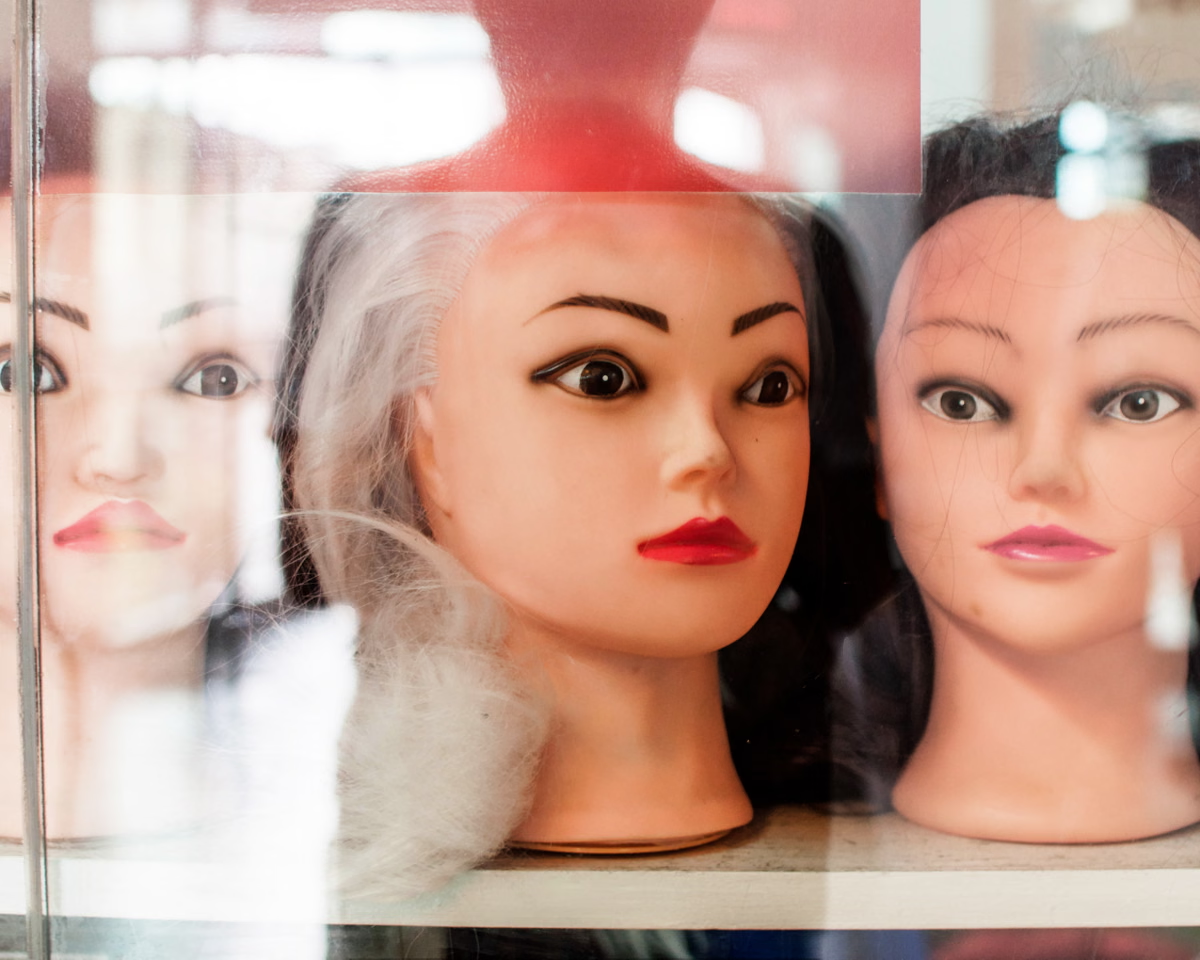
At the 2026 Consumer Electronics Show, Singapore-based firm Lovense unveiled “Emily,” an AI-powered companion doll featuring personality-switching modes like “co-worker” or “gym buddy.” Additionally, Los Angeles-based brand Coeros offers custom-made doll heads, which can be modeled after specific photographs of real people, original characters, or AI-generated imagery. A custom head typically costs approximately US$1,790.
The normalization of these products has sparked debate within online communities. On The Doll Forum, some members contrast real-life relationships with their silicone counterparts, with one user claiming that “girlfriends are for guys who haven’t found the right doll yet.” Conversely, Tammie Paine, owner of the Adelaide-based retailer Naughty by Nature, argues that users are not a monolith and that owning a doll does not inherently reflect a person’s character.
Academic perspectives remain divided on the psychological implications. Prof. Kelly Richards of the Queensland University of Technology notes that some men perceive these dolls as actual people. However, critics like Australian author Caitlin Roper describe these items as “replica female sex slaves,” arguing that they reduce women to mere penetrable objects. Roper highlights the broader risks of this trend, referencing a recent case in South Korea where a 23-year-old man, Jang Yoon-gi, admitted to the rape and murder of a 16-year-old student.
The social impact was also felt in Adelaide this past March, when a man listed his 5’6” sex doll for sale on a forum. The advertisement resulted in 20 hours of police time and significant community distress. As the technology becomes more sophisticated, the debate continues over whether the commodification of the female form through AI-driven dolls poses a genuine threat to social standards and gender equality. The report also notes that the wider public waited sombrely for Australia’s tally of dead women to tick up by one. The report also notes that but instead, a day later, after forensic analysis, it was determined that the woman in question wasn’t a woman at all. The report also notes that marked with fake bruises, left to rot on a lonely dirt road, the “body” was that of a sex doll. The report also notes that in Australia, as in the UK and some other European countries, it is not illegal to own a sex doll unless it resembles a child. The report also notes that police investigations were called off, given the doll’s seemingly mature presentation. The report also notes that desbuleux, Fuss has published papers on the link between the anthropomorphisation of sex dolls and gender-based violence. The report also notes that “To put it provocatively: it boils down to total availability, a youthful and attractive body, and zero emotional demand or dialogue.”.