

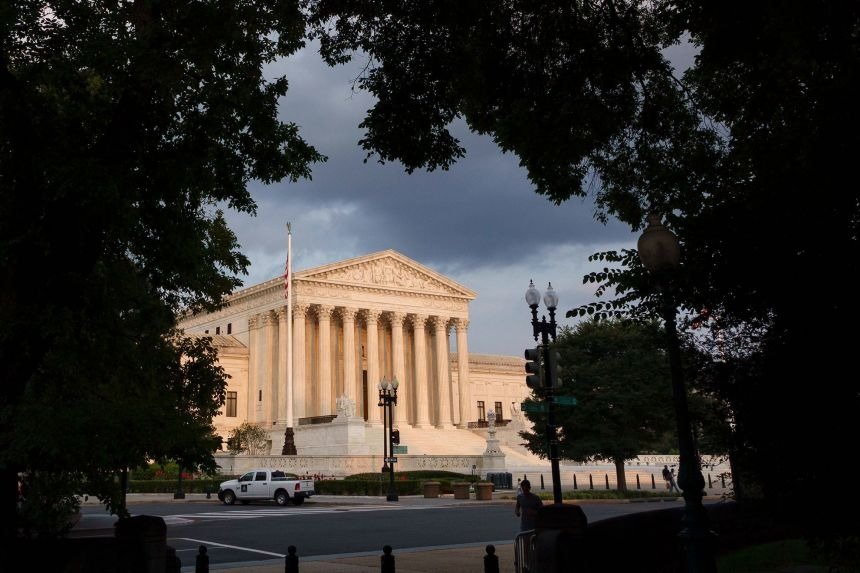
In a significant election-related development, the U.S. Supreme Court ruled against a Republican-favored congressional map in Missouri on Thursday. The court’s decision, issued as a brief, one-paragraph order without noted dissent, effectively blocks a plan that could have secured an additional House of Representatives seat for the GOP. Instead, the state is now expected to utilize a previous map that provides six winnable seats for Republicans rather than seven.
While the ruling impacts only a single district, it represents an unusual setback for the party at the hands of the 6-3 conservative majority. The decision complicates efforts by President Donald Trump and his allies to leverage state-level redistricting to maintain Republican control of the House in the upcoming cycle. The map in question had targeted the 5th Congressional District, currently held by Democratic Representative Emanuel Cleaver, by fragmenting its Kansas City base and extending the district into more rural, GOP-leaning regions.
The legal battle originated with the group People Not Politicians Missouri, which organized a referendum campaign to challenge the legislature’s redistricting plan. Richard von Glahn, the group’s executive director, praised the outcome, stating, “The law is the law, the Missouri constitution is clear as was the Missouri Supreme Court.” He added that over 305,000 voters from across the political spectrum had worked to oppose what he described as a political power grab.
The timeline of the dispute was marked by intense legal maneuvering. After Missouri’s highest court ruled against the state’s attempt to block the referendum, officials appealed to the U.S. Supreme Court, where Justice Brett Kavanaugh initially declined to intervene. However, a federal district judge subsequently issued a temporary order favoring the GOP-aligned map. This prompted Missouri Secretary of State Denny Hoskins to announce that the state would proceed with the Republican-friendly version, leading to a flurry of emergency appeals that brought the case back to the Supreme Court on Wednesday evening.
During Thursday’s proceedings, the Trump administration’s Solicitor General, D. John Sauer, argued in favor of the GOP map. Sauer contended that the opposition group lacked legal standing and warned that altering maps between primary and general elections creates equal protection issues. “The Constitution guarantees an equal right to vote for one’s own representatives,” Sauer told the court. “Switching maps at this stage would violate that guarantee: Some voters will have had the opportunity to vote in primaries for the members of Congress who will represent them, while others will not.”
The litigation also spilled over into state courts, where Missouri officials faced scrutiny for waiting until August 4—the day of the state primary—to declare that the constitutional right to referendum did not apply to redistricting. This delay led People Not Politicians to seek a contempt order against Secretary of State Hoskins. During a hearing on that motion, the state’s chief justice reportedly warned Hoskins to stay close to the capital, Jefferson City.
Despite this specific loss, Republicans maintain a broader advantage in national redistricting, having secured nine more favorable seats than Democrats, according to recent analysis. While the GOP hopes this will bolster their House majority against headwinds related to economic concerns and the president’s polling, Democrats remain optimistic about defending seats in districts with significant Latino populations that have shown signs of shifting back toward the left after the 2024 election cycle. The report also notes that particularly in districts with significant Latino populations that shifted to the right during Trump’s 2024 victory but have, democrats believe they can still hold onto several of the seats drawn to Republican advantage. The report also notes that but the high court’s quick resolution of the case — without any substantial writing or dissent — suggests that for all the drama and confusion around the litigation, Missouri never stood much of a chance. The report also notes that a Republican, did not immediately respond to a request for comment, aides to Missouri Attorney General Catherine Hanaway. The report also notes that that doesn’t mean the GOP will gain nine seats this fall due to redistricting. The report also notes that effectively requiring the state to revert to an earlier map, missouri’s highest court had backed that effort last week.