

Prime Minister Pedro Sanchez has dismissed claims that his administration is being blackmailed by Morocco as mere entertainment, comparing the accusations to Netflix drama plots. During an address on Monday, the Spanish leader pushed back against suggestions that Rabat is leveraging sensitive information from a hacked phone to influence his stance on the recent migration crisis in Ceuta.
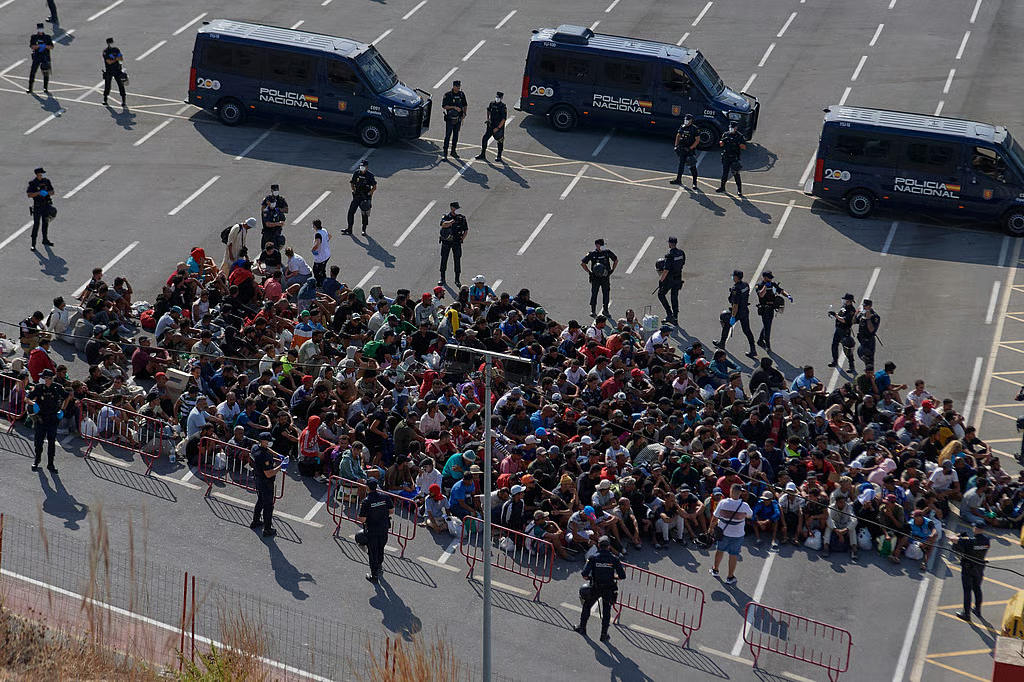
Political opposition, led by Popular Party chief Alberto Nunez Feijoo, has intensified pressure on the government, alleging that fear of leaked data is preventing Sanchez from taking a firmer stand against Morocco. These accusations gained traction after approximately 70,000 migrants arrived at the Spanish North African enclave at the end of July.
Sanchez maintained that he remains open to a robust response if evidence ever surfaces. “I have never said that we would not respond firmly to Morocco if it is proven that Morocco is behind what happened on July 30 and 31,” he stated. He emphasized that as of now, there is no information that solidly establishes Moroccan responsibility for the wave of arrivals.
The Prime Minister cautioned against building national policy on conjecture. “Relations between countries, and particularly with neighbours, must be based on respect and on facts, not on wild speculation or contempt,” he argued. He dismissed the ongoing reports surrounding his mobile device as false news lacking factual substance.
The situation in Ceuta has been grave, with official data indicating that the migrant rush resulted in a death toll that has reached as high as 80 people, with earlier reports citing at least 72 fatalities. While the majority of those who crossed on July 30 and 31 were sent back to Morocco within hours, several thousand individuals remain in the territory.
The continued presence of these migrants has triggered ongoing instability, including violent incidents and frequent local protests in Ceuta. Authorities are currently tasked with the complex process of identifying those remaining to assess asylum eligibility, while strict legal protections prevent the summary deportation of unaccompanied minors.
Beyond the crisis in Ceuta, the Spanish government has also recently implemented new border controls, including measures affecting travel from Italy. As Morocco works to prevent further mass crossings, Madrid continues to manage the humanitarian and political fallout from the late July surge. The report also notes that since over 70,000 migrants streamed into the Spanish enclave from Morocco at the end of July, Sanchez has maintained he has no “solid proof” that Rabat planned the rush — something that has not convinced opposition parti.