

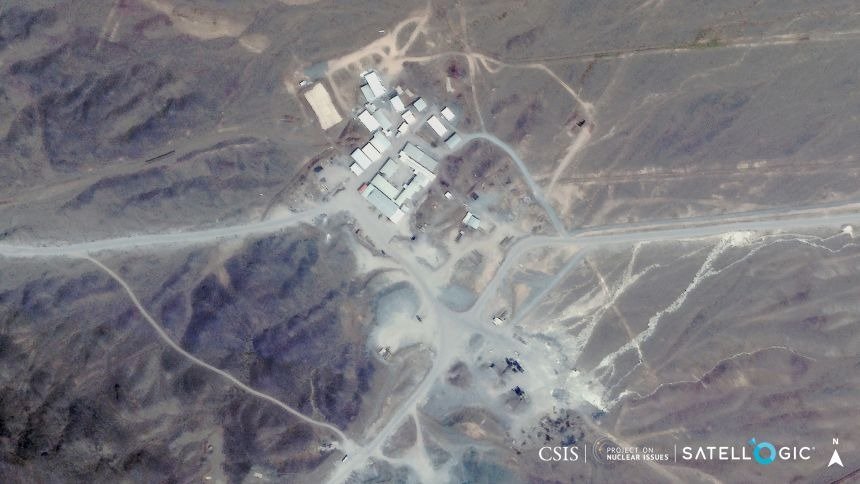
A suspected Iranian nuclear site, situated within a granite mountain near the Natanz complex roughly 140 miles south of Tehran, has undergone a flurry of construction throughout the current year. Satellite imagery analysis from the Center for Strategic and International Studies (CSIS) indicates a clear surge in activity at the Pickaxe Mountain site, which intelligence agencies view as a potential sanctuary for Iran’s nuclear program.
The CSIS report suggests that the facility is likely intended to serve as a centrifuge assembly plant, an enrichment site, or a hub for nuclear weapons-relevant activities like uranium metal conversion. While analysts note that the site appears to be shifting from active excavation toward internal construction and exterior reinforcement, they caution that the ongoing work suggests the facility is not yet operational for enrichment purposes.
President Donald Trump has publicly acknowledged the site, telling reporters last week, “We may hit Pickaxe very soon,” and claiming that the US is tracking movements at the location. The US military maintains operational plans for potential strikes against the facility, which was included in a target package under consideration earlier this summer during periods of heightened conflict escalation.
Despite these plans, the site’s location deep within granite presents a significant challenge to even the Pentagon’s most powerful non-nuclear munitions. The US has previously utilized the Massive Ordnance Penetrator, yet officials have expressed concerns that such weapons may be insufficient to destroy deeply buried targets. Consequently, the military is actively developing a next-generation penetrator bomb, with prototype development contracts awarded in September 2025 and industry solicitations issued by the Air Force in June.
Efforts to address these deep-seated threats have included a recent “planning sprint” within the Defense Department. Furthermore, evidence suggests the US has been preparing for potential strikes since the onset of the conflict. On February 27, just one day before the war began, the Defense Threat Reduction Agency (DTRA) authorized an emergency $1.2 million contract to repair a unique subterranean test facility at the White Sands Missile Range in New Mexico. This “rapid test prep” was mandated by a time-sensitive national security directive to validate capabilities against emerging threats.
Satellite imagery confirms that excavation work began at the White Sands test site between February 16 and February 18, aligning with the timing of the emergency contract awarded to Pate Construction. This remote site, known as the Alternate Seismic Hardrock in Situ Test Site, is also carved into granite, mirroring the geological challenges posed by Pickaxe Mountain. Activity at the New Mexico site continued through mid-March before appearing to halt.
While the Pentagon has not confirmed the specific purpose of the White Sands activity, sources familiar with the matter indicate the tests were directly linked to the war in Iran and the necessity of simulating strikes against hardened, deeply buried facilities. As the conflict persists, the US continues to refine its operational strategies to reach targets that were previously considered beyond the reach of conventional weaponry. The report also notes that even as US forces have largely focused on other types of targets during the six-month conflict with Iran, but there are signs the US is working to devise some means of striking those sites. The report also notes that a program manager at an obscure Pentagon agency charged with combating weapons of mass destruction signed an emergency $1.2 million contract justification to repair a “unique subterranean test facility at White Sands Missile Range” in New Mexico for a “live-fire test designed to validate classified capabilities against rapidly emerging threats.”, four days before the US launched Operation Epic Fury. The report also notes that the US previously struck nuclear sites in June 2025 as part of what the military called Operation Midnight Hammer. The report also notes that according to federal contracting records, the timing aligns with that of the emergency contract: Pate Construction provided an estimate for the test work on February 17 and received the deal the next day. The report also notes that nor could confirm the purpose of the work at the DTRA test site observed via satellite imagery, could not independently verify whether the test occurred. The report also notes that the Pentagon did not immediately reply to questions from.