

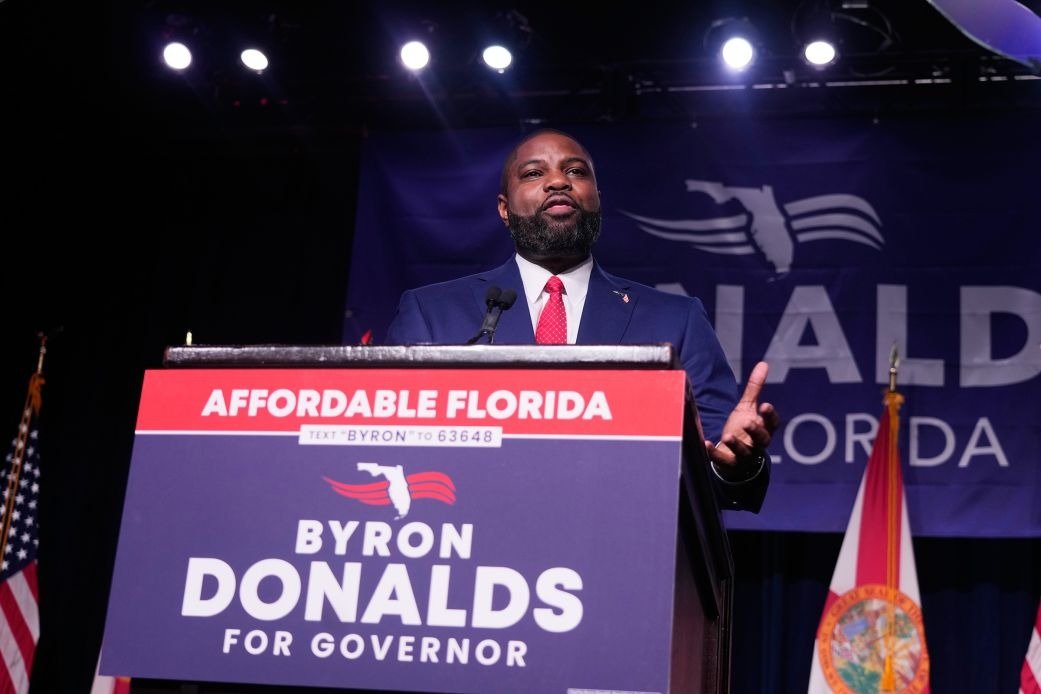
As Florida voters look toward the post-Ron DeSantis era, the Republican Party has selected a close ally of Donald Trump as their gubernatorial nominee. Despite the endorsement and the backing of the state’s GOP establishment, the candidate’s primary performance fell short of the 50% threshold, prompting internal questions about potential vulnerabilities heading into the general election. The candidate, who raised over $100 million, enters the race with significant fundraising advantages and a favorable electorate, boasting 1.5 million more registered Republicans in the state. At his victory party, he praised Sen. Rick Scott for building a strong foundation, declaring, “We put aside our differences tonight. We are one united Republican Party.”
The primary results in Florida also underscored the mixed influence of Trump’s endorsements. While some candidates secured nominations, others faltered, including in the Wyoming Republican gubernatorial primary, where voters favored state Sen. Eric Barlow over the Trump-backed state Superintendent of Public Instruction, Megan Degenfelder. In Florida, the trend of Trump-backed candidates facing hurdles continued; Rep. Cory Mills, who received an endorsement in February, was defeated by a challenger after being embroiled in an ethics investigation regarding potential campaign finance violations and allegations of misusing pandemic relief funds. Trump had reportedly urged Mills to drop out of the race prior to the primary.
Democratic politics in Florida saw a significant shift as state Rep. Angie Nixon secured a victory in the Senate primary, defeating retired Army Lt. Col. Alex Vindman. Despite being heavily outspent by Vindman, Nixon’s win highlights growing frustration within the Democratic electorate regarding the war in Gaza. Nixon, who recently joined the Democratic Socialists of America, emphasized her legislative record on early childhood education and corporate price gouging. She told supporters, “We can talk about labels all day long, people’s labels. I am concerned about the needs of people.” Her victory, however, presents challenges for the party in a state that has trended significantly toward the GOP in recent years.
In Alaska, the electoral landscape remains in flux as voters participated in a primary to narrow the field for the general election. Decision Desk projects that incumbent Republican Sen. Dan Sullivan and Democratic former Rep. Mary Peltola will advance. A unique complication arose in the race due to the presence of a second candidate named Dan Sullivan, a former teacher. While the incumbent is listed as Dan S. Sullivan, the presence of a namesake on the ballot created confusion, though it is not expected to pose a serious threat to the incumbent’s primary standing.
The broader political climate is also being shaped by the retirement of Sen. Cynthia Lummis in Wyoming, where Rep. Harriet Hageman is now positioned to pursue the seat. Meanwhile, in Florida’s 19th District, the race to replace the outgoing congressman saw several former lawmakers fall short. The district’s primary featured two former Republican members of Congress from other states, but neither succeeded in securing the nomination. The outcome in this district also carries historical weight, as the winner’s path likely means the area will not be represented by a Black lawmaker for the first time in over three decades.
Political analysts are closely monitoring these results for signs of shifting coalitions. David Jolly, who transitioned from the Republican Party to become a Democrat, noted the changing landscape, stating, “There is a new coalition emerging in American politics tonight, and it’s starting right here in the state of Florida.” As the general election approaches, both parties are evaluating the strength of their candidates and the resonance of their platforms with an electorate that has consistently supported Trump in previous cycles.
The primary season continues to demonstrate that while Trump’s endorsement remains a potent asset, it is not a guarantee of success. With losses in governor’s races across states like Iowa, Minnesota, Georgia, and South Carolina, the influence of the former president is being tested in diverse political environments. As the focus shifts to the general election, candidates are recalibrating their strategies to address both base voters and the broader, more moderate electorate necessary for victory in November. The report also notes that david Jolly, who left the Republican Party in 2018 and officially became a Democrat last year. The report also notes that and Donalds enters the general election with huge advantages on the fundraising front (he raised more than $100 million during the primary) and in in the electorate overall, wit, florida isn’t the swing state it once was. The report also notes that he was on track to finish below the 50% threshold despite campaigning for more than a year with Trump’s endorsement and the backing of much of the state GOP establishment. The report also notes that as Florida voters prepare to replace term-limited Gov. The report also notes that running for the first time in newly redrawn districts, survived challenges from the left, but two of the party’s House incumbents. The report also notes that here are key takeaways from Tuesday’s primaries in Florida, Alaska, and Wyoming – on a day where voters in California were also choosing between two Democrats to fill a vacancy in the House. The report also notes that and Donalds enters the general election with huge advantages on the fundraising front (he raised more than $100 million during the primary) and in in the electorate overall, with 1.5 million more registered Republicans than Democrats in the Sunshine State, florida isn’t the swing state it once was. The report also notes that data center regulations, and a close embrace of the Trump administration, donalds focused his campaign on property tax reforms.