

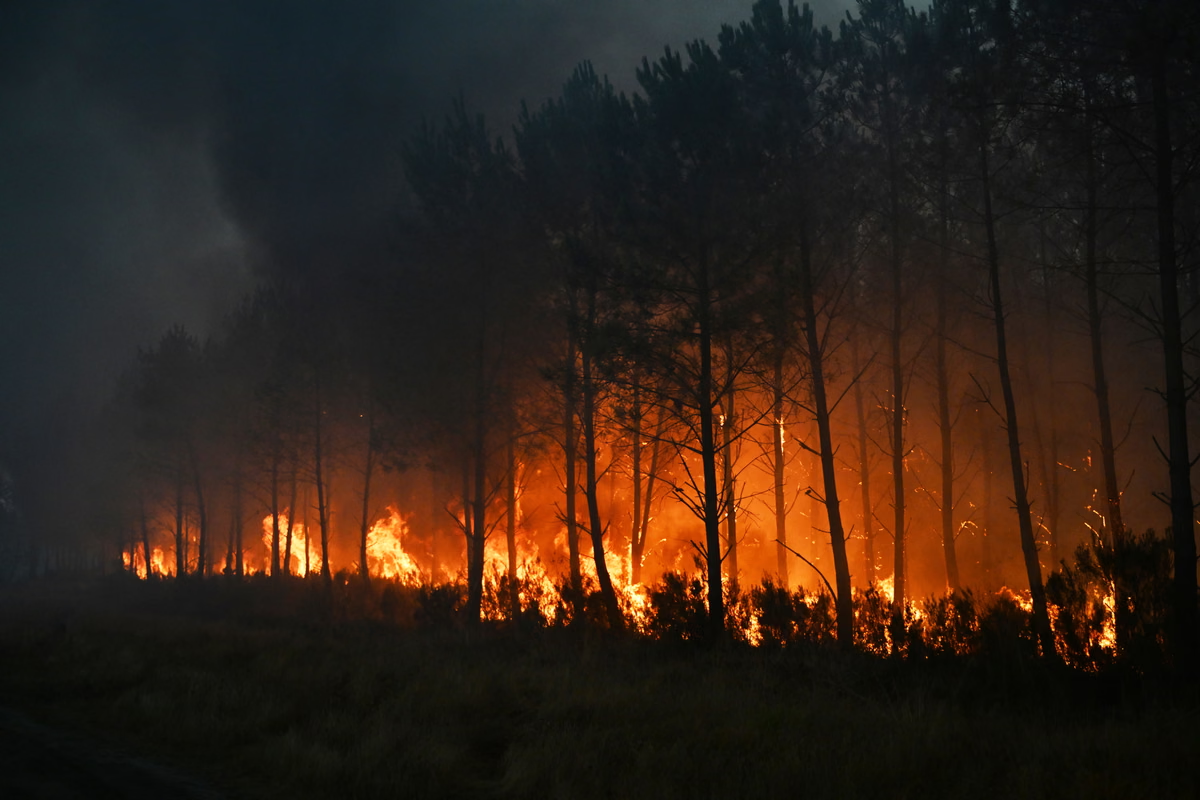
The devastating wildfires that swept through France this summer have scorched more land than any previously recorded event, displacing more residents than at any time since the second world war. Scientists suspect the resulting air pollution may represent the country’s first major climate-driven health crisis. The smoke from France’s largest inferno in nearly 80 years choked Limoges, a city 125 miles from the flames, with toxic particulate matter exceeding the levels inhaled by Delhi residents on their worst smog day last year.
A Landscape Engineered for Disaster
While the blaze that tore through forests outside Bordeaux in late July reconfigured France’s relationship with fire in a matter of weeks, the underlying conditions were centuries in the making. In the 18th century, the coastal wetlands of south-western France were so swampy that shepherds relied on stilts to traverse the landscape during winter. This changed in 1857, when a decree from Napoleon III compelled landowners to drain the marshes and populate the region with maritime pines. This project transformed the water-logged terrain into Europe’s largest human-made forest, which has since evolved into a regional economic engine supporting 30,000 timber-industry jobs.
The Firefighter’s Nightmare
The Landes forest, now 90% maritime pine, presents a significant challenge for fire management. The trees contain resin that burns like petrol, shed needles that carpet the forest floor with highly flammable material, and produce cones that act like grenades when heated, whizzing through the wind to spread flames across vegetation breaks that should theoretically act as firewalls. This phenomenon was tragically illustrated in 1949, when a sawmill fire consumed 50,000 hectares. Gorging on plentiful, homogeneous fuel, the flames killed 82 people, most of whom were volunteers attempting to suppress the blaze.
The Climate Multiplier
Humanity has released 1.85 trillion tonnes of planet-baking carbon into the atmosphere since the 1857 decree, warming Europe by 2.4C. This shift has increased the frequency of hot and dry extremes that were once considered unthinkable. A strikingly wet winter in western Europe this year encouraged lush plant growth, only for subsequent relentless heatwaves to strip the vegetation of moisture, creating a massive fuel surplus. By mid-July, temperatures across France had consistently exceeded 30C for three straight weeks.
The Saumos Ignition
Not long after noon on 22 July, smoke rose from the tightly packed pine stands near Saumos, a village 20 miles west of Bordeaux. While the exact source of ignition remains under investigation, the fire engulfed several hundred hectares within hours. It reached the outskirts of La Porge, a town that would lose one in ten homes to the flames in the following days. Bruno Lafon, head of the regional forest fire prevention service, noted: “From an ecological and forest management point of view, everything was in place to increase the risk of a very large fire. Not only because of the climate, but because of the amount and homogeneity of the fuel.”
Human Factors and Arson
Most wildfires are initiated by human activity, ranging from discarded cigarette butts to improperly extinguished campfires. While public awareness campaigns have helped reduce fire incidents in southern Europe since the 1980s, preventing deliberate arson remains a significant challenge. French police have arrested nearly 500 people on suspicion of starting fires since the beginning of the summer, with approximately 70% of these cases suspected to be intentional acts.
The Response and Ongoing Risks
The fire’s rapid spread was exacerbated by the terrain, which had been flattened by a powerful storm in 1999 and subsequently replanted with uniform tree heights, creating a continuous fuel load. Regarding the firefighting efforts, one official remarked: “The men on the ground did what they could, though I think it would have taken a greater number of planes from the beginning.” A shift in weather conditions eventually allowed firefighters to halt the blaze at 42,000 hectares by the end of July. However, crews have continued to battle small flare-ups and smouldering “zombie fires” underground that could persist for months. Studies indicate that wildfire smoke is responsible for 1.5 million deaths annually worldwide, marking it as a critical environmental health threat. Without improved fire management strategies, the burned area in Europe is projected to rise by 39% even under best-case scenarios for pollution reduction. The report also notes that which retain more moisture and have shady canopies that stop vegetation from drying, the dense monoculture can burn with fury when sparks catch, without the diversity offered by broad-leafed species. The report also notes that but workers contracted by Enedis, a utility company that manages France’s electricity distribution, were active in the area and reported having sparked a fire with a faulty machine, the source of ignition is under investigation. The report also notes that which has identified the machine as its leading line of inquiry, did not respond to requests for comment, the Bordeaux public prosecutor. The report also notes that enedis declined to answer specific questions because of the continuing investigation. The report also notes that failing to properly extinguish campfires or dispose of barbecues, most wildfires are started by humans through actions such as dropping cigarette butts. The report also notes that it is weather and geography that dictate whether it will quickly wither or morph into a hellish blaze, once a fire has begun. The report also notes that it was immediately clear that firefighters were facing the latter, outside Saumos. The report also notes that which would lose one in 10 homes to the flames in the days that followed, the fire engulfed several hundreds of hectares in a matter of hours and reached the outskirts of La Porge.