

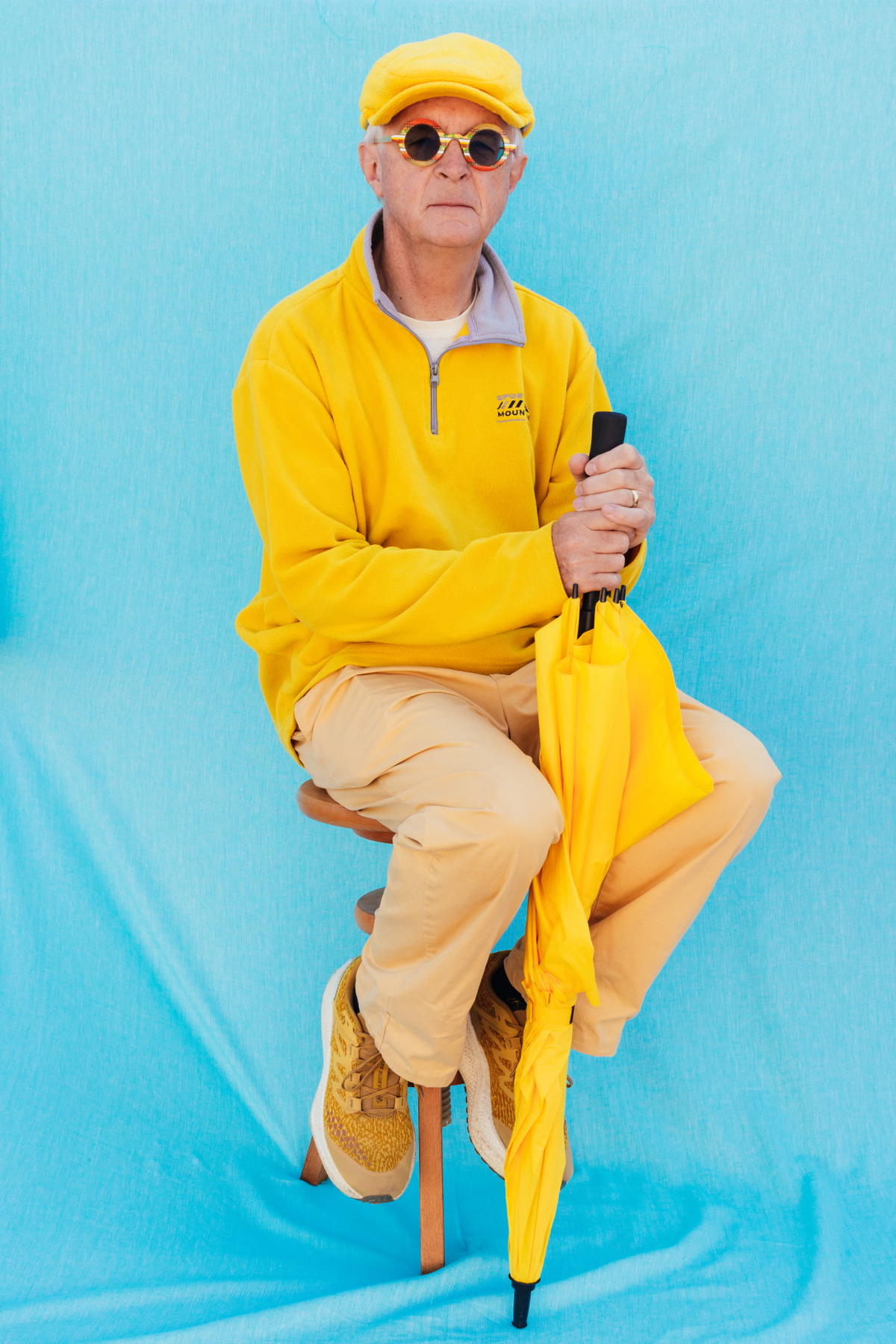
For Andrew Geldart, a 65-year-old retired civil engineer living in Bude, Cornwall, fashion has become a tool for connection. After spending three decades in conventional grey and navy attire, he retired at 55 and embraced a brighter aesthetic. His transition to a yellow-heavy wardrobe began a decade ago, sparked by a camper van named Primrose. While he notes that he does not always go full banana, he adjusts his style to the situation. His signature look serves a practical purpose, making him easily identifiable to his grandchildren in crowds, while also acting as a conversation starter. People frequently compliment his glasses—he rotates between a jazzy, stripy yellow pair for summer and a more muted, translucent version for winter—which he believes helps move interactions beyond simple greetings like Good morning. As a church leader and food bank volunteer, Geldart finds that his choice of clothing can even help him blend in when necessary, though he ultimately aims to spread positivity and encourage others to step outside their own comfort zones.
Anouchka Grose, a 56-year-old psychoanalyst based in London, uses her wardrobe to challenge traditional perceptions of her profession. She consciously avoids overly conservative attire to distance herself from the outdated notion of analytic neutrality, which she equates to a bland, corporate aesthetic. Instead, she favors a uniform of genderless jumpers or jackets paired with men’s shirts or slogan T-shirts, such as one referencing Laura Mulvey’s theory regarding the male gaze. Grose views her clothing as a way to subvert expectations, noting that while some patients may be intimidated by her style, she embraces the idea that therapists often attract the patients they deserve. For her, clothing is a medium for communicating social signals and navigating the fractured nature of human associations.
The relationship between identity and attire is equally significant for 30-year-old disability activist Lucy Edwards, who lives near Birmingham. Having lost her eyesight nearly 14 years ago—her right eye at age 11 and her left at 17—Edwards has moved away from the style of her sighted past. She emphasizes that she no longer feels the need to adhere to the internalised ableism that suggests a sighted person must validate her appearance. She now relies on the direct, honest feedback of a friend with autism, whose black-and-white perspective provides her with comfort and clarity. For Edwards, rejecting the pressure to conform to traditional beauty standards is a vital part of her personal journey.
For others, fashion serves as a bridge between personal history and professional roles. Arielle Stein, a 35-year-old rabbi in New York, views her style as a form of storytelling that helps her connect with a generation struggling to engage with religion. While she maintains a professional look for her traditional Reform congregation, she uses accessories like shoes to introduce personal flair, often coordinating them with the 12 Hebrew months. Stein believes that demonstrating the multiplicity of Jewish identity is essential, proving that one can care about style while remaining deeply committed to faith.
Dr. Bhasha Mukherjee, a 30-year-old GP in London, navigates the lack of a formal dress code in medicine by balancing comfort with self-expression. She often incorporates jewellery into her daily wear, which serves a dual purpose as a tactile tool for managing her autism and ADHD. Mukherjee recalls the challenges of navigating medical school as a woman, where she faced criticism for her clothing choices. While she acknowledges that patients’ trust in doctors can be influenced by appearance, she maintains that her style is a reflection of her personality. She notes that she avoids wearing traditional Indian dress in professional settings because her style in that context is maximalist, which she prefers to keep separate from her clinical practice.
These individuals demonstrate that clothing is rarely just about aesthetics; it is a complex language of identity, history, and social interaction. Whether it is through the bold, intentional color choices of a retired engineer or the subversive, thoughtful selections of a psychoanalyst, each person uses their wardrobe to navigate their environment and express their values. By moving past the pressure to conform, they find that their personal style can foster deeper connections, challenge societal norms, and provide a sense of authenticity in their daily lives. The report also notes that then I retired at 55, moved down to Bude in Cornwall with my wife, Lynn, and the sun came out, for 30 years as a civil engineer I wore conventional grey and navy. The report also notes that where you can be yourself, bude is a positive place. The report also notes that i first started down the yellow route 10 years ago when we moved to Bude with a camper van called Primrose. The report also notes that people gave me yellow accessories for it and the seed was sown – I thought I might wear yellow myself. The report also notes that i prefer sunflower yellow rather than mustard tones: it’s bright and cheerful. The report also notes that but I would to a funeral of a friend, as I’m known for wearing it and I would be honouring them, i wouldn’t wear yellow to a Remembrance Day parade. The report also notes that if I want to go under the radar, I wear beige. The report also notes that in fact, they walk past me if I’m not wearing yellow, and ask: “Where’s Pops?” But the main reason I choose to stand out is to connect with people, to show that I am friendly and approachable, even if I’m not smiling.