

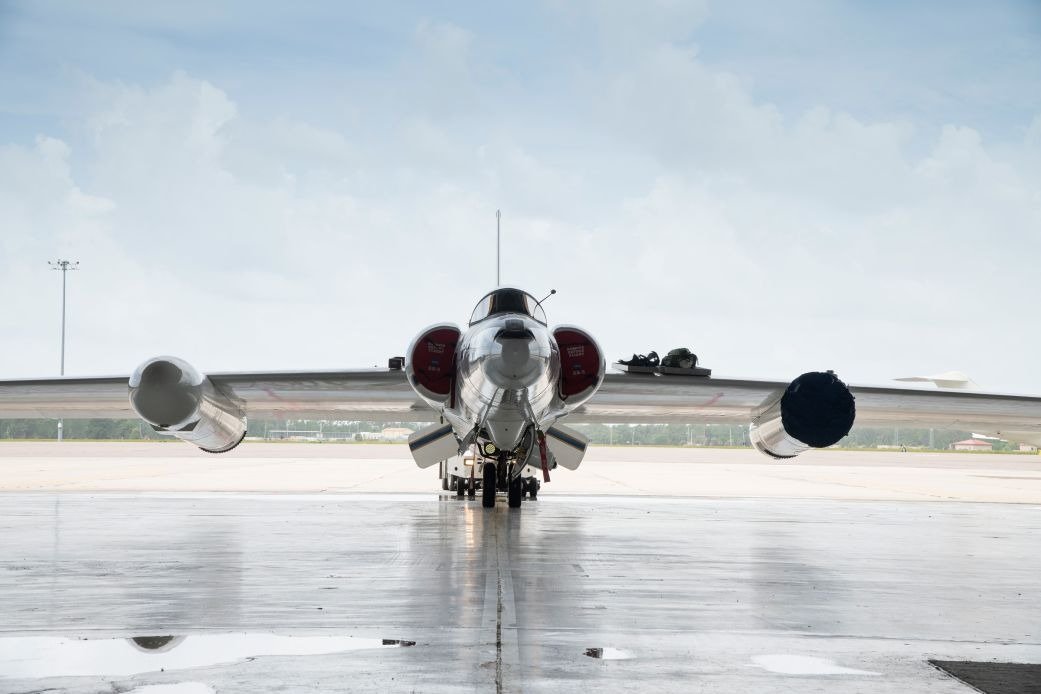
NASA is currently utilizing a modified version of the iconic Cold War-era U-2 spy plane to investigate one of the most enigmatic and least understood weather phenomena on Earth: storms generated by wildfires. Known as the ER-2, this aircraft has been repurposed as a high-altitude flying laboratory, replacing traditional military defenses with a suite of advanced scientific instruments and specialized wiring to conduct atmospheric research.
The aircraft’s primary objective is to study pyrocumulonimbus storms, which are massive, dangerous thunderstorms produced by the intense heat of wildfires. These extreme weather systems are capable of generating their own lightning, powerful winds, and, in certain conditions, fire tornadoes. David A. Peterson, a meteorologist at the Naval Research Laboratory and principal investigator for NASA’s INjected Smoke and PYRocumulonimbus Experiment (INSPYRE), describes the mechanism as a chimney-like effect where smoke is thrust upward into a thunderstorm, accelerated through a vertical column, and eventually released.
According to Peterson, the generated smoke column functions as a warm bubble that triggers the thunderstorm. It behaves like any other severe, tall thunderstorm cloud, but the addition of smoke creates a unique feedback loop where the fire essentially feeds itself. Meteorologists have historically struggled to properly forecast these pyrocumulonimbus storms because they form under highly unpredictable conditions. Scientists have only recently discovered that these fire-generated systems can breach the natural atmospheric barrier to reach the stratosphere, creating a volcano-like effect that allows smoke to be transported rapidly across the globe by jet stream winds.
The INSPYRE mission, which commenced flight operations in July, has already conducted sorties over active wildfires in northern Oregon and western Canada. NASA, which balances its mandate for aeronautics research with space exploration, relies on the ER-2 because of its exceptional high-altitude capabilities. Peterson notes that the aircraft acts as a steerable satellite, flying above the weather at approximately 65,000 feet, allowing researchers to orbit back and forth over a wildfire to collect precise data on plume energetics, air motion, and lightning activity.
To gain a comprehensive view, NASA is simultaneously operating a Gulfstream 5 jet inside the storm clouds while the ER-2 monitors from above. “The idea is that the data they collect can inform each other,” Peterson explained. By having the G-5 positioned directly within the clouds, researchers can correlate in-situ measurements with the remote sensing data provided by the ER-2, creating a multi-layered understanding of the storm’s structure. This data integration is critical for the mission’s ultimate goal: developing the capability to accurately predict these erratic fire-driven storms.
The ER-2’s lineage is deeply rooted in the mid-1950s, a period before the advent of spy satellites when the United States required a platform to monitor activities behind the Iron Curtain. The National Museum of the United States Air Force notes that during the early 1950s, Soviet military and economic developments were a mystery to the US due to the USSR’s status as a secretive, closed society. The U-2, nicknamed the “Dragon Lady,” was specifically engineered to fly at extreme altitudes to capture intelligence over the Soviet Union.
Although a U-2 piloted by Francis Gary Powers was shot down on May 1, 1960—proving that the US had underestimated Soviet defensive capabilities—the aircraft remained a vital intelligence asset throughout the Cold War, the Cuban Missile Crisis, the Vietnam War, and subsequent conflicts in Iraq and Afghanistan. More than 70 years after its first flight, the “Dragon Lady” continues to serve a vital role. Today, NASA’s ER-2 is in the air working to defeat what researchers call the “fire-breathing dragon of clouds,” using legacy technology to solve modern environmental challenges. The report also notes that and so it can inform the radars that are seeing the cloud and then relate that to what the airborne satellite, is telling you.”, the G-5 is directly in the clouds. The report also notes that “We’re both using tools that are just being developed now by some of our science team members to help guide the mission, but we’re also using the mission to help feed back to improve those prediction tools,” Peterson sai. The report also notes that “There will inevitably be a component of the mission where we produce better tools to predict this type of fire behavior.”. The report also notes that so, there’s radars that can tell you how big the plume is, the altitude it’s at, and then also the air motion within it. The report also notes that “We’re both using tools that are just being developed now by some of our science team members to help guide the mission, but we’re also using the mission to help feed back to improve those prediction tools,” Peterson said.