

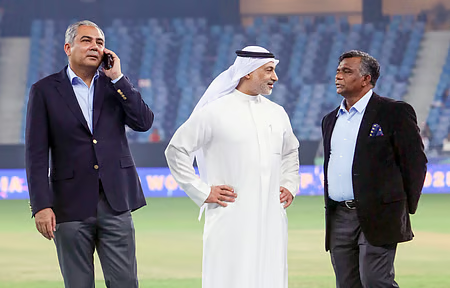
In a repeat of the controversy surrounding the 2025 Men’s T20 Asia Cup, the Indian women’s cricket team declined to accept their trophy from Asian Cricket Council (ACC) President Mohsin Naqvi on Sunday. The incident occurred at the Dubai International Cricket Stadium shortly after Harmanpreet Kaur’s side secured a dominant 72-run victory over Sri Lanka, marking India’s record-extending eighth Women’s Asia Cup title.
The standoff mirrors the events of the 2025 Men’s tournament, where the Indian squad, led by Suryakumar Yadav, also refused to receive the trophy from Naqvi after defeating Pakistan. The primary point of contention is Naqvi’s dual role; he serves as the ACC president while simultaneously holding high-ranking political and administrative positions in Pakistan, including Minister of Interior and Chairman of the Pakistan Cricket Board (PCB).
The Board of Control for Cricket in India (BCCI) has maintained a firm stance that its players should not accept accolades from a senior official who is also a prominent political figure in Pakistan, citing ongoing political tensions between the two nations. This position was formally communicated to the ACC by the BCCI ahead of Sunday’s final, rendering the subsequent refusal a calculated and anticipated move.
Despite the foreknowledge that another presentation issue might arise, Naqvi remained on the podium in his official capacity as head of the regional governing body. While he did participate in the ceremony by presenting the runners-up cheque to Sri Lanka captain Chamari Athapaththu, the Indian team notably did not emerge to claim their trophy from him.
India women’s coach Amol Mazumdar addressed the situation following the match, confirming that the team was acting in accordance with the BCCI’s established policy regarding the presentation of trophies by Naqvi. He stated clearly, “We stand by BCCI’s decision not to receive the trophy,” reaffirming the board’s protocol.
The recurring nature of these trophy incidents—occurring at the same venue and under identical circumstances—has drawn significant attention to the friction between the two cricketing boards. As a result, the controversy has once again overshadowed the team’s historic athletic achievement on the field.
With the 2026 Women’s T20 Asia Cup concluding in such a manner, the underlying tensions within the ACC leadership structure continue to impact high-profile tournament protocols. Analysts had speculated about this possibility in the days leading up to the final, as the climate surrounding such diplomatic gestures remains sensitive.
While Naqvi’s presence was consistent with his duties as the president of the continental organization, the divergence in expectations between the BCCI and the ACC remains unaddressed. The incident underscores a persistent diplomatic impasse that has left the sport’s presentation ceremonies in an awkward position whenever India emerges victorious in events hosted under the council’s banner. The report also notes that so the obvious question is: why was Naqvi there again.