

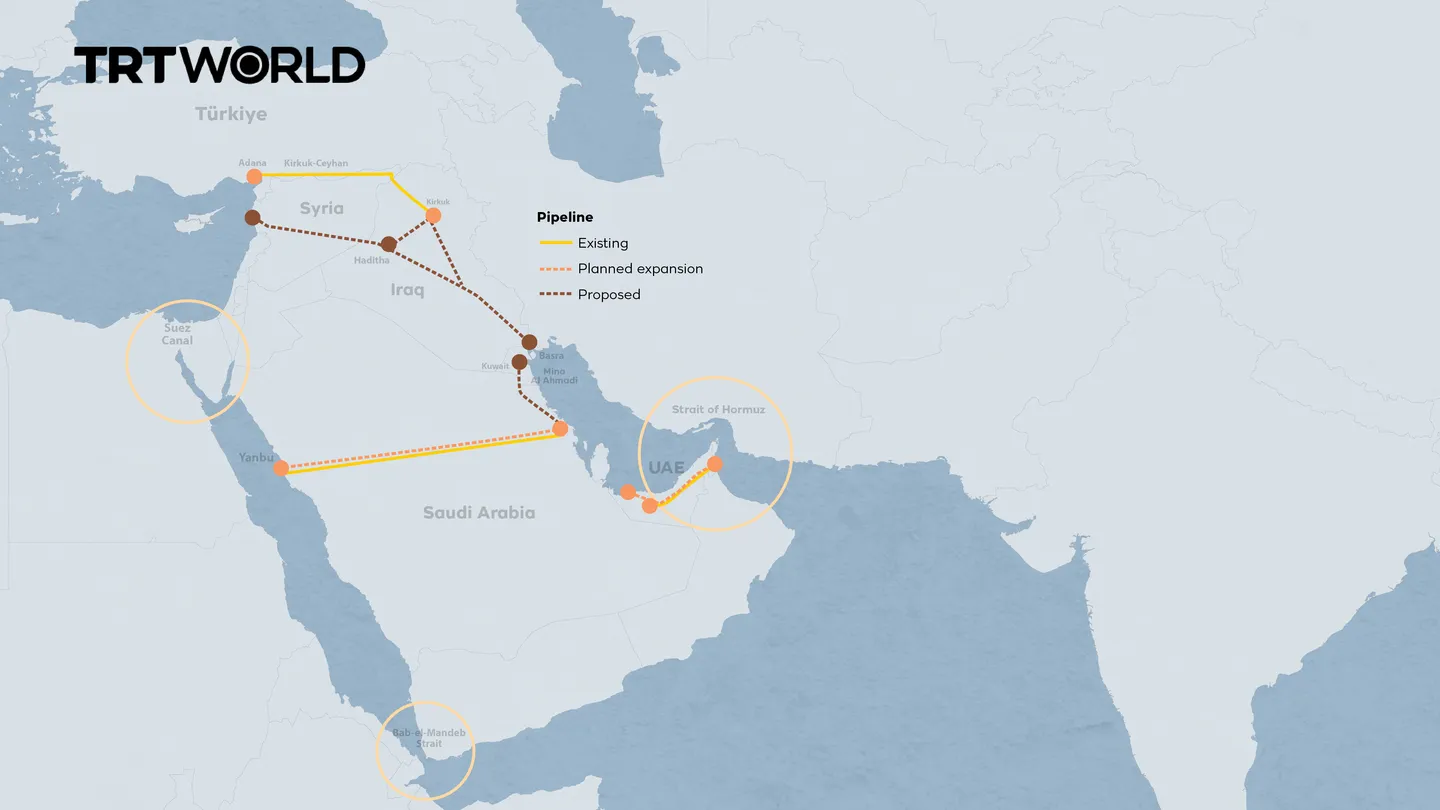
As Washington seeks ways to navigate the persistent Gulf standoff, countries across the Middle East are increasingly looking beyond the Strait of Hormuz. From Saudi Arabia and the United Arab Emirates to Iraq, Syria, and Türkiye, governments are exploring alternative land routes and pipelines capable of securing energy exports against potential maritime blockades. Analysts suggest that if the crisis persists, this gradual shift towards these corridors could weaken Iran’s leverage over global energy markets while reshaping the political and economic geography of the region.
Dania Koleilat Khatib, an expert in US-Arab relations and co-founder of the Research Center for Cooperation and Peace Building, suggests that the ongoing crisis is fundamentally altering the regional landscape. “Hormuz will become less and less important,” Khatib tells. She emphasizes that the United States is actively encouraging these alternative routes because regional states no longer want to be subject to Iranian pressure. “It’s much better to have alternative routes than to have a fight with Iran on Hormuz because the military conflict with Iran does not guarantee any concrete result even with the US involvement,” she says.
The region is not starting from scratch. Saudi Arabia and the UAE already operate pipelines that allow part of their oil exports to bypass the Strait of Hormuz, with a combined capacity of nearly 10 million barrels per day—roughly half the volume that passed through the waterway before the current crisis. Saudi Arabia’s East-West pipeline transports crude from the kingdom’s eastern oil fields to the Red Sea port of Yanbu, providing Riyadh with an alternative export route that avoids the Gulf. This pipeline can transport between 1.5 and 1.8 million barrels per day.
The UAE has also invested in bypass infrastructure through the Habshan-Fujairah pipeline, which links Abu Dhabi’s oil fields to the Gulf of Oman. However, neither country considers its existing infrastructure sufficient. Saudi Arabia is currently considering expanding its pipeline network to connect with neighbouring Gulf producers or building new export routes to increase capacity. “Several of the best alternatives for crude oil—Saudi Arabia’s East-West Pipeline, the UAE’s Habshan-Fujairah line—have performed well despite being within range of Iran’s weapons, though that could change any time,” notes Chris Newton, a senior analyst at Inter-Regional Analysis.
Not every Gulf state has the same room to manoeuvre. Unlike Saudi Arabia and the UAE, countries like Kuwait, Bahrain, and Qatar lack alternative export routes that bypass the Strait of Hormuz, leaving them vulnerable to maritime disruptions. Analysts suggest these nations may eventually have to rely on Saudi or Emirati infrastructure to keep their energy exports flowing. Qatar faces particular challenges because its economy depends heavily on liquefied natural gas, which is significantly harder to reroute than crude oil. “Crude oil can probably be rerouted the most in the short-term, but other commodities like LNG less so,” Newton explains.
Beyond the Gulf, Iraq is aggressively pursuing new corridors. In the wake of Hormuz tensions, Baghdad has launched the Basra-Haditha pipeline project with a planned capacity of 2.5 million barrels per day. This project aims to transport crude oil to Syria’s Baniyas and Türkiye’s Ceyhan in the Mediterranean. “From Syria’s perspective, we are very much looking forward to such a project,” officials have indicated, noting the potential for regional integration. Furthermore, Ankara and Baghdad continue to operate the 970-kilometre Kirkuk-Ceyhan oil pipeline, which remains Iraq’s largest crude export route with a capacity of up to 1.5 million bpd.
The strategic implications of these projects extend far beyond local energy security. Experts argue that these routes would influence commercial relationships extending outside the region. If more Gulf energy flows to the Mediterranean, it brings supplies closer to key European consumers. However, the value of the Suez Canal and Egypt’s revenue could fluctuate depending on the specific corridors that are completed and how they affect global ship traffic. While the complete bypassing of the Strait of Hormuz remains an unlikely prospect given that 80 percent of global commerce still moves by sea, the shift is undeniable.
“They want overland routes to do the work that the ocean does,” says analyst Greg Bruno. Although developing these alternative corridors could cost between $50 million and $100 million and take years to complete, proponents argue that the investment serves as a vital signal to global markets. By demonstrating that the region is no longer solely dependent on a single, vulnerable maritime chokepoint, these nations hope to stabilize energy prices and reduce the risk of economic blackmail.
“The US will also encourage alternative routes and the Middle East will turn to alternative corridors because the region does not want to be subject to Iran’s blackmail,” Khatib adds. This sentiment is driving a flurry of diplomatic activity, including recent talks between Syria and Iraq regarding energy transit. The shift is not merely about logistics; it is a calculated move to dilute the strategic value of the Strait of Hormuz, thereby weakening Iran’s ability to threaten the global economy through its control of the waterway.
During the current period of conflict, Iran has targeted both UAE and Saudi oil facilities from Fujairah to Yanbu, signalling that even the safety of land-based infrastructure is not guaranteed. Despite these risks, the drive for diversification continues. Analysts believe that if the value of Hormuz were reduced, Iran’s leverage over the region and the global economy would weaken to the extent that it would be unable to effectively threaten the new alternatives.
Ultimately, the success of these projects depends on regional cooperation and long-term political stability. As countries like Türkiye, Iraq, and the Gulf states align their infrastructure goals, the traditional reliance on the Strait of Hormuz is being systematically challenged. While the transition will be costly and technically complex, the consensus among regional planners is that the status quo is no longer sustainable in an era of heightened geopolitical volatility.
The ongoing development of these corridors reflects a broader trend of Middle Eastern states seeking greater autonomy in their economic and security affairs. By building a network of pipelines and land routes, these nations are creating a more resilient energy architecture. As these projects move from planning to implementation, the geopolitical map of the Middle East is likely to undergo a significant, long-term transformation.
Besides the Syria-Iraq talks, Ankara and Baghdad, the two neighbours that have operated the 970-kilometre Kirkuk-Ceyhan oil pipeline from central Iraq to Türkiye’s Mediterranean coast for decades, have recently signed a
Türkiye and Saudi Arabia, the two heavyweights of the Middle East alongside Pakistan, have recently signed a military pact signalling their intention to develop alternative strategic avenues to defend regional interests with indigenous forces against any potential threat from Israel, Iran or any outsiders.
It would represent a global commitment to Syria, to its recovery, and to its strategic importance, turning our country into a major regional corridor,” Omar Alhariri, a Syrian journalist and political analyst, says.
The key point is that there would be a Plan B,” he said.
“It is important to take this strategic card out of Iran’s hands, because Tehran fully understands the leverage and importance of controlling such a critical chokepoint.”
Besides the Syria-Iraq talks, Ankara and Baghdad, the two neighbours that have operated the 970-kilometre Kirkuk-Ceyhan oil pipeline from central Iraq to Türkiye’s Mediterranean coast for decades, have recently signed a deal allowing crude to flow to global markets.
“The diversion of a certain volume of oil flow to those corridors is expected to shift the current concentration of power toward the countries hosting these projects,” Rasim Ozcan, professor of economics at Istanbul University, tells.
Since reaching a capacity significant enough to substantially alter the status quo—if achievable at all—would take years,” Ozcan adds, warning that no one should expect quick political results from these alternatives in the near term.
“Some of these new corridors would require reworking political relationships and tying some actors together in the long-term – like Gulf exporters with Yemen and Syria, and potentially give greater geopolitical leverage to anyone able to pose a credible threat to the alternatives, maybe even some smaller groups,” Newton says.
Analysts warn that new pipelines, railways and highways could simply create new targets for Iran and its regional allies, including the Houthis in Yemen and Iran-backed armed groups in Iraq.
“The matter here is less one of logistics as it is one of geopolitics.