

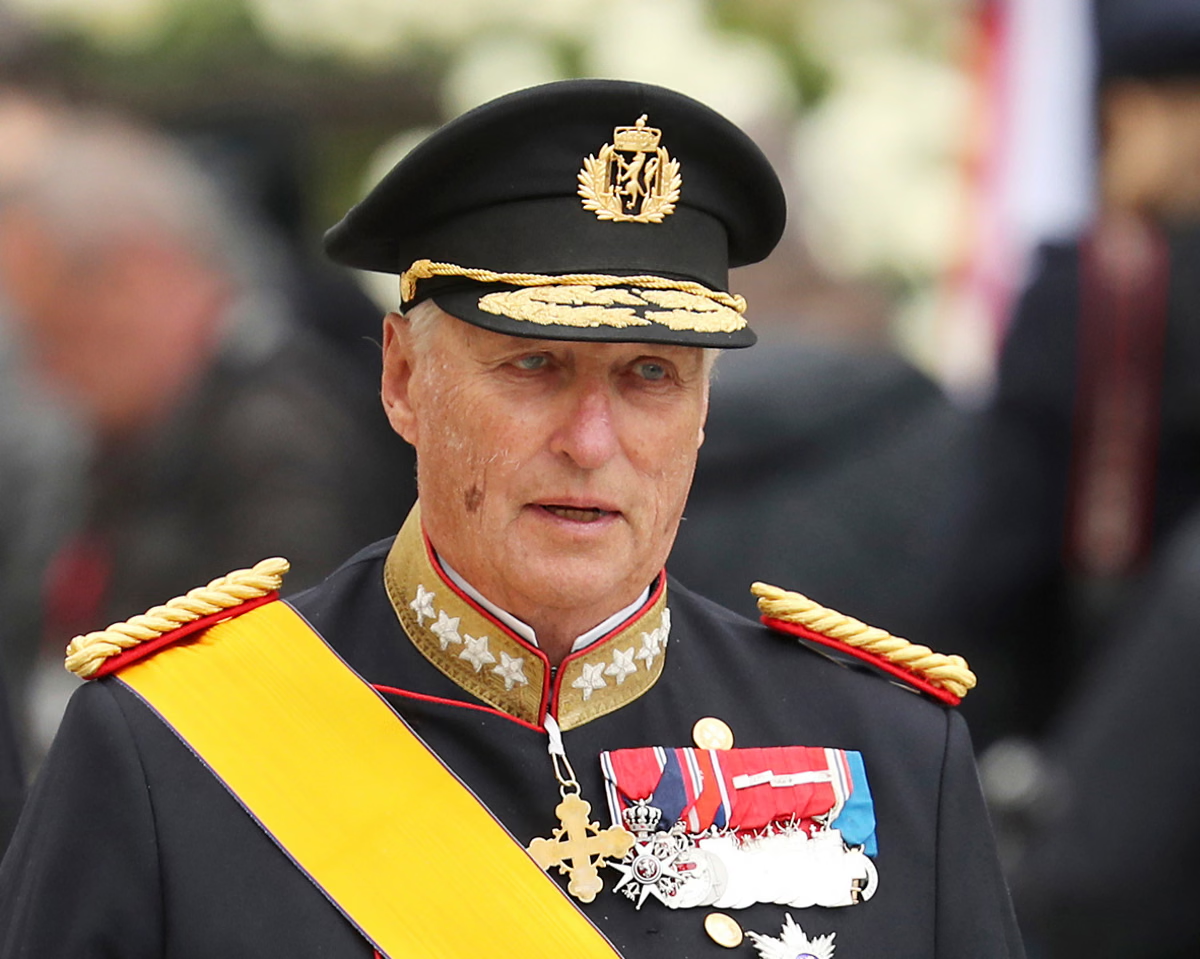
King Harald V of Norway, the longest-serving monarch in Europe, has died at the age of 89. As the third king since Norway regained independence from Sweden in 1905, his reign was marked by a transition toward greater transparency and public engagement. Although he served as the head of the Lutheran state church until 2012 and held a constitutionally “holy” status until 2018, he was widely admired for his approachable demeanor, which earned him the title of Norway’s person of the year in 2017.
Born in 1937, Harald was the first Norwegian king to be born within the country since 1370. His lineage was deeply international, connecting him to the Swedish and British royal families. His parents were King Olav V and Princess Märtha of Sweden, while his grandparents were King Haakon VII and Queen Maud, the daughter of Britain’s Edward VII. Reflecting on his complex heritage, he once remarked, “It is not easy to say where we come from. Home is where the heart is.” His family roots in the Glücksburg dynasty mirrored those of the Duke of Edinburgh and the former Greek royal family.
Harald’s early life was defined by the upheaval of World War II. At age three, he fled the Nazi invasion of Norway, eventually finding refuge in Washington, D.C., where he spent the war years. His father and grandfather led the government-in-exile from London, where King Haakon VII famously encountered a BBC receptionist who asked, “Where did you say you were king of, dear?” Following the war, Harald returned to Norway, eventually studying at Oslo University and Balliol College, Oxford. A dedicated athlete, he represented Norway in sailing at the 1964, 1968, and 1972 Olympics and earned world championship medals.
In 1968, Harald broke with tradition by marrying Sonja Haraldsen, a commoner and daughter of a textile manufacturer. He had maintained the relationship for years, eventually telling his father that he would remain unmarried if he could not wed her, a move that would have ended the dynasty. Upon ascending the throne in 1991, Harald worked to modernize the monarchy, opening royal palaces and estates to the public. The Norwegian parliament continues to debate the monarchy’s future every four years, with a recent vote of 141 to 26 in favor of its continuation.
The King was a source of national stability during the 2011 terror attacks by Anders Behring Breivik, which claimed 77 lives. His public displays of grief and calls for national solidarity were widely praised. In his later years, Harald faced several health challenges, including bladder cancer in 2003, a Covid-19 infection, the installation of a pacemaker in 2024, and treatment for haemolytic anaemia.
He is survived by Queen Sonja and their children, Princess Märtha Louise and Crown Prince Haakon. The royal family has faced recent scrutiny, including an apology from Haakon’s wife, Mette-Marit, regarding her past contact with convicted sex offender Jeffrey Epstein, though the King stated she had not broken any law. Additionally, Mette-Marit’s son, Marius, was sentenced to four years in prison this June for drug and assault offenses. Crown Prince Haakon now succeeds his father as King Haakon VIII, adopting the traditional royal motto: “All for Norway.” The report also notes that he did exhibit the Scandinavian moderation, stoicism and genial approachabilit, although he ceased to be head of the Lutheran state church in 2012 and subsequently lost his constitutional status as “holy” six years later. The report also notes that who was king as Olav V between 1957 and 1991, and his wife, Princess Märtha, a member of the Swedish royal dynasty, his parents were Crown Prince Olav. The report also notes that the first king of the independent country, who reigned for 52 years from 1905, and his wife, Queen Maud, daughter of Britain’s Edward VII, his grandparents were King Haakon VII. The report also notes that he was Queen Elizabeth II’s second cousin and a knight of the garter. The report also notes that at the time of his birth, Harald was 16th in line to the British throne, though he had fallen in the rankings to around 80th in more recent years. The report also notes that confusingly, he was not the fifth Harald to rule his country, but the sixth – the 10th-century Harald Bluetooth generally not being assigned a number in the list of Norwegian kings. The report also notes that the king never attracted a picturesque title as did some of his Viking predecessors – such as Bluetooth, Harald Fairhair and Harald Hardrada, who tried to seize the English throne a few weeks before the Norman invasion in 1066 and was killed at the battle of Stamford Bridge.