

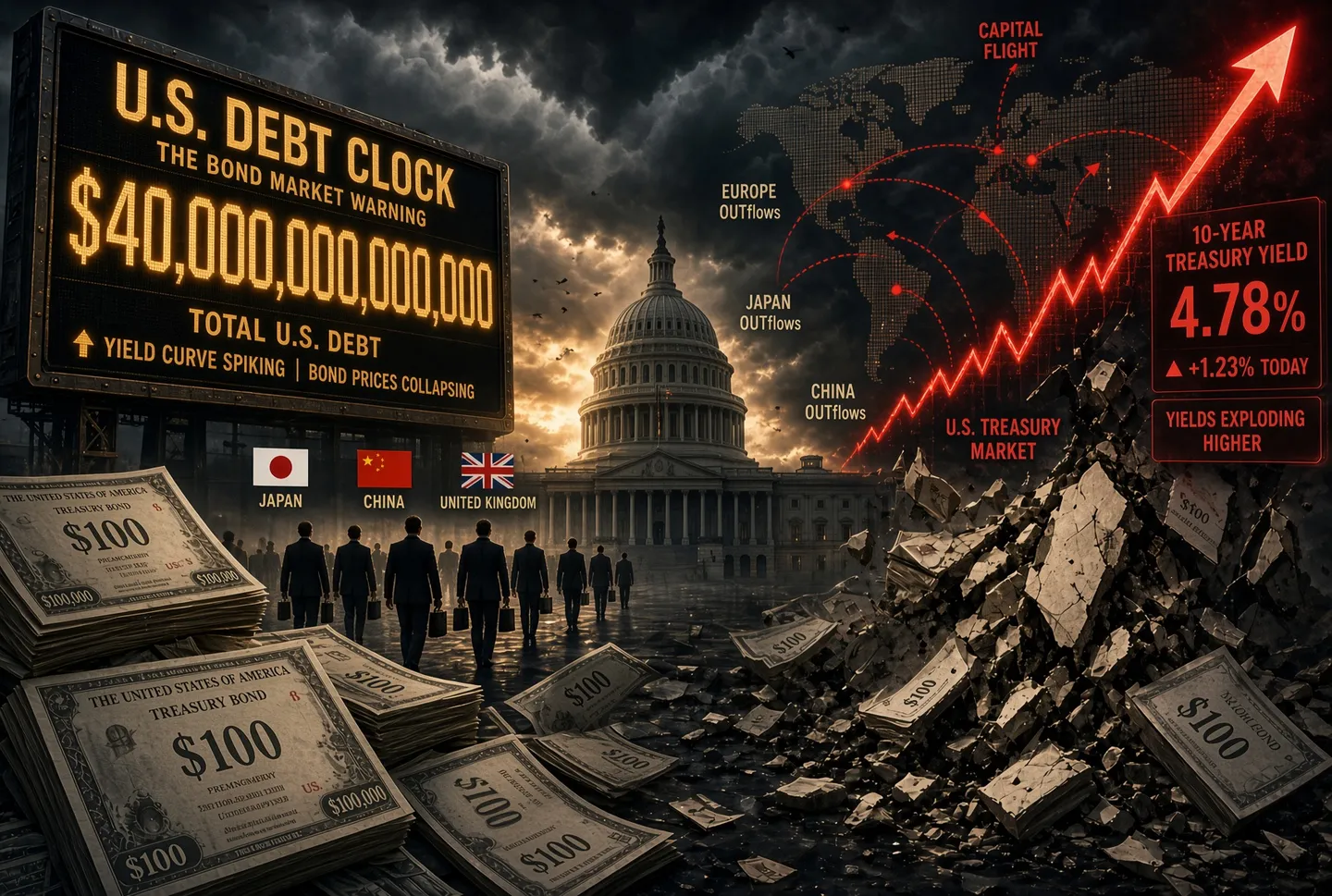
The United States Treasury market, long considered the bedrock of global financial stability, is currently signaling significant investor anxiety. As Washington’s national debt exceeds a record $40 trillion, major international creditors—including Japan, China, and the United Kingdom—have begun reducing their holdings. This shift comes as borrowing costs reach their highest levels in nearly two decades, creating a complex economic environment that extends far beyond American borders.
Treasury bonds function as the government’s IOUs, serving as a benchmark for global interest rates because of the United States’ history of consistent repayment. However, the current sell-off is altering this dynamic. When investors sell these bonds, prices drop and yields rise. For instance, if a $100 bond paying $5 in interest drops to $90 in market value, the yield for a new buyer increases from 5% to approximately 5.6%. Sustained high yields force the US government to offer more attractive returns when issuing new debt, effectively increasing the cost of servicing its massive obligations.
Foreign divestment has been notable, with holdings falling throughout June. Japan and China, the two largest overseas holders, have been particularly active; in March alone, they offloaded $47.7 billion and $41 billion, respectively. The motivations behind these sales vary. In Japan, private institutions like pension funds and insurers are shifting capital toward domestic bonds. Meanwhile, the Bank of Japan has been forced to intervene due to a weakened yen and rising oil costs linked to the conflict in Iran. China’s reductions are largely driven by state-level reserve strategies, while some of the decline attributed to the UK reflects London’s status as a global custody hub for various international funds.
A primary driver for this global retreat is the significant paper loss experienced by foreign holders. In March alone, foreign investors saw their existing Treasury holdings lose $142.1 billion in value as yields climbed. Compounded by concerns over domestic inflation and the sheer scale of US debt, many investors are viewing alternative assets as safer bets. The situation is further complicated by the fact that the traditional flight-to-safety pattern has broken; when the US and Israel engaged in military action against Iran on February 28, Treasury yields rose rather than falling.
In response to these pressures, the US Treasury has intensified its bond buyback program. On August 19, Treasury Secretary Scott Bessent announced that the department would more than double the scale of these operations, increasing them from $2 billion to at least $4 billion per cycle, effective from September 9 through November 4. Additionally, Washington has intervened in currency markets to support the yen, aiming to alleviate the pressure on Japan to sell its US debt holdings.
Despite these interventions, market analysts remain skeptical about their long-term efficacy. Joseph Brusuelas, chief economist at RSM US LLP, described the buyback as a “temporary salve to an open financial wound,” noting that it fails to address the underlying issues of inflation, the high borrowing demands of the AI sector, and the sheer volume of national debt. Fixed-income manager Kelsey Berro echoed this sentiment, telling CNBC that lower yields cannot be sustained without fundamental support. Furthermore, the Treasury’s own advisory panel has previously cautioned against using buybacks as a primary tool for debt management.
The fiscal outlook remains challenging. Total federal debt reached $40.047 trillion on August 18, more than double the 2017 figure. While the market-traded portion of this debt is closer to $32 trillion, the cost of interest has surged to over $1 trillion annually, surpassing Medicare as the government’s second-largest expense. The Peterson Foundation attributes this accumulation to a combination of long-term tax cuts, war and healthcare spending since 2001, emergency expenditures during the 2008 financial crisis and the Covid-19 pandemic, and the needs of an aging population. Recent pressures, including war spending related to Iran and a wave of tariff refunds following a Supreme Court ruling, have added further strain.
While most economists agree that the US is not facing imminent bankruptcy—largely because it borrows in its own currency—some experts are sounding alarms. Professors such as Johns Hopkins’ Steve Hanke and former Comptroller General David Walker have argued that the nation is effectively insolvent. The Committee for a Responsible Federal Budget suggests the primary risk is not a sudden default, but rather a “slow decay” characterized by rising costs and shrinking policy options. With the Congressional Budget Office estimating that debt could reach $63 trillion by 2036, the market’s current warning reflects deep-seated concerns about the sustainability of America’s fiscal trajectory. The report also notes that what the US is doing about it, and why it matters well beyond America’s borders, here’s what’s driving it. The report also notes that goods, or services to another), treasury bonds are simply the US government’s IOUs (I Owe You – a simple written acknowledgement that someone owes money. The report also notes that these IOUs are considered among the safest investments on earth, because the US has never missed a payment. The report also notes that a yield of 5%, say a bond has a face value of $100 and pays $5 a year in interest. The report also notes that offloading $47.7B and $41B, respectively, japan and China had already sold heavily in March. The report also notes that since official data groups together very different actors, it helps to be precise about who is actually selling.