

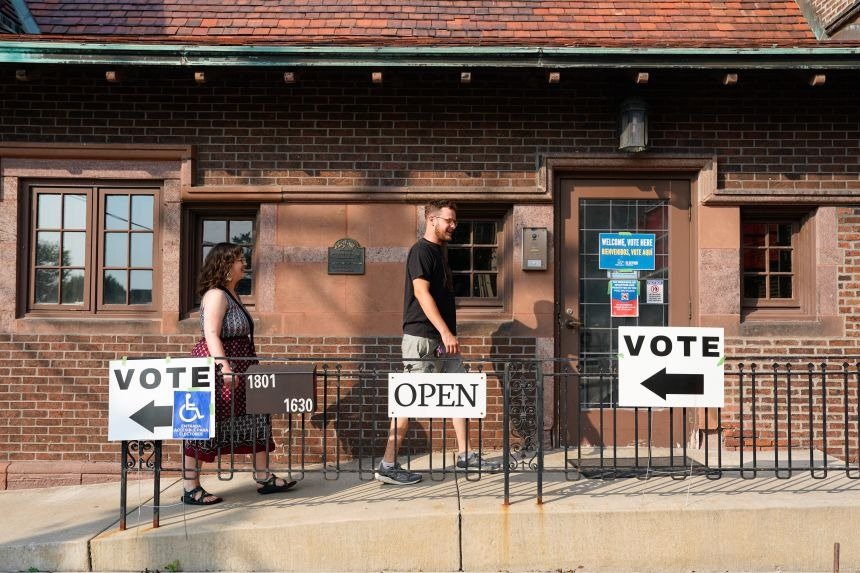
The Democratic establishment saw a significant resurgence in Wisconsin this Tuesday, as party voters coalesced around Milwaukee County Executive David Crowley to defeat democratic socialist Francesca Hong in the gubernatorial primary. Decision Desk projected a narrow victory for Crowley, who had previously exited the race only to re-enter following the withdrawal of another prominent candidate. This outcome reflects a strategic shift among primary voters in a critical battleground state, driven by concerns that Hong might struggle to secure a general election victory against Republican Representative Tom Tiffany.
Governor Tony Evers played a pivotal role in the final days of the campaign, rallying support for Crowley. Voter sentiment in recent interviews suggested that Hong’s campaign faced hurdles following several television appearances, including a notable interview where she provided a meandering response regarding a 2020 social media post in which she suggested canceling Thanksgiving. The race served as a broader test of the party’s ideological direction, questioning whether the progressive momentum seen in deep-blue districts could successfully translate into swing-state victories.
The primary season has proven challenging for the party’s left wing, which has struggled to demonstrate electoral viability beyond urban strongholds. For the second consecutive week, progressive candidates faced intense competition; last week, Abdul El-Sayed won the Michigan Democratic Senate primary by a razor-thin margin. While polling in primary elections remains notoriously difficult due to unpredictable voter turnout, the late consolidation behind Crowley—following a July Marquette Law School poll that placed him at 11% compared to Hong’s 46%—suggests that voters increasingly prioritized electability as the contest narrowed.
In Minnesota, progressives achieved a notable victory as Lieutenant Governor Peggy Flanagan defeated moderate Representative Angie Craig in the Democratic Senate primary, aiming to succeed retiring Senator Tina Smith. Flanagan’s campaign focused on criticizing Craig’s financial ties to the American Israel Public Affairs Committee and her support for the Laken Riley Act, which mandates the detention of certain migrants. Unlike the Wisconsin race, Flanagan did not face significant electability concerns and secured endorsements from Senators Bernie Sanders and Elizabeth Warren. She now advances to the general election as a heavy favorite against first-time candidate and former NFL broadcaster Michele Tafoya. Additionally, former state senator Matt Little won a crowded primary for the 2nd District House seat being vacated by Craig.
South Carolina’s Republican special primary for a full Senate term saw Darline Graham secure first place with approximately one-third of the vote, leveraging President Donald Trump’s endorsement. However, her failure to reach a majority forces her into a runoff against Representative Ralph Norman. Graham’s performance is statistically significant, as she is currently far from the 50%-plus-one threshold typically seen by successful Trump-backed candidates. Her position mirrors that of Lieutenant Governor Pam Evette, who lost by 37 points in a June runoff after failing to consolidate support in the initial primary.
Representative Norman, a leader of the House Freedom Caucus, enters the runoff with strong conservative credentials, though he faces potential friction due to his 2024 decision to support former Governor Nikki Haley over Trump. Norman has maintained that his choice was based on personal ties, stating, “My record is an open book.” The runoff will be a critical test for the Trump-endorsed slate, which has seen a string of recent losses, including Mike Lindell’s defeat in the Minnesota GOP gubernatorial primary to state House Speaker Lisa Demuth marked the third loss for a Trump-backed candidate in just over a week.
The broader trend of primary losses for Trump-endorsed candidates has reached seven for the current season, including five individuals who sought statewide office. This includes the August 4 defeat of Michigan congressional candidate Amir Hassan by Tom Smith, and the loss of incumbent Representative Andy Ogles to former Tennessee Agriculture Commissioner Charlie Hatcher last Thursday. As these races conclude, the focus shifts to how these internal party dynamics will influence the upcoming November general election landscape. The report also notes that in interviews in recent days, Democratic voters in the state said Hong’s stumbles in television interviews — including a interview in which she gave a meandering answer when asked about a 2020 tweet in which she advo. The report also notes that and Crowley at 11%, mandela Barnes at 21%. The report also notes that the issue of immigration enforcement became a flashpoint in Minnesota after federal agents shot and killed two US citizens who were protesting mass deportation efforts there in January. The report also notes that in interviews in recent days, Democratic voters in the state said Hong’s stumbles in television interviews — including a interview in which she gave a meandering answer when asked about a 2020 tweet in which she advocated for canceling Thanksgiving — as they explained their worries about the 37-year-old state lawmaker and former restaurant owner’s electability. The report also notes that its candidate had a dogfight on their hands, but for the second straight week. The report also notes that and perhaps some voters were convinced those votes would be too risky, democratic leaders have worried greatly about nominating both El-Sayed and Hong. The report also notes that because the universe of voters isn’t as predictable, polling primary elections is also more difficult than general elections. The report also notes that urban voters (who favor more left-wing candidates) and under-sampling more rural, blue-collar ones, and there is some thought that these surveys might be over-sampling more-educated.