

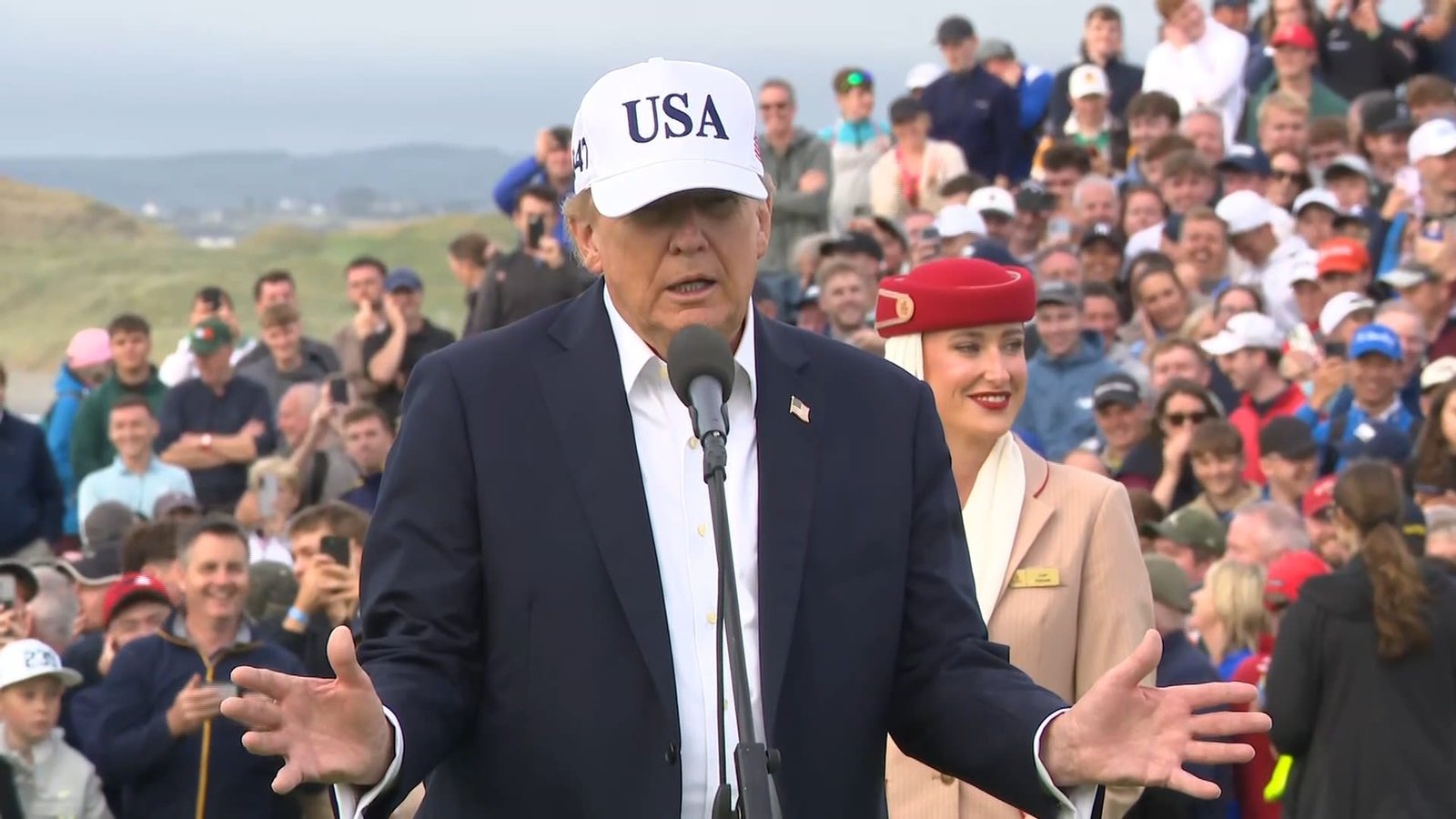
While visiting his golf resort in Doonbeg, Donald Trump announced his decision to eliminate the 10% tariff currently imposed on Irish whiskey. This trade barrier had previously been enacted by the Trump administration as part of a broader set of tariffs targeting goods imported from the European Union.
Trump described the policy shift as a response to persistent requests from Irish officials, including Taoiseach Micheál Martin, and those involved in the Irish Open. During the trophy presentation, Trump recalled being frequently urged to address the issue, noting, “Would you do me a favor? It’s so unfair what’s going on. Could you possibly take the tariffs off of Irish whiskey?” He then told the crowd that, on behalf of the United States, he would move to remove the duties.
The announcement follows a similar trade concession granted in April, when the administration removed tariffs on spirits from the United Kingdom, including Scotch, following a state visit by King Charles and Queen Camilla. Although the US trade representative has yet to provide a specific timeline for the change, industry representatives have reacted positively. Chris Swonger, CEO of the Distilled Spirits Council of the United States, described the decision as a significant step toward reducing international trade barriers.
Irish government officials also praised the development. Simon Harris, the deputy prime minister and minister of finance, characterized the removal as an economically significant move that reflects the constructive dialogue held between the two nations regarding trade over the past 18 months. Taoiseach Micheál Martin echoed these sentiments, highlighting the enduring ties between Ireland and the United States, and praising the Trump family’s substantial investment in the Doonbeg golf facility.
Businesses in the spirits sector are anticipating a tangible impact. Michael Delahunty, manager of Dublin’s Temple Bar, labeled the decision “fantastic” for commerce, noting that the removal of tariffs will help bolster exports to the American market. Delahunty emphasized that the bond between American consumers and Irish whiskey is mutually beneficial, noting that Irish drinkers hold a similar appreciation for American bourbons.
The weekend visit proved eventful, as Trump’s time in Ireland was marked by both professional engagements and political controversy. While his Sunday trophy presentation at the Irish Open drew cheers from members, his Saturday meetings in Dublin were overshadowed by comments supporting Irish unification. Throughout his stay, security measures were high, and his presence drew protests in parts of Dublin as well as the Shannon and Doonbeg regions.
Trump expressed satisfaction with the trip, describing Ireland as an incredibly inviting place and noting his pride in the development of his golf property. As he concluded his visit, he reaffirmed his commitment to the bilateral relationship with Ireland, stating that the economic and diplomatic connections between the two countries would continue to grow stronger. The report also notes that “We export a lot to America,” he said. “It’s good for us, good for business, great for Irish whiskey as a whole.”. The report also notes that “The Trump family in particular have invested very heavily in the recent decade in this golf course, making it an exceptional and one of the great key golf courses now anywhere in the world,” Martin said of Doonbeg, and. The report also notes that on foreign land but home turf, Donald Trump presented the Irish Open trophy to Shane Lowry at the president’s Doonbeg golf course. The report also notes that and Shane talked about it, and everybody’s been bugging me, taoiseach and I talked about it. The report also notes that while not a drinker himself, Trump presented the show of good faith at the end of his quick visit to Ireland — where he made controversial comments voicing support for Irish unification, met with Irish President Catherine Connolly and Taoiseach Micheál Martin, and became the first sitting president to attend the Irish Open.