

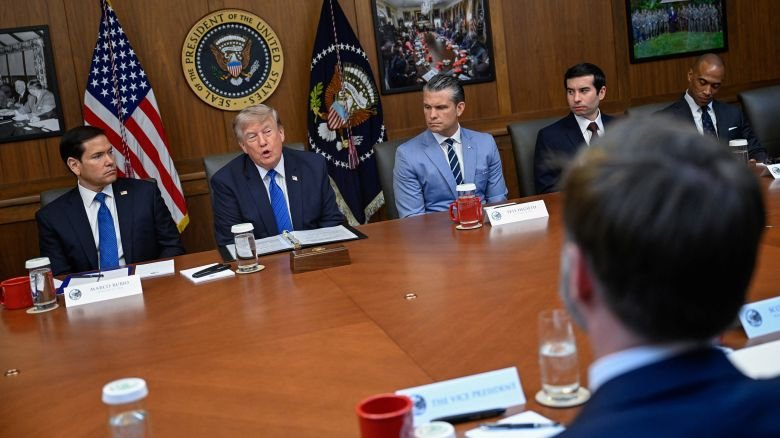
CNN’s ongoing fact-checking initiative maintains a rigorous focus on holding political figures and candidates accountable by scrutinizing their public statements. Recent investigations have highlighted a persistent pattern of false or unsubstantiated claims across various policy areas, ranging from international conflicts to domestic economic issues. A significant portion of recent reporting addresses claims made by Donald Trump, including his baseless allegation that Tim Walz was behind a cyberattack, a claim repeated during a recent Cabinet meeting despite being previously debunked.
Further scrutiny was applied to Trump’s remarks at the White House Correspondents’ Dinner, a NATO press conference, and a meeting with Erdogan, where multiple false statements were identified. Fact-checkers also addressed his fabricated stories regarding George Washington and the Panama Canal. In another instance, Italy’s prime minister refuted a story Trump told about her supposedly begging him for favors, adding to a growing list of anecdotes that lack any basis in reality.
The Iran war has become a focal point for misinformation. Four key claims Trump made regarding the conflict have fallen apart under examination, including his false assertion that the inflation rate was just 1.7% prior to the war. Furthermore, Trump falsely claimed that Pope Leo suggested Iran could possess a nuclear weapon. Despite denying a specific remark about Iran on one day, records show he made the exact statement on camera just 24 hours earlier, contributing to a broader barrage of unproven claims regarding his foreign policy record.
Economic rhetoric has also been heavily scrutinized. While J.D. Vance touted a rebound in manufacturing jobs, data shows the U.S. is actually down 77,000 jobs this term. Regarding inflation, the discourse has become contentious, with Vance and Whoopi Goldberg debating Trump’s past comments. Meanwhile, fact-checkers noted that while eggs are cheaper than when Trump returned to office, almost everything else is not. Additionally, the average U.S. gas price remains higher today than during 91% of Joe Biden’s presidency, contradicting claims of a pre-war price paradise.
Trump’s habit of asking Americans to “remember” events that never occurred remains a recurring theme in his rhetoric. This pattern extends to his claims about the Reflecting Pool and his admission that he does not know where his own false claim about Black unemployment originated. Analysts point out that Trump frequently insists “nobody” knew or expected outcomes that were, in fact, widely anticipated by experts and the public alike.
The White House has frequently adopted the mantra “President Trump is right” as a standard response to these documented falsehoods. This defensive posture has not silenced the fact-checkers, who have documented 28 separate false claims made by the former president in a single week. These inaccuracies span diverse topics including NASA, tax policy, and immigration, often presented with the same level of confidence as his verifiable statements.
Domestic policy claims have faced similar challenges. Trump has repeatedly lied about California’s election processes ahead of the state’s primaries and continues to push debunked narratives to undermine mail-in voting. Simultaneously, the Colorado governor’s rationale for freeing election denier Tina Peters was found to be misleading, adding to the complex landscape of political misinformation currently circulating in the United States.
The broader political environment is also seeing an increase in synthetic misinformation. Senate Republicans recently released an AI-generated deepfake of James Talarico, highlighting a growing trend of phony videos proliferating in midterm races. This development underscores the increasing difficulty in maintaining a shared factual reality in modern political discourse.
Ultimately, CNN’s reporting serves as a critical filter for the public, ensuring that claims regarding the economy, international security, and election integrity are measured against verifiable data. By consistently documenting these discrepancies, the initiative aims to provide voters with the necessary context to navigate a political landscape increasingly defined by creative storytelling and outright fabrication.
Brian Kaiser/Bloomberg via Getty Images Fact check: The average US gas price is higher today than during 91% of Biden’s presidency