

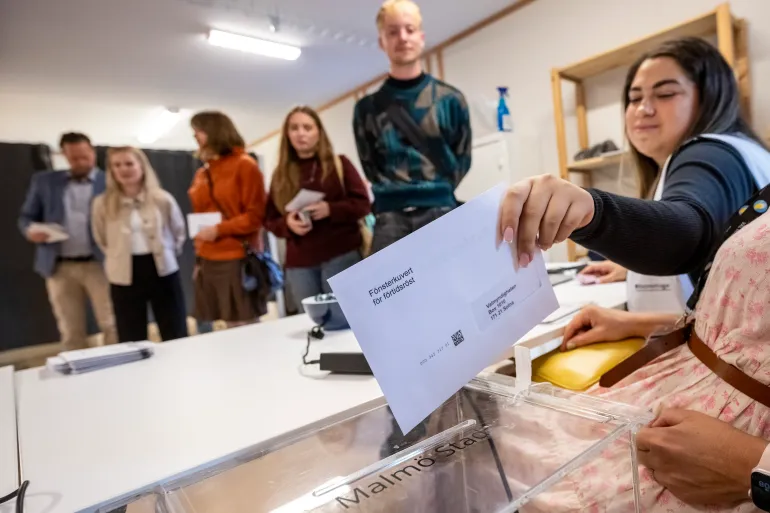
Sweden’s centre-left opposition bloc has emerged with an early lead in the nation’s general election, according to exit polls released as voting concluded at 18:00 GMT on Sunday. Data from the public broadcaster SVT suggests the centre-left coalition is currently projected to secure 51.3 percent of the vote, placing it ahead of the incumbent right-wing alliance, which holds 46.8 percent. A separate election-day survey conducted by the broadcaster TV4 corroborated these findings, also indicating a lead for the centre-left.
Official ballot counting is now underway, with results expected from the Swedish Election Authority in the coming hours. While early projections often serve as a reliable indicator, they are not definitive. In the 2022 election, initial polls anticipated a victory for the Social Democrats under Magdalena Andersson, only for the final outcome to favor a right-wing coalition led by current Prime Minister Ulf Kristersson.
The electoral landscape tightened significantly as the campaign progressed. Earlier in the year, the opposition led by Andersson held a substantial lead of approximately 10 percentage points. However, that advantage narrowed to a margin of just two to three points by the final weeks. The governing four-party alliance, which includes the nationalist Sweden Democrats, has faced a stiff challenge to maintain power after winning the previous parliamentary contest.
A potential success for the centre-left would offer a notable shift in the broader European political climate, where right-wing and far-right movements have recently seen significant gains. This follows a high-profile result in Germany just last week, where the far-right Alternative for Germany (AfD) party captured 44 percent of the vote in a state election, marking its strongest performance since World War II.
Should the exit polls prove inaccurate, the election could pave the way for the Sweden Democrats to enter the national government for the first time. The party, which has historical roots in the neo-Nazi movement, secured 20.5 percent of the vote in 2022 and has served as a key parliamentary partner for Kristersson’s minority government. In April, Kristersson signaled that his Moderates party would be open to including the Sweden Democrats in a governing coalition if the right-wing bloc achieved a majority, potentially granting them cabinet-level positions. Conversely, if the current exit-poll trends are confirmed, the likelihood of the Sweden Democrats joining the government would be substantially diminished.