

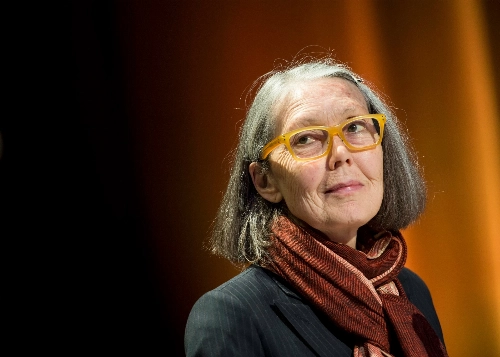
Canadian poet, translator, and essayist Anne Carson has been awarded the Nobel Prize in literature. The 76-year-old, Toronto-born author is celebrated for her innovative, genre-defying works that blend classical antiquity with modern themes, often fusing poetry, essays, and fiction into a single creative vision. This year, the prize is accompanied by a cash award of 12 million Swedish kronor, which translates to approximately $1.2 million. However, the prize can also introduce readers to writers and works beyond their own languages or reading habits. The Nobel Memorial Prize in Economic Sciences will be announced Monday.
The Swedish Academy reached Carson in Iceland to break the news, where she was reportedly “listening to the wind.” According to Ingrid Carlberg from the academy, Carson was thoroughly caught off guard by the announcement. Speaking to the Icelandic public broadcaster RUV, Carson humorously commented on the win, saying, “I think they’re all crazy,” while describing the notification call as “rather halting” because they asked standard questions to which she had no answers. So basically I think it’s good because it’s brief.
Reflecting on her medium, Carson noted that poetry is perhaps more practical than prose in the contemporary era due to its brevity, stating that “everybody is in a hurry” and poetry is fast, though she added that Homer is a notable exception. While the Nobel in literature is sometimes criticized for selecting lesser-known, highly experimental writers over those with broad commercial appeal, Carson stands as a relatively high-profile recipient. When asked how the prestigious honor might affect her book sales, she joked, “I’ll get a sticker on the front of my book. Stickers help.”
Carson’s extensive body of work includes “Eros the Bittersweet,” an examination of desire in ancient Greek writings, the verse novel “Autobiography of Red,” and “Men in the Off Hours”—a collection that earned Canada’s Griffin Prize for poetry in 2001. She has also gained acclaim for her translations of ancient Greek texts, including Sappho fragments in “If Not, Winter,” and tragedies by Sophocles and Euripides. Anders Olsson, chair of the Nobel Literature Committee, praised her output, stating that her work lives at the intersection of a philologist’s focus on words and a poet’s quest for new meaning, resulting in playful, ironic, and multi-vocal pieces. From the ancient Greeks to John Keats, Virginia Woolf and Emily Bronte, lead “to playful and ironic works that move not only between classical and modern poetry but also between different genres and art forms,” Olsson said, carson’s wide-ranging influences. Offering “different voices that play off against each other,” he added, carson blends genres and styles. Economy of the Unlost,” from 1999, sets ancient Greek poet Simonides of Keos against 20th-century poet Paul Celan, he said, while “Men in the Off Hours,” published in 2000, “aligns the historian Thucydides with Virginia Woolf. Carson did not immediately respond to emails from The Associated Press.
Having taught classics at multiple North American universities, Carson has a deep personal and creative connection to Iceland, where she and her husband, Robert Currie, were granted citizenship in 2022. She has frequently woven intensely personal experiences into her writing. Her 2010 book “Nox” served as an emotional epitaph for her brother Michael following his decades-long absence and subsequent death. Olsson described the work as a sculptural masterpiece, presented as an accordion-fold box containing letters, photos, and a translation of an elegy by the Roman poet Catullus.
Her most recent publication, “Wrong Norma,” released in 2024, is a diverse collection featuring her own hand-drawn illustrations and writings previously published in venues like The New Yorker and The Paris Review. That same year, writing in the London Review of Books, Carson opened up about her diagnosis with Parkinson’s disease. She described the deterioration of her handwriting as a “particularly mortifying” symptom, expressing the deep, authentic shame of losing her signature penmanship, describing bad handwriting as ugly and unrepresentative of oneself.
The announcement of Carson’s literature prize in Stockholm follows several other Nobel honors revealed earlier in the week. The medicine prize was awarded to three scientists for developing a light-based tool to study brain function. In physics, a researcher was recognized for work demystifying a rare group of neutrinos, while the chemistry prize went to two scientists who successfully mapped mirror-image molecules to aid in drug development. The announcements will continue with the peace prize and concludes with the economics award. A discovery that has been used to develop countless drugs, the chemistry prize recognized two scientists for untangling mysterious mirror images in molecules.