

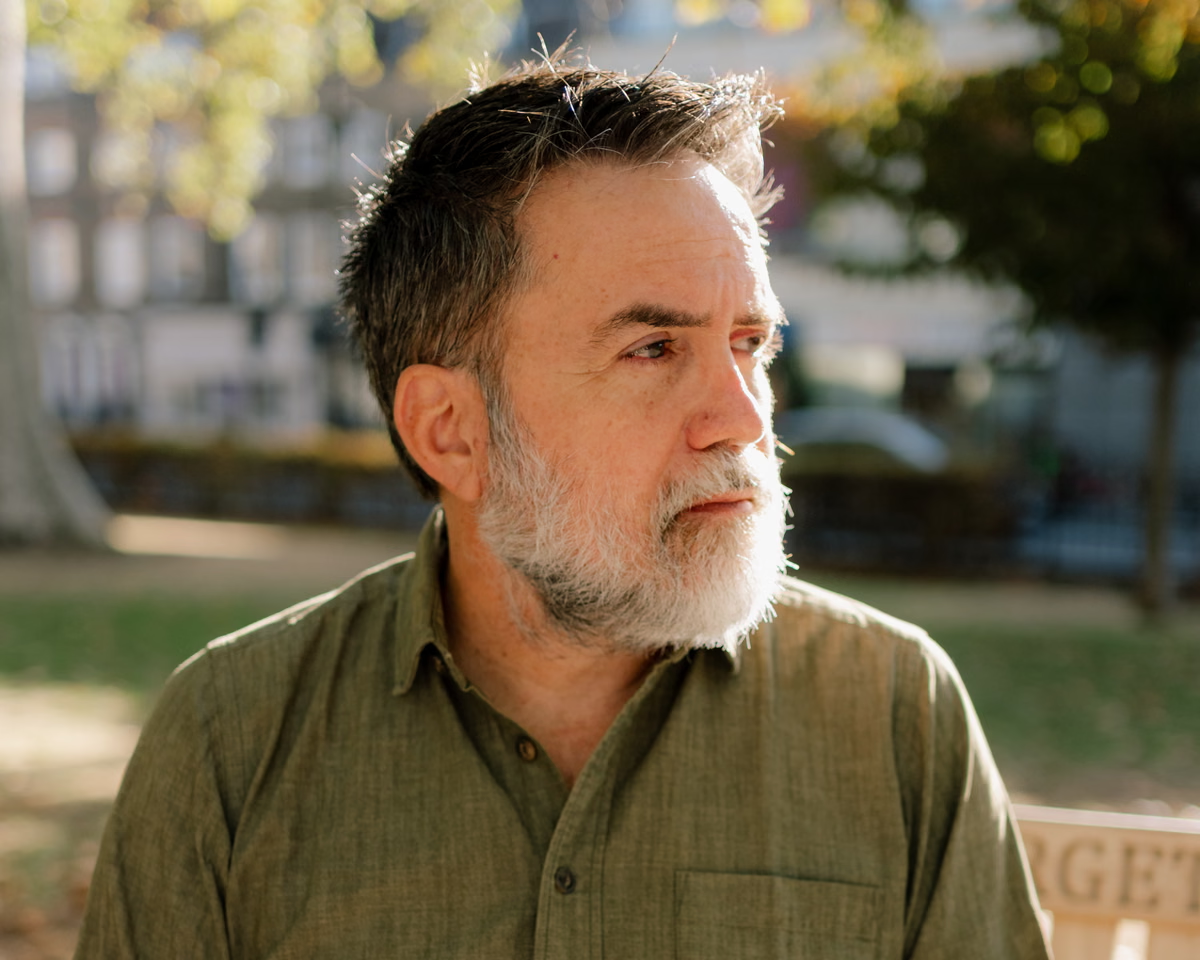
As the film The Social Reckoning arrives in cinemas, it spotlights the internal turmoil at Meta, further chronicling the company’s ongoing challenges regarding user safety. The narrative centers on Frances Haugen, who famously leaked internal documents in 2021, and highlights the broader pattern of oversight issues that Arturo Béjar witnessed from within the company. On October 5, 2021, the same day Haugen testified before the US Senate, Béjar—who served as a consultant on Instagram’s wellbeing team—sent a pivotal email to Mark Zuckerberg and senior leadership. He aimed to flag a significant disconnect between how the company addressed user harm and the actual experiences of its community members. But the real world has already been working on a sequel – or rather, a threequel, t he Social Reckoning hits cinemas this Friday. The movie is a follow-up to The Social Network, detailing the further misadventures of Mark Zuckerberg and his social media empire, and in particular Frances Haugen, the employee who in 2021 leaked internal documents that appeared to show Facebook was aware of the harms its products had inflicted, directed by Aaron Sorkin. On 5 October 2021, it’s no spoiler to reveal the film climaxes with Haugen’s testimony to the US Senate. That very same day, Arturo Béjar, a consultant on the wellbeing team of Instagram (which is also owned by Facebook), hit send on a long-gestating email to Zuckerberg and other senior Facebook executives on a similar theme. “I wanted to bring to your attention what I believe is a critical gap in how we as a company approach harm, and how the people we serve experience it,” Béjar began, before laying out some shocking. This was a far greater degree of harm than the company’s existing measurements suggested. He’s one of the most fiercely competitive people I know.”.
Béjar, who spent eight years at Facebook and its successor, Meta, struggled to convince leadership to treat user protection as a moral imperative. He noted that discussions about preventing critical issues like suicide were often dismissed unless they were framed strictly through metrics. This detached, efficiency-driven environment is, according to Béjar, accurately captured in the portrayal of Zuckerberg as a control-oriented figure devoid of empathy for the human cost of his platform’s design. Béjar recalls a moment when he attempted to lighten the mood after a tense meeting by asking, “Are we having fun yet?” to which Zuckerberg responded, “I’m not here for fun—I’m here for impact.” He had learned how to communicate with Zuckerberg. “You couldn’t talk to Mark about, ‘We have to do this thing to prevent suicide because it’s the right thing to do,’” he says. “You had to put everything in terms of metrics. And he recognises Jeremy Strong’s portrayal of Zuckerberg as a detached, awkward, humourless control freak all too well. “Oh, it’s accurate,” he says. “I don’t recall him ever being empathetic to the harm that somebody was experiencing and wanting to make that better … The only thing that really consistently came across in all my interactions with him was winning, béjar has seen The Social Reckoning.
The tension reached a breaking point shortly after that 2021 email. While Béjar hoped for a cultural shift in how Instagram prioritized the safety of its younger demographic, Zuckerberg’s subsequent response to the leaked Facebook Files prioritized defensive corporate strategy. By 2023, Béjar had transitioned from an internal advocate to a public witness, testifying under oath against Meta at least seven times in various hearings. His persistence was instrumental in a major legal outcome requiring the company to pay up to $18 billion, a sum set against its 2025 revenue of over $200 billion.
Beyond financial penalties, the legal pressure resulted in concrete safety mandates, including two-hour daily time limits for users under 18, restricted notifications during school hours, nighttime app blocking, and the disabling of autoplay features. Béjar views these changes as a significant accomplishment, noting that no other entity has successfully pushed the company to limit the time children spend on its platforms. Additional legal setbacks, such as a New Mexico trial that saw Meta pay $942 million in damages for misleading the public, further underscore the growing accountability facing the firm.
Béjar’s drive to reform the platform is deeply personal. Around 2018, his daughter, then 14, shared that she was receiving unwanted sexual advances and nude photos on Instagram, alongside other forms of harassment. These experiences stood in stark contrast to his earlier tenure at the company, which began in 2009 with a shared sense of optimism about connecting the world. Raised in Mexico City and a tech veteran who worked at IBM as a teenager, Béjar had initially focused his work at Facebook on fostering positive interactions and developing user-to-user safety tools.
His internal efforts to improve safety were often met with resistance, despite his finding that most users who behaved aggressively were responsive to private, respectful feedback. Upon returning to the company as a consultant in 2019, he discovered that leadership was already well aware of the risks, including issues related to addiction and the harm documented in cases like that of Molly Russell. Data confirmed the severity of these problems: internal research indicated that 51% of Instagram users reported harmful experiences within a seven-day period. Furthermore, roughly 24.4% of 13-to-15-year-olds reported receiving unwanted advances, and 21.8% reported instances of bullying.
Despite the prevalence of these incidents, reporting mechanisms remained ineffective; only 1% of those who suffered harm reported it, and of that fraction, content was only removed in 2% of cases, totaling just 0.02% of all incidents. Béjar now argues that the path forward requires rigorous, independent assessment of social media safety, similar to how society monitors vehicle emissions. He maintains that families deserve transparency regarding the likelihood of encountering harm on these platforms, as he continues to push for systemic industry changes.