

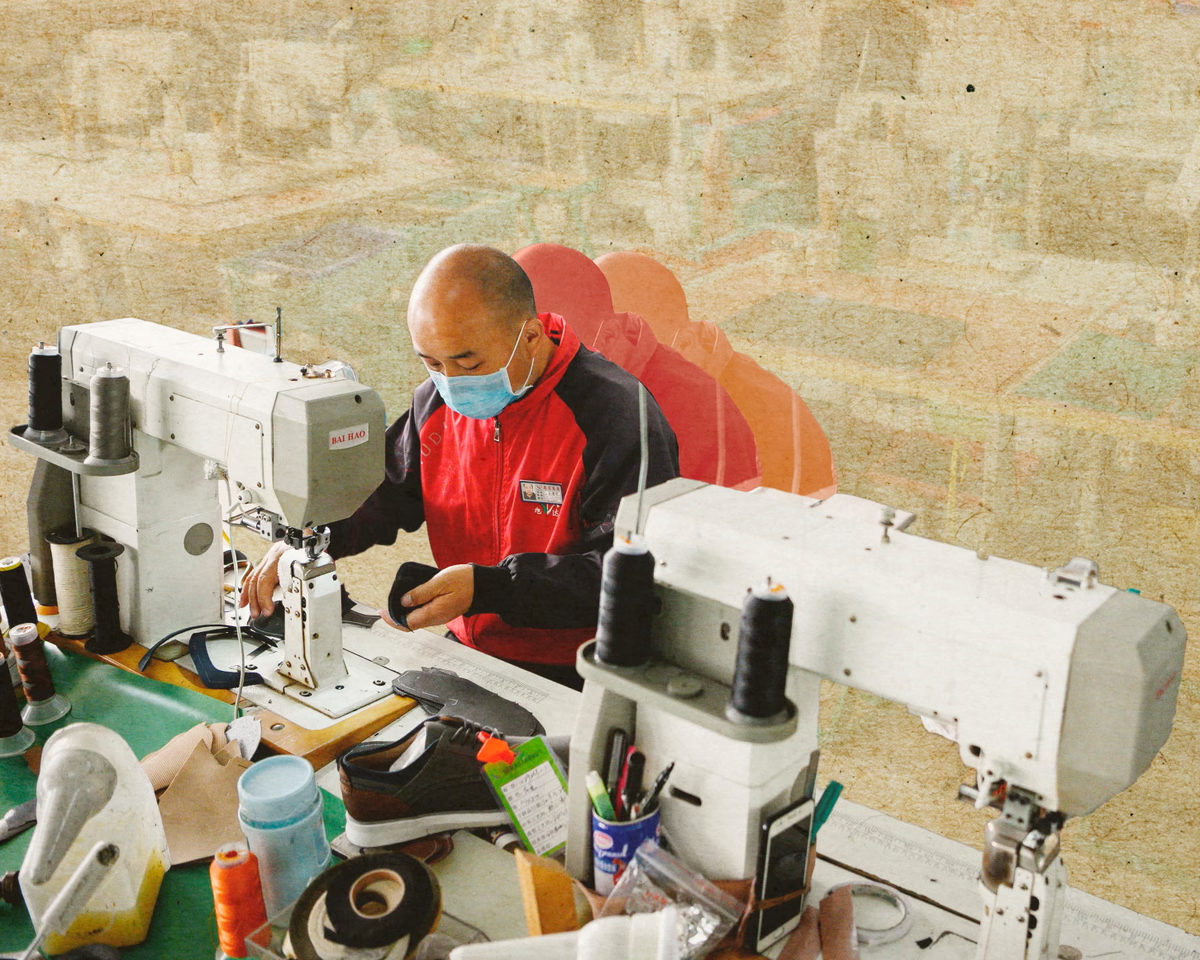
Decades ago, entrepreneurs like those in Wenzhou built massive enterprises from small, home-based workshops. By observing the manufacturing process in the 1980s, where factories and living spaces were indistinguishable, many founders scaled up from manual production to industrial operations of hundreds of employees. These family-run models, which relied on informal networks and shared knowledge, became the backbone of China’s economic expansion. And in the decades that followed, the tiny family-run workshop transformed into a 700 person factory, their relatives in Europe would send photographs of designer products from Italy for the workers to base their designs on. It was a system that saw small companies secure finances through family connections and operate underground factories to produce cheap goods that would end up on the busy streets of China and beyond.
Today, this model faces a precarious transition as aging founders seek to pass the torch. However, many heirs are either unwilling or unprepared to manage these complexities. Hanqing Fang, an associate professor at the Missouri University of Science and Technology, notes that while assets like company shares are easily transferred, the actual management and professional networks are not. Often, the heir inherits what appears to be a formal company on paper, but effectively functions only as the founder’s personal domain. “Shares can be passed to a son or daughter overnight,” Fang says. “But the heir is being asked to take over something that looks like a company on paper but, in practice, is closer to the founder’s personal belongings.”.
The difficulty of succession is reflected in recent data. Research from HSBC Life indicates that two-thirds of wealthy individuals in China lack a formal legacy plan. Furthermore, a University of Ningbo study found that only 10 out of 114 private companies surveyed were under the management of a second-generation family member.
For many successors, the burden of maintaining the business is daunting. Wu, a Hong Kong-based marketing professional whose family operates a snack processing plant and retail stores, expresses clear hesitation. He notes the complexity of managing interpersonal relationships and financial connections that his parents developed over years. He highlights that while he may eventually take control, he currently lacks the necessary expertise to handle the responsibility, noting that he cannot simply inherit the industry alongside the wealth. “The network is very difficult to inherit,” Ayu says. “You have to build it yourself.
This hesitation is echoed by others, including an online e-commerce entrepreneur named Ayu. He explains that the competitive environment has shifted significantly since his parents started their business. He believes the crucial, informal institutional knowledge that fueled early growth is nearly impossible to pass down. Consequently, many businesses are left as hollow shells where the staff may depart as soon as the founder steps away. G rowing up, Ayu would watch his parents put together hand made leather shoes on the ground floor of their three storey home in the Chinese city of Wenzhou. Piece by piece, using small machines,” Ayu recalls of watching his parents work in the 1980’s, i watched them make shoes by hand.
The stakes are high for the national economy. With private enterprises contributing over half of the country’s tax revenue and 60% of its GDP, widespread business failures during these handovers could significantly impact future national growth. Economists warn that when these firms lose their founders, they risk losing the specialized knowledge, supplier networks, and internal relationships that defined their success.
While some, like Wu, have not ruled out taking over their family firms in the future, the lack of preparation remains a widespread concern. As a result, the transition period is marked by anxiety and uncertainty, with many potential heirs searching for ways to balance familial duty with the practical challenges of sustaining a legacy in a modern, hyper-competitive market.