

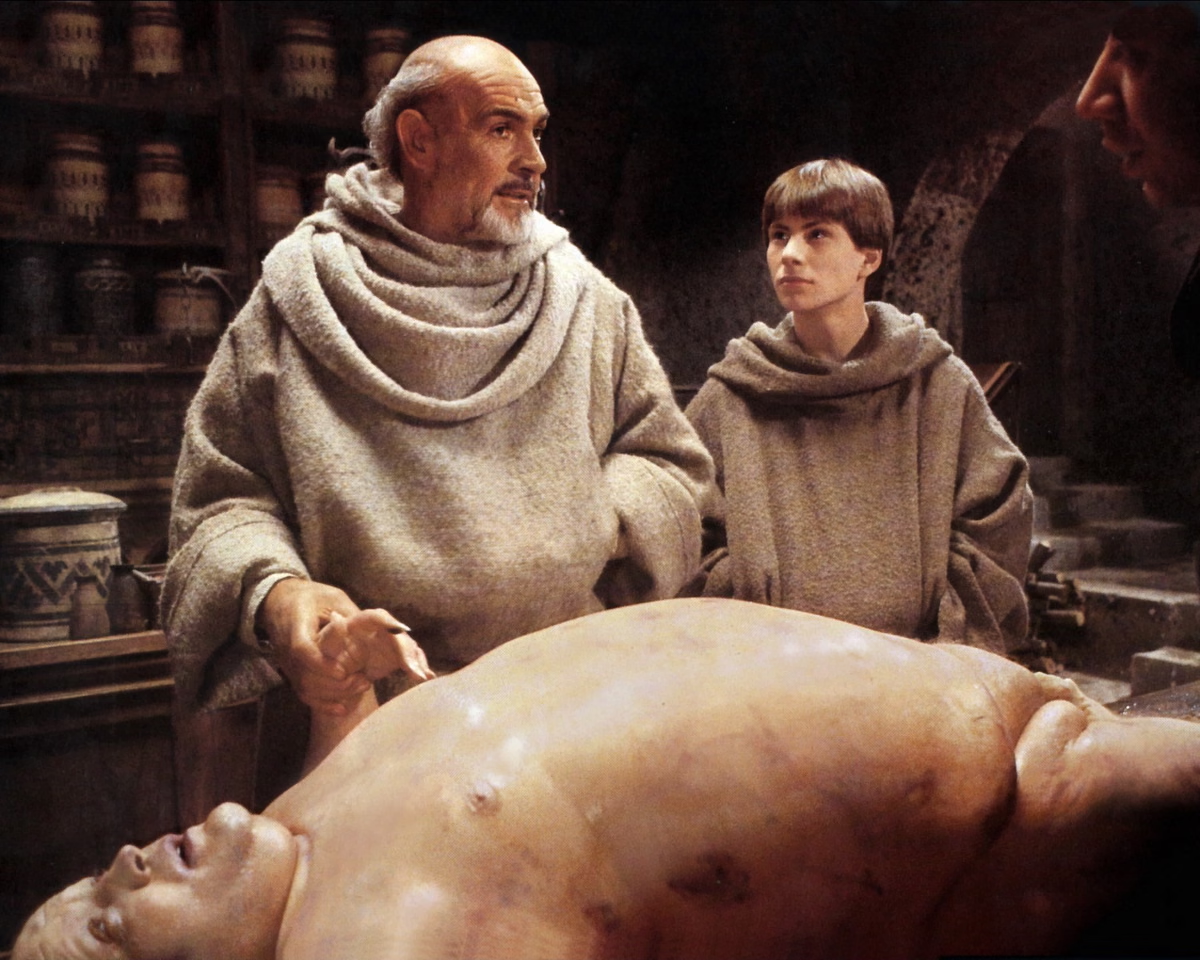
When director Jean-Jacques Annaud first proposed the film adaptation of Umberto Eco’s mystery novel, The Name of the Rose, he was captivated by the prospect of bringing a story about medieval monks and lost Aristotelian texts to the screen. To ensure historical accuracy, Annaud consulted with medievalist Jacques Le Goff, gathering precise details on architecture, liturgy, and costume. While the director initially sought an unknown actor for the lead role of William of Baskerville, Sean Connery eventually secured the part after delivering an audition that perfectly matched Annaud’s internal vision for the character. A murder mystery about monks in the middle ages fighting for the fictional missing part of Aristotle’s Poetics, i read an article about a curious book that had great reviews in Italy. Since childhood, I had been fascinated with medieval and religious architecture, and Aristotle’s Poetics is my favourite literary work. The author, was going to be in France for one night and agreed to meet me at his hotel and that I would drive him to Charles de Gaulle airport, i learned that Umberto Eco. Which looked like the silhouette of Sherlock Holmes – Umberto was a man of great humour, and he met me wearing a deerstalker, with a pipe in his mouth, the first thing I saw was his shadow on the hotel staircase. In the car, I asked questions: what sort of shoes would the Franciscans have been wearing. He said: “I don’t know, I didn’t have to write any of that. Architecture, liturgy and so on, i ended up hiring medievalist Jacques Le Goff and seven of his colleagues to make sure we got all the details right – costumes. The friar who investigates the deaths, and travelled the world to watch plays featuring great actors in their 50s, i wanted an unknown to play William of Baskerville.
Casting for the film involved several unconventional turns, including the selection of 16-year-old Christian Slater for the role of the novice Adso. Despite his mother—the casting director, Mary Jo—initially attempting to dismiss him for arriving unprepared, Slater’s chemistry with co-star Valentina Vargas solidified his place in the production. The filming process was fraught with intensity, including a dangerous set malfunction where a burning library structure caused a piece of timber to collapse on actor Feodor Chaliapin Jr. Despite his age of 80, the actor was more concerned about the quality of the take than his own injury.
Ron Perlman, who played the hunchbacked monk Salvatore, drew upon his previous collaboration with Annaud on Quest for Fire to secure the role. He developed his character’s unique, multilingual dialogue by randomly selecting words from seven different languages—Latin, Spanish, Italian, and others—that Eco had associated with the character. Perlman’s transformation into the role was physically demanding, requiring up to 13 hours in the makeup chair. His performance also included a haunting lullaby scene, suggested by a dialect coach, to illustrate Salvatore’s childlike detachment from his impending execution.
A significant technical challenge arose during filming when Perlman was tasked with spitting in Sean Connery’s face. Initially unable to bring himself to perform the action, he was encouraged by Connery to be aggressive for the sake of efficiency. Because the scene required coverage from multiple camera angles—including profile, closeup, and over-the-shoulder shots—Perlman estimated that he had to spit in Connery’s face 16 times. He reflected on the experience as a lesson in filmmaking, noting that he spent as much time as possible watching Connery, whom he regarded as a true hero of the craft.
The production faced further hurdles, including the abrupt sale of its Munich production office by producer Bernd Eichinger to help fund the film. Throughout the project, the focus remained on historical authenticity and the intricate, often difficult, process of bringing Eco’s complex world to life. By the end of the production, the cast and crew had navigated extreme physical transformations, on-set accidents, and the logistical complexities of a cross-cultural historical epic.