

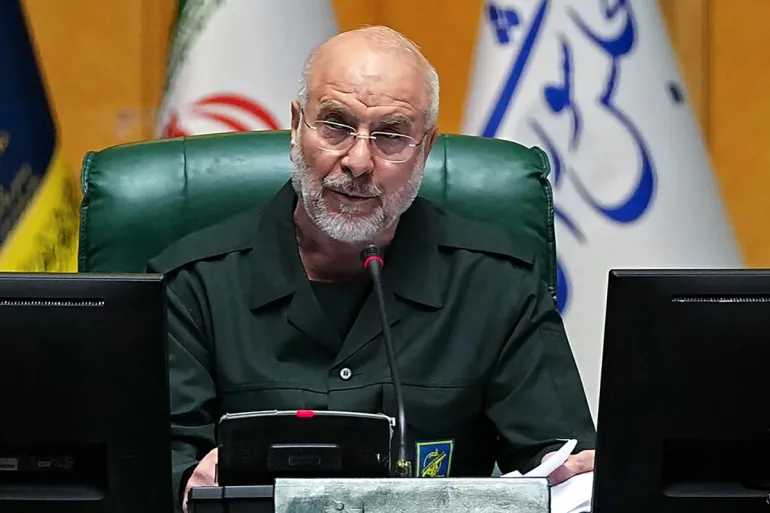
Iranian Parliament Speaker Mohammad Bagher Ghalibaf has introduced a new rhetorical dimension to the ongoing conflict with the United States by utilizing economic formulas to mock Washington’s financial decisions. Following the Pentagon’s recent admission that US military assets in the Middle East have sustained significant damage from Iranian missiles and drones, Ghalibaf shared a variation of the Taylor equation—a benchmark central banks use to set interest rates—on social media. His post served as a pointed commentary on the limitations of monetary policy in addressing the realities of the war.
Addressing the Federal Reserve’s tools, Ghalibaf remarked that a rate hike cannot reopen the Strait of Hormuz or produce a single barrel of oil. He emphasized that the strait functions as a critical chokepoint currently under Iranian influence, asserting that the resulting risk premium is set by Tehran, not by interest rate adjustments. His comments arrived shortly before the Federal Reserve announced a 25-basis-point increase to its benchmark interest rate.
The Taylor rule, developed by economist John Taylor in the 1990s, traditionally aligns the federal funds rate with inflation and the economic output gap. While the formula provides a general reference, the Federal Reserve considers a broader range of indicators. Fed Chairman Kevin Warsh noted that the conflict between the US and Iran, which escalated following the outbreak of hostilities on February 28, has driven up fuel costs, serving as a contributing factor in the Fed’s decision to raise rates.
Market analysts suggest that Iran’s impact on global energy supplies has indirectly pressured the Federal Reserve. IG Group’s chief market analyst, Chris Beauchamp, described Ghalibaf’s social media strategy as a sophisticated form of agitprop, highlighting Iran’s consistent ability to challenge the US administration throughout 2026. Susannah Streeter of the Wealth Club acknowledged that while the Middle East conflict and rising oil prices were significant, they were not the sole drivers behind the Fed’s recent policy shifts.
Beyond the current interest rate debate, Ghalibaf has maintained a steady campaign of economic critique against the Trump administration. He previously mocked US oil future strategies by noting that financial maneuvering cannot manufacture fuel. In another instance, he targeted US domestic issues by posting a graphic titled Make America Hungry Again, which included data on US food insecurity to suggest that the administration is concealing military setbacks through claims of economic strength.
Despite the high-profile nature of Ghalibaf’s social media messages, experts maintain that Tehran is not in control of US monetary policy. Streeter noted that while Iran has influenced the factors feeding into US economic forecasts, the final decisions on interest rates remain firmly with the Federal Reserve, which evaluates a wide array of domestic data points, including strong capital investment in the artificial intelligence sector and resilient consumer demand.
The current conflict, which began on February 28, continues to reshape economic and military landscapes. As the war persists, officials like Ghalibaf appear committed to using the language of global finance to highlight what they describe as the failure of the current US approach in the Middle East. The report also notes that damaged or destroyed hundreds of the United States’ buildings at its bases in the Middle East, and drained its inventories of military equipment worth billions of dollars, the Pentagon conceded earlier this week, iran’s missiles and drones have downed dozens of US aircraft. The report also notes that “Let’s see if a hike could open SOH or produce a single barrel,” he wrote, referring to interest rate hikes and the Strait of Hormuz, a crucial waterway Iran has effectively blocked for global shipping. The report also notes that which was launched by the US and Israel against Iran on February 28, Ghalibaf frequently used financial arguments to mock how the conflict was being conducted by the administration of US President Donald Trump, to point to Iran’s ability to hurt Washington economically unless it changed its approach, early in the war. The report also notes that “This is a spectacular bit of agitprop from Iran, a country which, if nothing else in 2026, has demonstrated an impressive ability to needle its US opponent,” Chris Beauchamp, chief market analyst at IG Group, told. The report also notes that but what exactly is Ghalibaf trying to say. The report also notes that interest rate = inflation + 0.5(output gap) + 0.5(inflation − 2%) + 2%.