

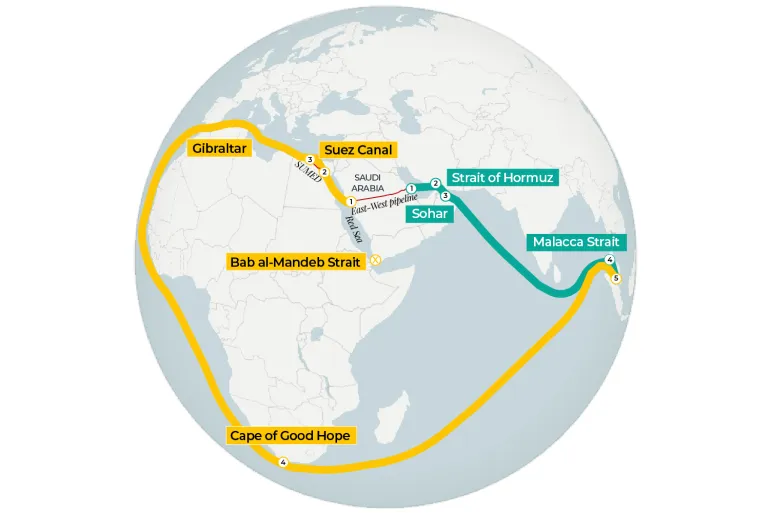
Saudi Arabia’s energy sector faces significant operational challenges following recent drone strikes that disabled a critical segment of the kingdom’s East-West pipeline. The 1,200km (746-mile) infrastructure, which links eastern oil fields to the western port of Yanbu, previously allowed Saudi crude to bypass the Strait of Hormuz. The attack has halted oil flow through this conduit, removing an estimated 4-5 million barrels per day (bpd) from the global supply. While repairs are underway, estimates suggest the process could take between three to eight weeks, leaving market analysts uncertain about the timeline for full recovery.
The disruption has drastically altered Saudi crude export patterns. Loadings, which remained robust at 7.5 million bpd in early 2026, plummeted to roughly 2.1 million bpd during the first half of September. As the kingdom grapples with this outage, state revenue remains at risk; crude and petroleum product sales, which generated 606.5 billion riyals ($162bn) in 2025, account for over half of government funding. UBS Research has subsequently adjusted its 2026 budget deficit forecast to 5 percent of GDP, exceeding the original 3.3 percent projection.
With the primary land-based route compromised, exporters are increasingly relying on Gulf terminals, specifically Ras Tanura and Ras al-Ju’aymah. According to Rishi Rajanala, a research specialist at LSEG Data & Analytics, the kingdom is now prioritizing shipments through the Strait of Hormuz. This shift includes conducting ship-to-ship transfers off the coast of Sohar, Oman, to navigate the current logistical squeeze. These maneuvers, while necessary, introduce higher freight costs and operational inefficiencies, according to Richard Matthews of Gibson Shipbrokers.
The reliance on the Strait of Hormuz has forced tankers to adopt precautionary measures, including moving under the cover of darkness. By disabling Automatic Identification System (AIS) transponders, vessels aim to mitigate risks while transiting Omani waters. Analysts note that these ships may coordinate with the US Navy despite the inherent dangers present in the region. Rahul Choudhary, vice president of Upstream Research at Rystad Energy, observed that exports through the Hormuz route surged by roughly one million bpd in early September compared to August totals, indicating a swift pivot in logistics.
The secondary strategy involves drawing from existing crude reserves located on the west coast and utilizing storage at Egypt’s Ain Sukhna and Sidi Kerir terminals. These supplies provide a temporary buffer for European refiners, though some have already begun sourcing alternatives from the North Sea, the Americas, and Central Asia. Asian buyers, who account for the majority of Saudi exports, are similarly being offered alternative loadings as the industry adapts to the tightened supply chain.
The geopolitical landscape complicates these alternatives further. Shipments moving south from Yanbu through the Bab al-Mandeb strait face instability following recent military offensives by Iran-backed Houthi forces near Yemeni ports like Mocha. Consequently, vessels bound for Asia are often redirected north through the Suez Canal or the Sumed pipeline, though technical constraints for Very Large Crude Carriers (VLCCs) remain a significant bottleneck. As regional disruptions persist, Brent crude prices have climbed above $105 per barrel, reflecting global anxiety over the continued volatility of these critical energy lifelines. The report also notes that halting oil flow and removing 4-5 million barrels per day (bpd) of oil from global supply, saudi Arabia’s oil exports took another blow last week when drone attacks knocked out part of the country’s East-West pipeline. The report also notes that although The Associated Press estimates three to five weeks, citing two regional officials, it is unclear how long repairs will take. The report also notes that the 1,200km (746-mile) pipeline connects the kingdom’s main oil-producing fields in the east of the country with Yanbu port on the Red Sea coast in the west, allowing Saudi crude to bypass the Strait of Hormuz, which has largely remained closed since the United States-Israel war on Iran began on February 28. The report also notes that as the world’s second-largest oil producer, Saudi Arabia’s ability to keep crude flowing has significant consequences for global energy markets. The report also notes that how the disruption could affect buyers worldwide, and what it means for the kingdom’s revenues, asked experts what alternatives remain. The report also notes that which topped 7.5 million bpd in January and February, had fallen to about 2.3 million bpd in August and roughly 2.1 million bpd in the first half of September – a drop of more than 70 percent, total Saudi crude loadings. The report also notes that since shuttle tankers crossing Hormuz with tracking switched off aren’t always captured in vessel data, analysts caution the real loadings figure may run somewhat higher. The report also notes that most Saudi crude left on ships through the Strait of Hormuz, the 39km (24-mile) shipping choke point connecting the Gulf to the Gulf of Oman, and the open sea beyond, before the crisis.