

A war crimes tribunal based in The Hague has handed a 25-year prison sentence to former Kosovar President Hashim Thaci for his involvement in conflict-era atrocities. The Kosovo Specialist Chambers (KSC) convicted the 58-year-old on Wednesday, determining that he played a critical role as a high-ranking commander of the Kosovo Liberation Army (KLA) during the territory’s push for independence from Serbia in the 1990s.
The court found Thaci guilty of charges including unlawful detention, torture, and the murder of 96 individuals who were identified as political rivals or perceived collaborators with Serbian security forces. While sentencing him, the presiding judge, Charles Smith, confirmed that the defense retains the right to appeal the decision.
Three other former KLA commanders also received prison terms for their involvement in the conflict. Jakup Krasniqi was sentenced to 25 years, while Kadri Veseli was given 18 years, and Rexhep Selimi received 13 years, with time already served in custody accounted for in the latter two cases. Despite these convictions, the panel of judges acquitted all four men on six specific counts related to crimes against humanity, citing insufficient evidence that the KLA’s actions constituted a widespread or systematic assault on the civilian population.
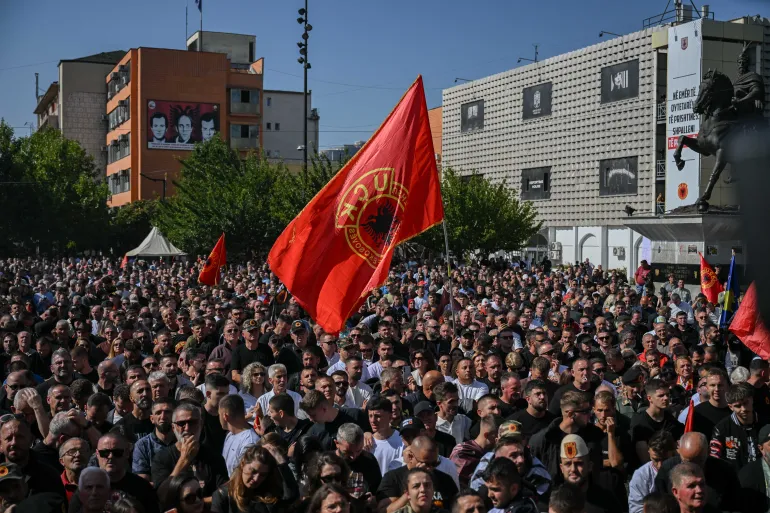
The verdict has ignited intense reactions within Kosovo, where many view Thaci and the KLA as symbols of national liberation. Thousands gathered in Pristina to watch the proceedings live, with many expressing shock and vocal support for the convicted leaders. High-level political figures were quick to respond, with Foreign Minister Glauk Konjufca describing the judgment as “terrible and harmful to Kosovo,” while Albanian Prime Minister Edi Rama labeled the decision a “disgrace” on social media.
Conversely, Serbian officials welcomed the ruling as a validation of long-standing claims regarding the KLA. Ivica Dacic, Serbia’s Deputy Prime Minister and Interior Minister, characterized the sentencing as a warning that a state cannot be built upon the “mass graves of murdered Serbs.” He maintained that the court provided a belated confirmation of the group’s criminal nature.
The legal fallout arrives as Kosovo continues to navigate a period of significant political instability. The nation has struggled to maintain a stable government or foster closer ties with the European Union, and observers suggest this legal outcome serves as a major complication for future stability. correspondent on the ground noted that for many ethnic Albanians, the ruling feels like a profound injustice, especially given the perception that the court has disproportionately targeted one side of the ethnic divide.
Critics like Jeta Xharra, director of the Balkan Investigative Reporting Network, argued that the judicial process appears skewed. She stated that while justice is essential for all victims, the court has focused heavily on the KLA while few perpetrators from the Serbian forces—who were involved in the deaths of over 10,000 civilians—have been held accountable. She added that many in Kosovo still carry the trauma of living as second-class citizens prior to the war and feel this tribunal functions as a one-sided legal pursuit.
Thaci served as a pivotal political figure following the war, moving from his leadership role in the KLA to become prime minister, foreign minister, and eventually president from 2016 to 2020. He resigned in November 2020 after the tribunal indicted him, leading to his transfer alongside the other defendants to detention in the Netherlands. The 1999 conflict itself saw approximately 13,000 people killed and hundreds of thousands displaced, leaving a legacy that remains deeply contentious decades later. The report also notes that he stood in silence as Presiding Judge Charles Smith read out the sentence, wearing a suit and tie. The report also notes that the trial has been controversial within Kosovo as many Kosovan Albanians see the KLA and Thaci as revered figures because of their role in the 1998-99 independence war. The report also notes that some started shouting slogans in support of the KLA and Thaci. The report also notes that and albeit belated, confirmation of what Serbia and the Serbian people have been saying loudly for more than a quarter of a century – that the so-called KLA was a criminal and terrorist organisation”, he said that the conviction represents a “clear. The report also notes that but its armed operations intensified in 1997 and 1998, the KLA first emerged in the mid 1990s. The report also notes that leading to a full-blown war in 1999, which resulted in the deaths of an estimated of 13,000 people and the displacement of hundreds of thousands, serbian forces responded with several large police and military operations. The report also notes that reporting from The Hague, Sonia Gallego said the verdicts come as Kosovo is facing “political deadlock”. The report also notes that “There have been repeated elections to try and get some form of stable government so they can get some kind of closer relationship with the European Union going, but there have been repeated blocks to that, and failures to form that government,” she said.