

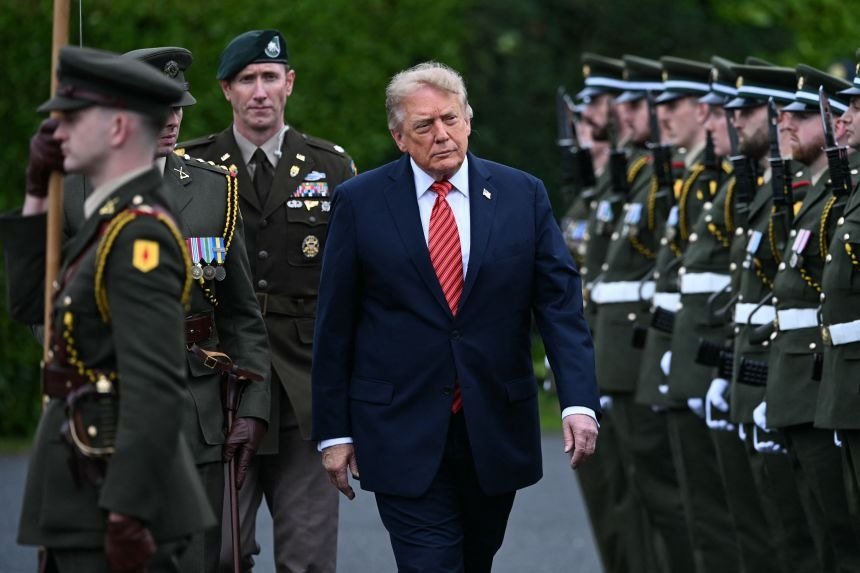
During a bilateral meeting in Dublin on Saturday, President Donald Trump stated that Irish reunification “would be a fantastic thing,” projecting that such a development is “going to happen eventually.” Acknowledging the sensitivity of the topic, Trump remarked, “Well, I don’t want to cause any trouble,” before adding, “But I will tell you, I’d love to see it unified,” suggesting it would serve as “a great feather in everybody’s cap.”
The prospect of reunification remains a deeply divisive issue, rooted in the history of the Troubles, a period of sectarian conflict that lasted nearly 30 years. Under the 1997 Good Friday Agreement, any move toward a united Ireland would require a majority of voters in both the north and south to support the change in border polls. Following Trump’s comments, the UK government signaled its opposition, with Downing Street referencing recent remarks by Prime Minister Andy Burnham, who stated that a border poll is “off the table” and reaffirmed his commitment to the Good Friday Agreement.
Gavin Robinson, leader of the Democratic Unionist Party, rejected the President’s commentary, asserting that the future of Northern Ireland “will be decided by the people of Northern Ireland, not by commentary in London, Dublin or Washington.” Despite the criticism, Trump remained optimistic, pointing toward Taoiseach Micheál Martin and stating, “You’ve got the right man over here to get it moving.”
The President arrived in Ireland on Saturday morning for a series of meetings with government leaders before traveling to his golf course in Doonbeg. He was accompanied by his son, Donald Trump Jr., and his daughter-in-law, Bettina. During an official ceremony, Trump observed an Irish band perform the American and Irish national anthems while Irish President Catherine Connolly stood by. In a subsequent statement, Connolly’s office noted that she “conveyed the strong view of the Irish people that the normalization of war and genocide can never be accepted.”
Trump’s visit occurs during a politically pivotal time, arriving just weeks before US midterm elections and amid rising tensions regarding the Houthis’ advance in Yemen. While in Dublin, the President was largely shielded from public view, traveling by motorcade to government residences in Phoenix Park. He also addressed business leaders at the residence of US Ambassador Edward Walsh, where he discussed economic cooperation and bilateral trade. When asked about protests occurring in the city, Trump claimed he was unaware of any significant opposition, describing the demonstrations as “friendly.”
Protests did take place in Dublin and near the Shannon airport, a site historically used by the US military for refueling. Activist groups, including those critical of the President’s policies, gathered to voice their opposition. Meanwhile, Trump’s son, Eric, defended the family’s business interests in the region, telling national broadcaster RTÉ that their golf course is a major local employer and a significant investment for the country.
Following his Dublin engagements, the President is scheduled to travel west on Sunday to attend the Irish Open at his Doonbeg resort. The visit highlights a complex balancing act for the Irish government, which relies heavily on US corporate investment while managing domestic political concerns regarding the President’s rhetoric and international policies. The report also notes that dividing opinion among the Unionists, typically from Protestant backgrounds, who would like Northern Ireland to remain part of the United Kingdom and Republicans, typically from Catholic backgrounds, who would like to see it reunited with the Republic of Ireland, the reunification of Ireland has long been considered a contentious issue. The report also notes that wary of such sensitivities, US presidents have typically avoided explicitly commenting on the issue, even President Joe Biden who frequently referenced his Irish heritage. The report also notes that that is currently “off the table,” he said, later confirming he would “100%” follow the Good Friday Agreement. The report also notes that however, Trump seemed confident that the move would happen eventually and questioned how it could be a negative thing. The report also notes that but I think it would be a great thing, now the UK will have something to say about obviously. The report also notes that and his wife, Bettina, disembarked from the plane afterward and also greeted officials on the ground. The report also notes that including one concerning traffic through the Bab al-Mandeb strait, trump briefly answered a couple questions on his way back into the Beast after the courtesy call with Connolly.