

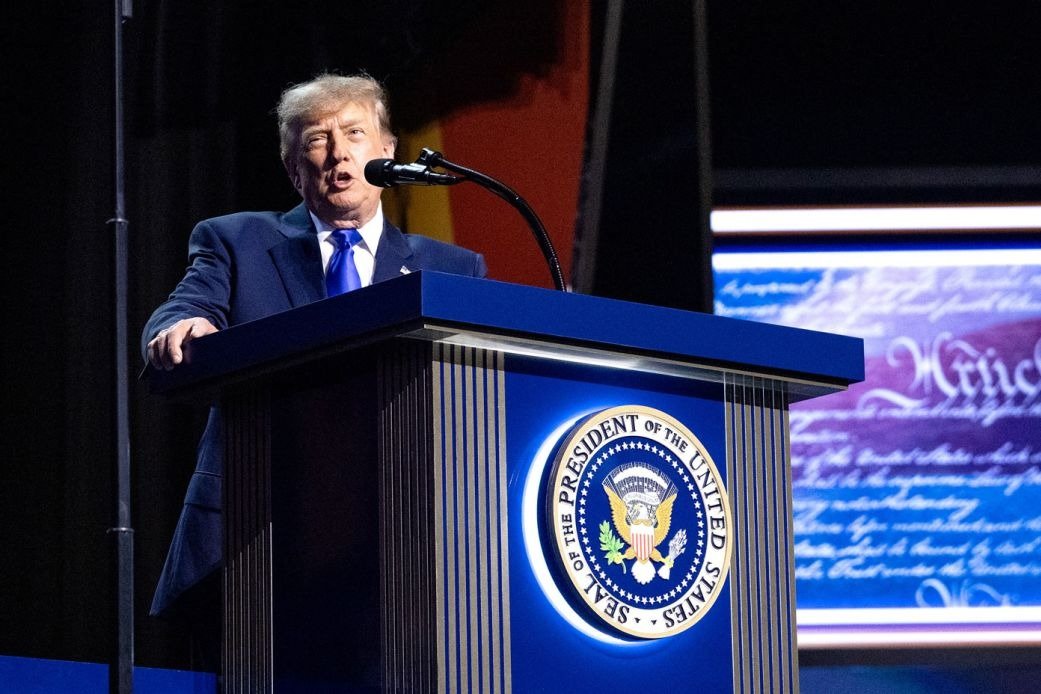
President Donald Trump has unveiled a high-stakes campaign promise, vowing to issue a $5,000 dividend to every adult American citizen if Republicans successfully retain control of both the House of Representatives and the United States Senate in the upcoming November midterm elections. Speaking at the opening night of a two-day GOP convention in Dallas—an event supporters have dubbed “Trump-a-palooza”—the president framed the proposal as a direct benefit for the public, stipulating that the funds must be spent domestically.
The ambitious plan, which the president has labeled “the Trump dividend,” comes as he seeks to bolster his party’s standing amid economic headwinds, lagging approval ratings, and historical trends that typically disadvantage the party currently in power. Despite the scale of the offer, the president provided no specific details on how the government would fund the $1 trillion initiative, which would further increase the national debt, already exceeding $40 trillion. Economists have expressed significant skepticism; Joe Brusuelas, chief economist at RSM US, described the proposal as the “working definition of ill-timed and ill-advised fiscal policy.”
Vice President JD Vance attempted to justify the potential revenue source during a subsequent interview on Fox News, suggesting that the funds would be generated through aggressive tariff policies. “We’re taking in an extraordinary amount of revenue because the president of the United States is actually standing up to both foreign companies, but also foreign countries,” Vance asserted. The president himself drew comparisons between this proposed dividend and the $1,776 checks his administration previously issued to military personnel, though critics have noted that any such payout would likely require formal congressional legislation.
The convention also served as a platform for the president to intensify his attacks on the Democratic Party, whom he referred to as “dumocrats.” Throughout his address, he touted his record on border security and emphasized his opposition to transgender rights. Addressing the crowd, Trump urged voters to treat the midterms as a referendum on his own leadership, stating, “I’m asking you to pretend that I’m on the ballot. I’m on the ballot. Just one more time.” He committed to an aggressive campaign schedule through November 3, planning to headline rallies in large arenas alongside approximately 35 competitive House and Senate candidates.
Internal party dynamics were on full display as the president threw his support behind Texas Attorney General Ken Paxton. While acknowledging that Paxton’s personal style and attire might be unconventional, Trump insisted that he is “maybe the top attorney general in the whole United States” and pledged to return to Texas multiple times to ensure his victory. Meanwhile, some GOP senators in tight races, such as Susan Collins of Maine and Dan Sullivan of Alaska, opted to skip the convention to focus on their local campaigns.
A notable moment occurred when a video featuring Democratic Senator John Fetterman was aired, in which he introduced his Pennsylvania colleague, Republican Senator Dave McCormick. Fetterman praised McCormick as a “great American” and a “great senator,” a gesture that drew significant applause from the convention attendees. Despite persistent rumors regarding a potential party switch, Fetterman issued a statement reaffirming his commitment to the Democratic Party, noting that he remains a lifelong member who intends to serve as a reliable vote for his caucus should the Senate flip.
The broader political landscape remains tense, particularly as the conflict with Iran has contributed to rising energy costs, with oil prices recently hitting $100 per barrel. Republicans at the convention sought to pivot the conversation toward affordability and economic relief. Lawmakers like Wisconsin Representative Derrick Van Orden highlighted the impact of previous tax cuts, while North Carolina Senate nominee Michael Whatley praised the president’s economic agenda. Treasury Secretary Scott Bessent also addressed the assembly, criticizing Democrats for their policy direction and warning against what he termed a “socialist hellscape.” The report also notes that which he equated to companies paying shareholders dividends and the extra $1,776 checks his administration issued to members of the military last year, but he offered no details on how he would pay for such a move. The report also notes that adding to its more than $40 trillion debt load, the effort would cost the US government $1 trillion. The report also notes that when Trump previously proposed issuing $2,000 tariff rebate checks to most Americans, his treasury secretary noted, “We need legislation for that.”. The report also notes that that’s equal to the amount that all AI companies are expected to spend on infrastructure this year – a number that is already clearly causing inflation to rise. The report also notes that “What the president is just saying is … if you keep us in power and allow us to continue to do these things, then you’re going to share in some of the benefit of this incredible wealth that we are creating.”. The report also notes that and as his political operation begins spending tens of millions of dollars, Trump vowed to campaign hard for the GOP through November 3. The report also notes that holding events with about 35 House and Senate candidates in competitive races as the GOP fights to keep its congressional majorities and Trump looks to buck the historic trend of poor performance by the sitting president’s party in midterm elections, trump told Republicans he would hit the campaign trail aggressively this fall.