

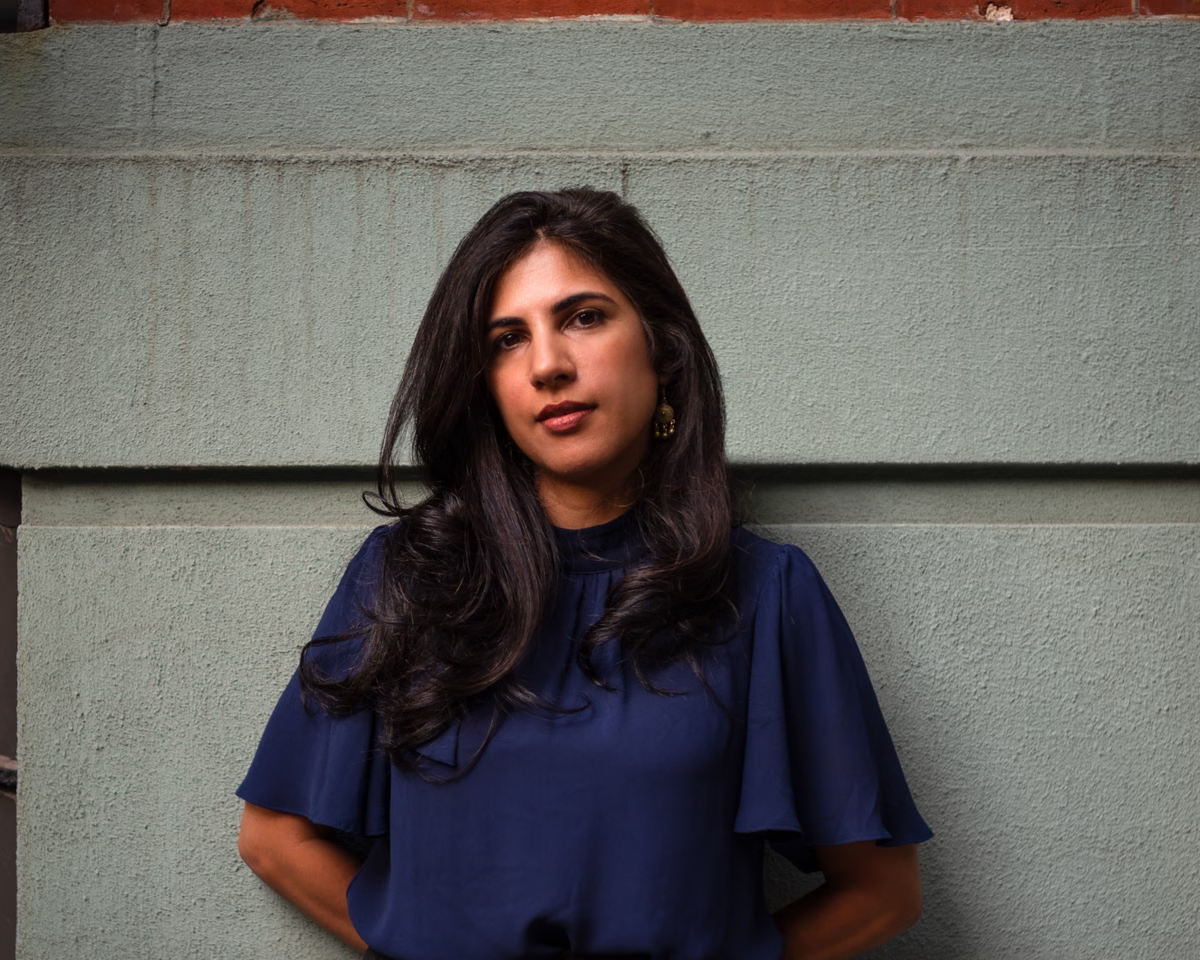
Growing up in California during the early 2000s, journalist Rozina Ali experienced a childhood defined by typical suburban interests, from reading books about the Kennedy family to watching Buffy the Vampire Slayer. At the time, she held a strong belief in American exceptionalism, viewing the United States as a bastion of tolerance and religious freedom. However, the September 11, 2001, terror attacks shattered that perspective. In the immediate aftermath, her parents warned her and her siblings that their lives would change, telling them that the country was at war and that Muslims would face widespread suspicion. While Ali initially resisted these warnings, believing in the inherent fairness of her home, her later reporting would confirm the accuracy of her parents’ fears.
In her new book, Seasons of Fury, Ali chronicles the history of Islamophobia in the United States, arguing that the phenomenon predates the 9/11 attacks by decades. The book, which took a decade to research, explores the systemic suppression and paranoia experienced by Muslim communities through the personal stories of four families. One central figure in her research is Abdeen Jabara, an Arab American attorney who, during the 1970s, exposed one of the most extensive government surveillance operations in American history.
Ali notes that the 1967 Israel-Arab war served as a critical turning point, galvanizing the Arab American community and shifting how the US government perceived and racialized Arab populations. This lens, shaped by the broader Israel-Palestine conflict, eventually expanded to encompass all Muslims. By the 1980s and 1990s, as political Islam gained visibility and immigration patterns shifted, the US government increasingly framed Islamic terrorism as a primary national security threat. This trend accelerated dramatically after 9/11, when the Bush administration’s vaguely defined “war on terror” provided a justification for expanding executive power and surveillance.
The tools developed during this era, such as the Department of Homeland Security, were designed to target Muslim neighborhoods, mosques, and cafes, often utilizing undercover informants. Ali observes that these mechanisms of state control have since been repurposed to target other groups, including Latino immigrants. She emphasizes that the constant invocation of “national security” has been used to justify policies like the Muslim ban, which eventually reached the Supreme Court.
The current climate remains deeply concerning to the author. A May 2026 poll by the Pew Research Center indicates that most Muslims in the US report experiencing daily discrimination. Furthermore, in the 25 years since the 9/11 attacks, the proportion of American adults who believe Islam is more prone to violence than other religions has more than doubled. This atmosphere of hostility is reflected in recent political rhetoric and actions; for instance, states like Texas and Florida have moved to classify the Council on American-Islamic Relations (CAIR) as a terrorist organization.
Public sentiment has also grown increasingly polarized. As the 25th anniversary of 9/11 approaches, an online petition has circulated calling for New York City Mayor Zohran Mamdani, who is Muslim, to “Stay Away.” Reflecting on these developments, Ali expresses astonishment at how pervasive Islamophobia has become, noting that while she initially intended to write a historical account, the reality of the current political landscape makes the subject feel more urgent than ever. She argues that the national consensus formed after 9/11 regarding the fight against terrorism has left a lasting, damaging legacy on American civil liberties and the treatment of minority communities. The report also notes that “I really, really also believed in American exceptionalism,” said Ali, now a journalist working for New York Times Magazine, in a recent interview with Stateside with Kai and Carter, a Guardian podcast. The report also notes that so when her parents sat Ali and her siblings down in the hours after the September 11, 2001 terror attacks, almost every word coming out of their mouths felt wrong. The report also notes that starting decades before 9/11, the result is a book she never intended to write – an ambitious attempt to trace the history of Islamophobia in this country. The report also notes that this interview has been edited and condensed for clarity. The report also notes that watch the Stateside podcast episode in full here. The report also notes that cS: We are talking just days ahead of the 25th anniversary of 9/11. The report also notes that what do you remember of that day, i’m wondering.