

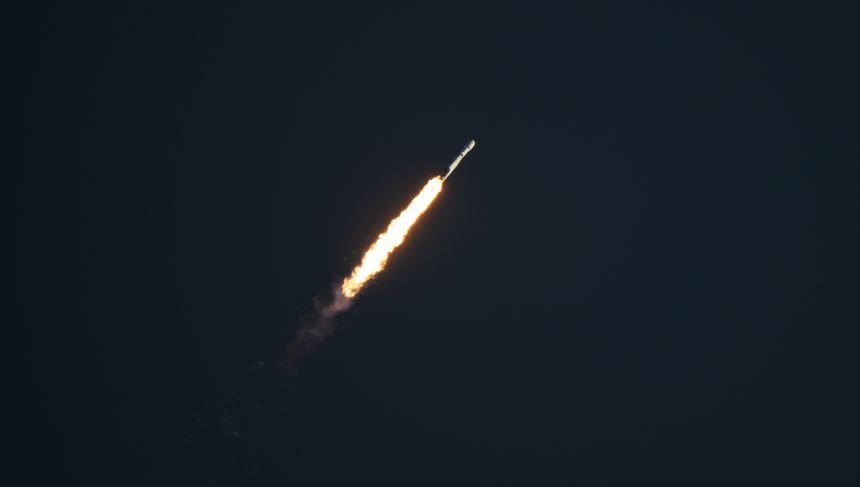
NASA’s Nancy Grace Roman Space Telescope, a massive observatory described by scientists as a “discovery machine,” has successfully launched into space. The telescope lifted off aboard a SpaceX Falcon Heavy rocket at 7:26 a.m. ET on Sunday, reaching orbit approximately 10 minutes later. This mission marks a significant milestone in space exploration, with the observatory designed to detect faint and otherwise invisible objects across the cosmos.
The telescope is currently beginning a three-month journey to reach its final destination, Lagrange Point 2 (L2), located about 1 million miles (1.6 million kilometers) from Earth—roughly four times the distance to the moon. During this transit, the mission team will oversee the commissioning phase, which involves testing onboard instruments and deploying the antenna necessary to transmit massive amounts of data back to Earth. Jeremy Perkins, a member of the Roman team, noted that the telescope is expected to relay one terabyte of data daily, a feat comparable to streaming 1 million songs from a million miles away.
NASA Administrator Jared Isaacman highlighted the significance of the project, stating that the telescope will provide Earth with a new atlas of the universe. With surveying capabilities more than 1,000 times faster than the Hubble Space Telescope, the Roman mission is set to capture scientific observations that were previously impossible. Dr. Nicky Fox, associate administrator for NASA’s Science Mission Directorate, emphasized that Roman will complement existing missions like Hubble and the James Webb Space Telescope to provide a more comprehensive picture of the universe.
The development of the $4.3 billion telescope spanned approximately a decade, following 16 years of prioritization by the scientific community. President Donald Trump joined the post-launch news conference to congratulate the team, praising the mission as a “great success” and describing the United States as the “hottest in space.” Dr. Fox reflected on the emotional nature of the launch, comparing the departure of the spacecraft to “sending your kids to college.”
The mission’s primary scientific goals include investigating dark energy, which drives the universe’s accelerating expansion, and mapping dark matter, which is believed to constitute 85% of the universe’s total matter. By measuring how gravity bends light over vast distances, Roman will create a 3D map of dark matter. Additionally, the telescope features an advanced experimental coronagraph—100 to 1,000 times more effective than previous versions—which will allow researchers to image planets near bright stars. Bertrand Mennesson, deputy project scientist at NASA’s Jet Propulsion Laboratory, noted that the coronagraph is designed for autonomous operation once in space.
Senior project scientist Dr. Julie McEnery described the mission as the largest census of planets ever conducted. The telescope will repeatedly survey patches of the sky to identify transient events like supernovas and potentially discover rogue planets or wandering black holes. Dominic Benford, a member of the project team, noted that the telescope’s ability to capture wide-field views while maintaining high resolution will allow scientists to ask questions that have not yet been conceived. The mission is currently slated for five years, with the possibility of an extension up to 10 years.
The telescope honors Nancy Grace Roman, NASA’s first chief of astronomy, who pioneered the concept of space-based observations in the 1960s. Her legacy continues through this mission, which aims to provide a panoramic view of the cosmos, from the largest galaxies to the smallest celestial details. The first images from the Roman telescope are expected in January, marking the beginning of an unprecedented era of astronomical discovery. The report also notes that but there is that moment where you think, ‘I’m never going to see that spacecraft again.’ I liken it to sending your kids to college.”. The report also notes that “Roman will give the Earth a new atlas of the universe,” NASA Administrator Jared Isaacman said as the space agency unveiled the completed telescope on April 21 at the Goddard Space Flight Center in Maryland. The report also notes that worlds around stars beyond our solar system, as well rogue planets that don’t orbit stars at all, it could allow astronomers to spot previously unseen galaxies and exoplanets. The report also notes that “It’s actually the member of the team that’s going to go on this grand expedition and send all that incredible treasure back to us here on Earth.