

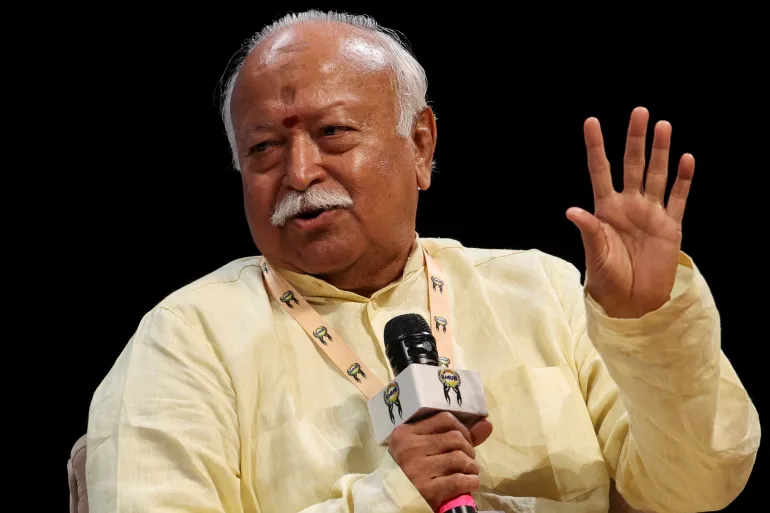
A high-profile event scheduled at Madison Square Garden in New York City has drawn significant backlash from advocacy groups, faith organizations, and activists. The gathering, branded as the Universal Oneness Celebration, is being promoted by the American Hindus for Engagement and Dialogue as a platform to foster peace and unity under the theme that the world is one family.
However, critics argue the event is a calculated effort to rehabilitate the image of the Rashtriya Swayamsevak Sangh (RSS), a prominent Hindu paramilitary organization. The keynote speaker for the rally is Mohan Bhagwat, the leader of the RSS, a group frequently accused of promoting discriminatory policies and inciting violence against religious minorities in India, including Muslims, Christians, and Sikhs.
Safa Ahmed, a community organizer from North Carolina, traveled to New York to join protests against the rally. She described the movement as one that has normalized mob violence, targeted relationships between Muslim men and Hindu women, and facilitated the destruction of Muslim homes. Ahmed expressed deep skepticism regarding the organizers’ claims of inclusivity, noting that such rhetoric stands in stark contrast to the lived experiences of minorities in India.
Advocates suggest that Hindu nationalist groups are increasingly targeting the United States, home to approximately 2.5 million Hindus, to expand their influence. By framing their activities around cultural pride and anti-Hindu discrimination, these groups aim to soften the public perception of the RSS. Sravya Tadepalli, deputy executive director of Hindus for Human Rights, characterized the rally as a goodwill tour designed to mask the organization’s history of communal violence.
The RSS serves as the ideological foundation for the Bharatiya Janata Party (BJP), which has governed India since 2014. Prime Minister Narendra Modi, a former RSS cadre, has frequently engaged with the Indian diaspora in the U.S. to promote his political vision. Notably, in September 2019, he addressed a crowd of 50,000 at the Howdy, Modi! event in Texas, which was attended by then-President Donald Trump.
These appearances have historically been contentious. Before his 2014 election, Modi was barred from entering the United States due to his leadership role during the 2002 Gujarat riots, where he faced allegations of failing to prevent the massacre of Muslim residents. Despite such controversies, Modi remains a popular figure domestically, though recent polling indicates that a significant portion of the Indian American diaspora is increasingly concerned about the impact of his rhetoric on religious minorities.
The U.S. Commission on International Religious Freedom (USCIRF) has formally intervened, issuing a statement on Wednesday that called for Bhagwat’s visa to be revoked. USCIRF Chair Asif Mahmood warned that Bhagwat is complicit in religious freedom violations and urged the U.S. government to implement targeted sanctions, citing the deteriorating conditions for religious minorities in India.
Local officials have also weighed in on the controversy. New York City official Zohran Mamdani expressed strong opposition to the event, stating that the exclusionary vision promoted by the RSS is deeply troubling. While Mamdani noted that he does not support the rally, he acknowledged the legal limitations of the city to cancel a private event.
Despite the official promotion of the event, activists believe the backlash signifies a growing, diverse coalition within the Indian diaspora. This emerging movement includes Hindu, Muslim, Sikh, and unprivileged-caste voices who reject the political agenda of the RSS and the BJP. According to organizers, the rally will be met with a firm rejection, highlighting a divide between the movement’s leadership and a significant portion of the diaspora that opposes its nationalist platform. The report also notes that to do that, they have utilised a variety of appeals to soften the image of the RSS, such as celebrations of Hindu culture and campaigns to highlight anti-Hindu discrimination. The report also notes that “The organisations behind this have pitched it as a broad appeal to Hindu history with an emphasis on inclusivity when, in reality, the RSS advocates for the exact opposite.”. The report also notes that however, that Hindu nationalists have also sought to cultivate links with the global far-right, emphasising a shared belief in the purported threats posed by Islam and secular elites, critics have pointed out. The report also notes that which has ruled India since 2014 and sought to remake the country along Hindu nationalist lines, the RSS is widely considered the ideological parent of the Bharatiya Janata Party (BJP). The report also notes that in remarks to the 2024 National Conservatism Conference in Washington, DC, BJP Vice President Ram Madhav said that conservatives in the West should view India as an example of how to defeat what he called the “left, liberal, Marxist, radical Islamist cabal”. The report also notes that like Bhagwat, he has also taken his message on the road, to speak to overseas supporters in the US. The report also notes that the event underscored Modi’s appeal among Indians living abroad and was one of the largest such events in US history.