

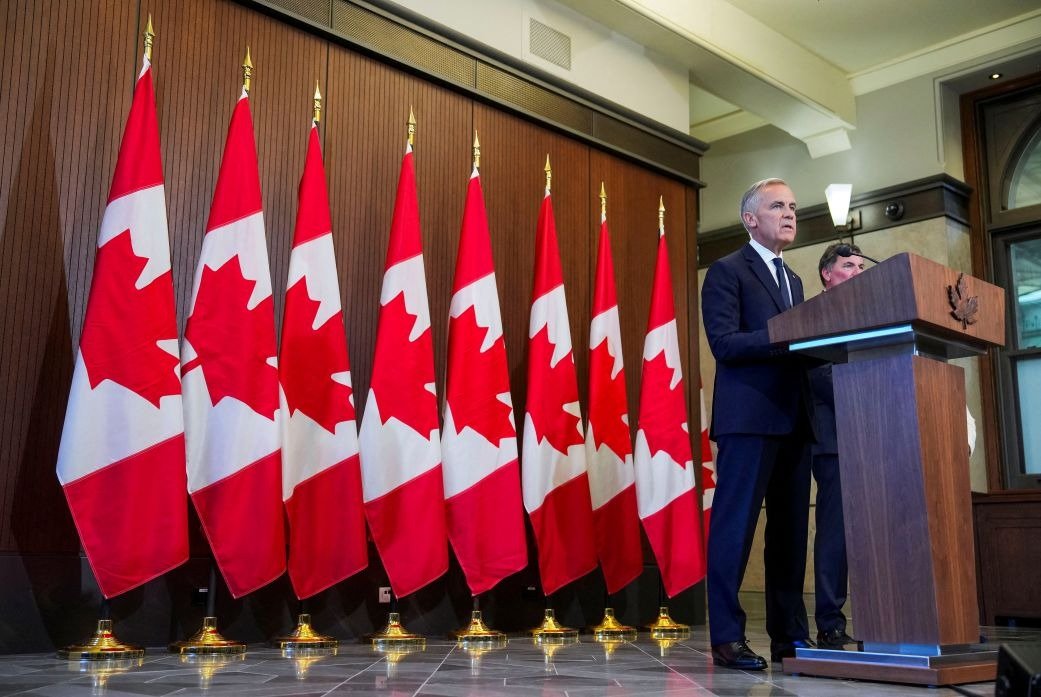
A deepening trade dispute between the United States and Canada has hit a significant impasse, with French language protections emerging as a primary point of contention. Following the collapse of negotiations last week, the two nations are bracing for a trade war, with the U.S. set to impose 50% tariffs on approximately $20 billion worth of Canadian goods starting September 8. Prime Minister Mark Carney has vowed to match these measures on a dollar-for-dollar basis.
The conflict centers on Canada’s long-standing language requirements, which the U.S. government has increasingly categorized as trade barriers. Canada, a bilingual nation, mandates that products be labeled in both English and French, while also requiring streaming platforms to promote domestic content, including French-language and Indigenous programming. For U.S. firms, these mandates necessitate costly packaging redesigns and additional production expenses, which Washington argues unfairly burdens American companies.
Prime Minister Carney has firmly rejected the U.S. demands, stating that his government could not accept a deal that would undermine these protections. He characterized the proposed agreement as containing “threats to French language and culture,” asserting that while Americans may view these policies as mere “irritants,” they represent fundamental rights for Canadians, particularly in the Francophone province of Quebec. During a news conference in Lévis, Quebec, Carney emphasized the “enormous gap” between the two nations’ perspectives, a stance that has garnered significant domestic support.
The tension was exacerbated on Monday when U.S. Trade Representative Jamieson Greer dismissed Ottawa’s concerns as a “funny, fake story.” Greer clarified in a CNBC interview that the U.S. opposition is not directed at the French language itself, but rather at what he termed a “discriminatory tax on American companies.” He specifically criticized policies like Quebec’s Bill 109, which requires streaming services to prioritize French-language content, arguing that the federal government is essentially forcing U.S. tech firms to subsidize their competitors.
These language rights are deeply embedded in Canada’s constitutional framework and are vital to Quebec’s identity. The province has historically sought to preserve its linguistic distinctiveness, a pursuit that has occasionally led to internal friction, including two past referendums on secession. Political analysts note that any concession on these laws could carry significant political risks for the federal government, especially with a provincial election approaching in Quebec where the separatist Parti Québécois is gaining momentum.
Stéphanie Chouinard, an associate professor of political studies at Royal Military College and Queen’s University, noted that bowing to U.S. pressure on such a core identity issue would be detrimental to Carney’s political standing. Furthermore, Quebec’s recent implementation of Bill 96—which enforces stricter French-language requirements for signage, packaging, and appliances—has already drawn scrutiny from the Office of the U.S. Trade Representative, which listed the legislation as a global trade barrier in 2025.
Stewart Prest, a political science lecturer at the University of British Columbia, argued that demanding Canada dismantle these protections is unreasonable. He compared the requirements to those in France, noting that for a country where French is the primary language for nearly 85% of Quebec’s population and roughly one-fifth of all Canadians, these laws are non-negotiable. As the September 8 deadline for the new tariffs approaches, the divide between the two allies remains wide, with President Donald Trump recently labeling Canada as “entitled” and difficult to negotiate with in a social media post. The report also notes that most recently in a 1995 vote where the “no” side won by a razor-thin margin of just 1.16%, quebec has twice held a referendum on whether to secede from the rest of the country. The report also notes that language laws include everything from the right for Canadians to access official services in both languages to the requirement that hair care companies display the French “shampooing” alongside English text on their bott. The report also notes that a core part of Canada’s national identity, many in Canada have rallied behind Carney’s decision — and particularly his comments about protecting French culture. The report also notes that which has fought to protect its distinct linguistic and cultural identity in an English-dominated North America, language rights have been entrenched in Canada’s constitution for decades and are particularly important to Quebec. The report also notes that this means added barriers as they must redesign packaging and pay extra production costs, for US companies looking to do business in Canada.