

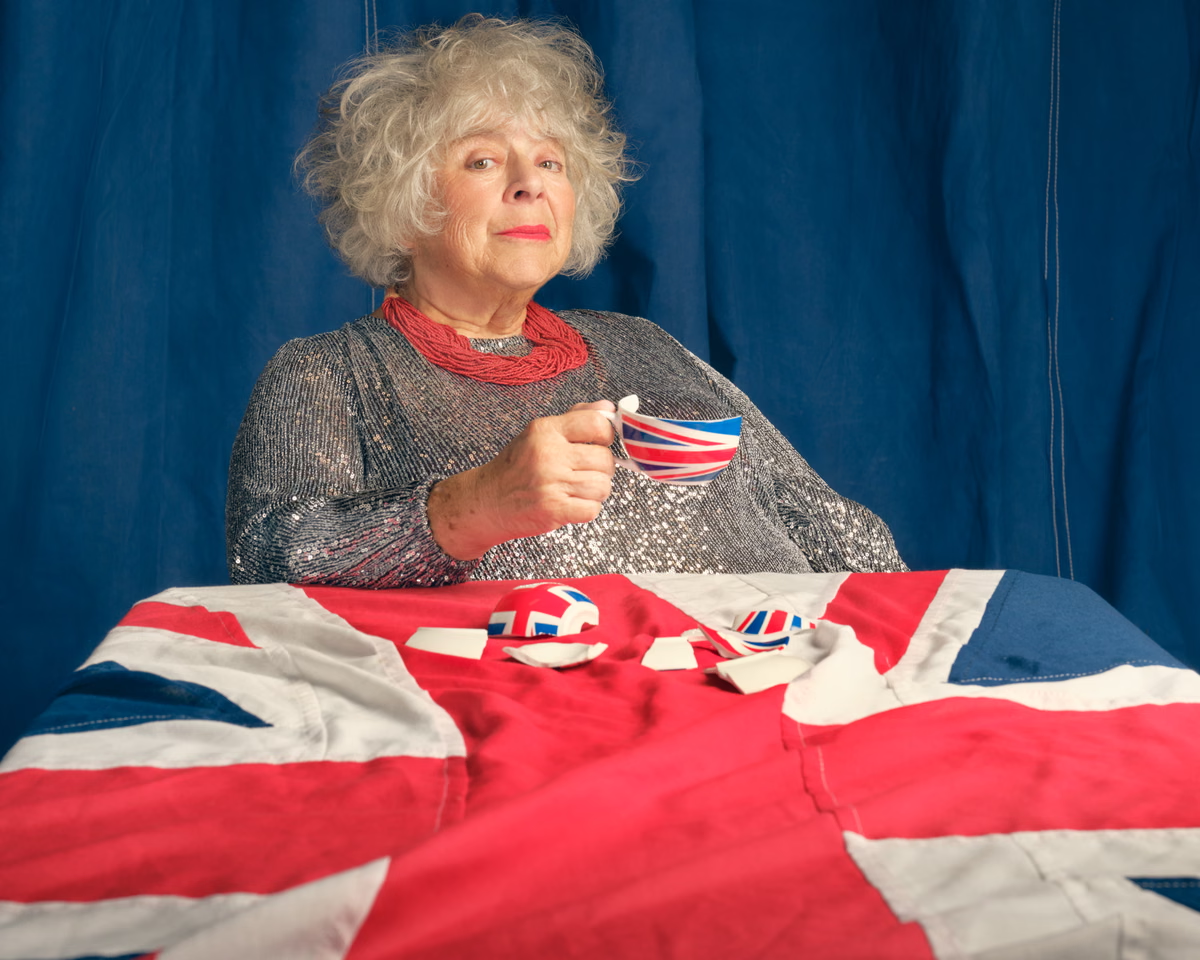
At 85, Miriam Margolyes observes that the world has turned increasingly hostile, a shift she attributes to both global political instability and her own aging process. Reflecting on her life, she notes that the Britain of her youth feels nearly unrecognizable compared to the current climate, which she describes as the most challenging she has encountered. She cites the historian Eric Hobsbawm, a friend she deeply admired, who famously argued that people often invent historical mythologies to serve their own agendas, despite the reality of the past being far more complex.
Margolyes acknowledges that while she is currently enjoying professional success and personal stability with her partner, she remains deeply concerned by the erosion of public institutions. The postwar generation she belongs to witnessed significant historical milestones, including the rise and fall of the Berlin Wall, the tenure of Winston Churchill, the establishment of the NHS, the emergence of the Beatles, the Profumo scandal, the reign of Elizabeth II, the Great Train Robbery, the introduction of the contraceptive pill, the IRA conflict, the Margaret Thatcher era, and the Falklands War.
She expresses alarm at the disappearance of fundamental societal pillars, such as local banks, the Post Office, and the reliability of free speech. She views the United States as an adversary and warns that the influence of powerful oligarchs is destabilizing the global order. To illustrate the historical friction between the English and their neighbors, she recounts jokes highlighting the mutual disdain between the English, Welsh, Scots, and Irish, noting that the English often remain oblivious to the resentment their perceived arrogance generates.
The actor explores various historical labels used to describe the British, such as the Roman-era “Brittunculi” (wretched little Brits), the Australian term “Poms”—which some suggest refers to “Prisoner of Mother England”—and the South African Boer nickname “Rooinek” or “redneck,” referring to sunburnt skin. She also notes the derogatory “soutpiel” (salty penis), implying a split loyalty between Britain and South Africa. Other terms include “Limeys” from the US, “Inselaffen” (island monkeys) from Germany, and the French “les rosbifs,” referencing a fondness for roast beef.
Margolyes argues that history is often shaped by the victors and warns against falling for nationalistic propaganda. She advocates for a more inclusive understanding of British identity, one that embraces the diverse linguistic and cultural contributions of the various tribes that have settled on the islands. She remains critical of attempts to sanitize or fix language, noting that history has seen various powers, from the Normans to the English, attempt to suppress native Irish, Welsh, and Scottish tongues.
Addressing the controversy surrounding her outspoken political views, particularly regarding Palestine and the Harry Potter franchise, she insists on the importance of speaking one’s truth. She criticizes the current media and political landscape for engaging in divisive campaigns, advising people to avoid those they perceive as dishonest. She recalls her own upbringing, noting that her mother encouraged her to “speak as you find,” a principle she uses to distinguish between decent individuals and those she deems vile.
Reflecting on her political past, Margolyes reveals she was once a teenage Conservative candidate in May 1955 at the age of 14. However, she has since moved toward leftist politics, contrasting her own development with that of former Conservatives who have joined the Reform party. She recalls that Lawrence Turner, the Tory candidate who won the Oxford constituency during her school campaign, later voted in favor of the Suez invasion, an event she views in the context of a period where over 70 million people had died to secure freedom, only for the nation to face the rise of the National Front in 1967 and Enoch Powell’s divisive “Rivers of Blood” speech in 1968.
She concludes with a sharp critique of public figures she views as hypocritical, including those who pose as “one of the lads” while benefiting from immense wealth or legal protections, such as those securing foreign citizenship for their families. For Margolyes, maintaining integrity in the face of such figures is essential to saving the nation from what she terms the “bad guys.” The report also notes that a funny thing happened on the way to 2026: I got old and the world turned nasty. The report also notes that it happened very quickly and it’s to do with politics (the world) and pelvic floor weakness (mine). The report also notes that it’s a shock to see wrinkles and grey hair, because inside I am still that naughty Oxford High School girl, risking detention just for the joy of entertaining her friends, sometimes when I look in the mirror. The report also notes that but actually we remain who we have always been, only more so, and we need to make our peace with that and with each other, people assume that with great age comes great wisdom. The report also notes that though – that feels almost unrecognisable, and everyone I speak to says the same thing, the Britain I grew up in. The report also notes that they don’t understand or feel a connection to the place they thought they knew, people feel adrift. The report also notes that now at 85, I look around at my remaining friends and at my unique relationship with a woman of different qualities but luckily the same politics.