

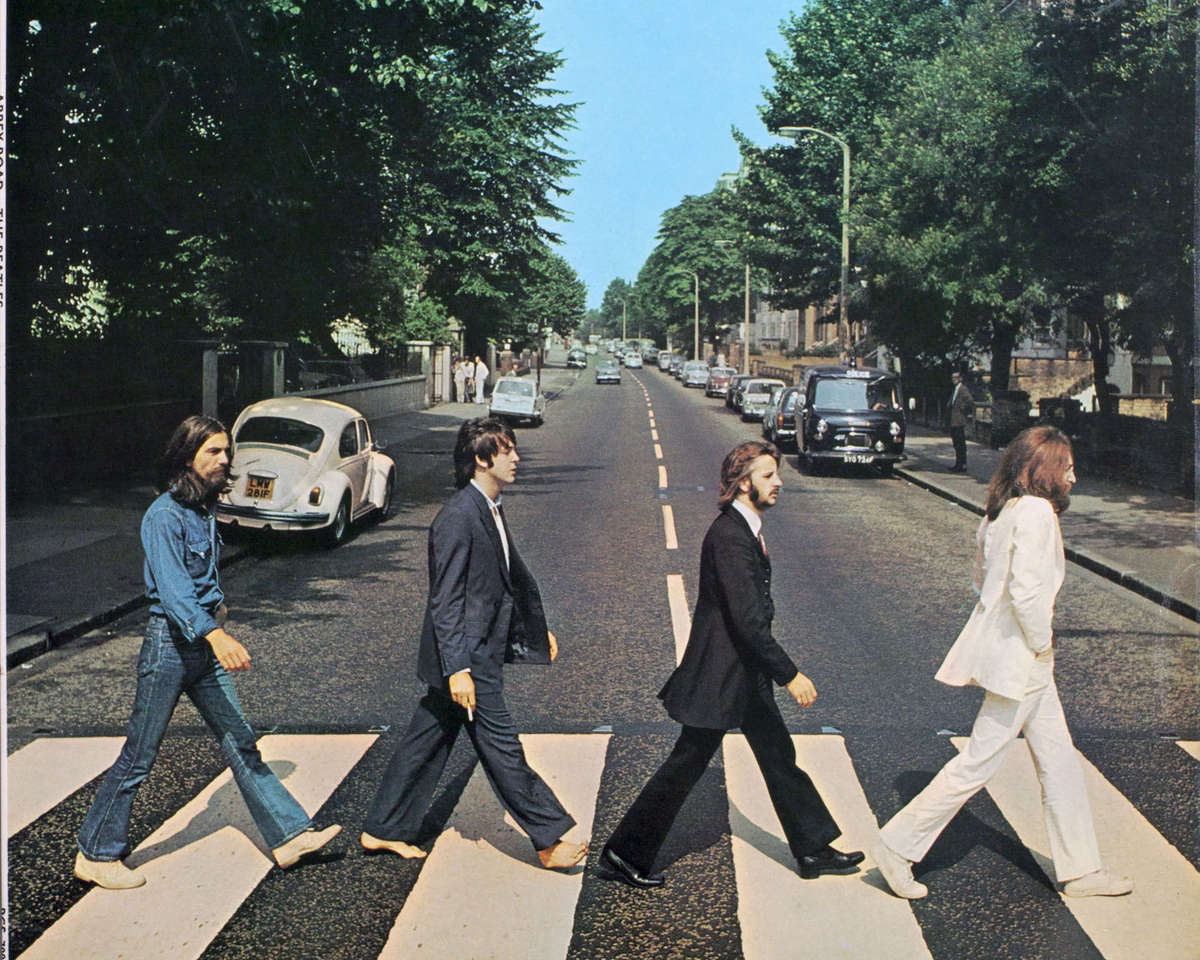
The enduring appeal of the Beatles’ Abbey Road album cover lies less in the four men crossing the street than in the setting itself. The north London road, with its crisp white stripes and vibrant summer greenery, creates a hyperreal vista that feels almost like a painting. By the time photographer Iain Macmillan captured the image on August 8, 1969, the band had reached a level of fame so transcendent that their simple act of walking across a road transformed into a moment of magical mystery.
This photograph has become one of the most parodied and recreated images in music history. From artists like Kanye West and the Red Hot Chili Peppers to Franciscan friars and filmmaker Sam Mendes, who recently utilized the scene for his upcoming Beatles biopics, the image remains a cultural touchstone. It captures a rare, eerie perfection in the dynamic between the four individuals and the collective unit, freezing them in time just as they were beginning to drift toward separate futures.
The band had explored this sense of impossible everydayness earlier in 1969, notably during their final live performance on the roof of Apple Corps in London’s Savile Row. The Abbey Road cover serves as a similar manifestation of their archetypal status. John Lennon, leading the group, appears somewhat detached and absorbed; his face is partially obscured, fueling long-standing speculation that he was already distancing himself from the band—a sentiment that mirrored his actual intentions to leave the group that September.
The image also famously sparked the bizarre “Paul is dead” conspiracy theory. Proponents of the myth interpreted Ringo Starr’s black attire as that of an undertaker and George Harrison’s clothing as that of a gravedigger. However, the theory was fundamentally flawed, as Paul McCartney himself was the creative force behind the shoot alongside Macmillan. McCartney had been collecting works by the Belgian surrealist René Magritte since 1966, and the photograph’s deadpan, haunting perspective is heavily influenced by that aesthetic.
The project was a deliberate piece of conceptual art rather than a chance encounter. After rejecting an initial plan to photograph the band in Nepal, McCartney proposed using the location outside their north London music studios in St John’s Wood. He even sketched out the concept, visualizing the band as stick figures on the crossing. On the day of the shoot, the group arranged for a police officer to halt traffic while Macmillan climbed a stepladder to secure the perfect angle.
Ultimately, the cover stands as a celebration of a distinctly British moment, grounding the band in a familiar, real-world setting. While the members were on the verge of parting ways, McCartney—the most devoted believer in the group’s longevity—ensured they were captured together one last time. By choosing to walk barefoot, he left a lasting mark on an image that continues to invite endless decoding, proving that even in their final days, the Beatles understood the power of their own mythology. The report also notes that the Beatles were so transcendently famous by the time Iain Macmillan took this picture on 8 August 1969 that seeing them do something as ordinary as cross the road becomes a magical mystery. The report also notes that the Beatles played on the same impossible everydayness months before this picture was taken when they performed live on the roof of Apple Corps in London’s Savile Row in January 1969. The report also notes that i can picture Lennon walking away because that’s what he told the group he was going to do that September. The report also notes that with summer trees veiling in bright green what might otherwise be dour brick houses, it could be a hyperreal vista painted by David Hockney, vanishing towards a perfect blue sky. The report also notes that enhancing the clarity of this psychedelic daydream, the black and white stripes of the crossing and the white line down the middle of the receding north London road are fresh and crisp. The report also notes that of course the four blokes do play a part. The report also notes that yet seems absent and absorbed: he is the only one whose face you can’t fully see and if he is the pacesetter, he might also be trying to get away, john Lennon leads. The report also notes that there’s a self-consciously symbolic quality to this picture that invites you to insert whatever allegory you please.