

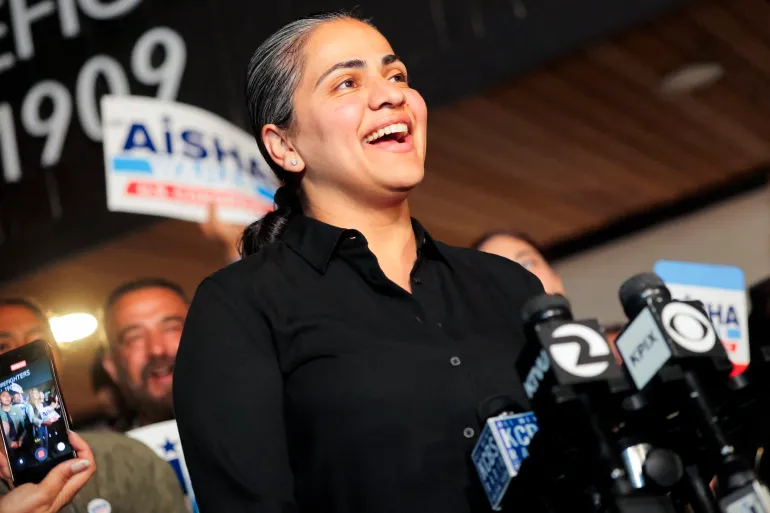
California state Senator Aisha Wahab has emerged victorious in a special election to fill the vacant seat previously held by Eric Swalwell. The race, which concluded on Thursday, saw the progressive candidate overcome a significant surge of attack advertisements funded by pro-Israel political groups during the final weeks of the campaign.
Wahab is set to represent California’s 14th congressional district—covering the southeastern San Francisco Bay Area—for the remainder of Swalwell’s term, which concludes in January. Following her win, Wahab stated, “I will fight for this district that raised me,” adding that the result proves her constituency “cannot be bought.” Reflecting on her path to office, she noted, “From foster care to Congress, this journey shows the possibility of the American Dream.”
The special election was necessitated by Swalwell’s resignation in April following allegations of sexual misconduct, which he has denied. Wahab, a longtime advocate for social and economic justice in the state legislature, is poised to become the first Afghan American to serve in the US Congress.
The contest became a focal point for testing the influence of pro-Israel lobbying in American politics, particularly as public support for the country has shifted amid the ongoing war in Gaza. While foreign policy was not the primary focus of her platform, Wahab has previously taken clear stances on the conflict. Last year, she co-authored a state resolution condemning the “horrific humanitarian catastrophe in Gaza” and, during an April candidate forum, affirmed her belief that the situation for Palestinians constitutes a genocide. Her opponent, moderate Democrat Melissa Hernandez, avoided a direct answer on the term, stating that while Israel has a right to defend itself, the destruction in Gaza has gone “too far.”
Despite Wahab’s strong lead in the June primary—where she secured over 42 percent of the vote compared to Hernandez’s 17 percent—the race tightened significantly in August. The United Democracy Project, a super PAC linked to the American Israel Public Affairs Committee (AIPAC), reportedly spent nearly $2.5m to support Hernandez. Additionally, CNN noted that BOLD America, another group receiving AIPAC funding, contributed $1.9m to the effort.
Much of the opposition spending targeted Wahab through controversial advertising. One prominent ad campaign leveled claims that she had weakened laws regarding the sex-trafficking of minors. Wahab countered these attacks with a video emphasizing her legislative record, which made it “illegal and a felony to traffic or solicit minors, across the board,” and she dismissed the opposing ads as “$5m of lies.”
Wahab’s victory follows a broader trend in the 2026 midterm season where progressive candidates have successfully navigated heavy outside spending. Similar challenges have been faced by other candidates, such as Michigan Senate hopeful Abdul El-Sayed, who also advanced to the general election despite significant opposition funding.
Representative Ro Khanna, a fellow California progressive, congratulated Wahab on her “decisive victory,” stating he looks forward to collaborating with her on key issues including Medicare for All, living wages, and ending the war in Iran. Wahab and Hernandez are scheduled for a rematch in November, where they will compete for a full two-year term representing the 14th district. The report also notes that roughly a third of US adults believed Israel had committed genocide in Gaza, a position backed by United Nations experts and rights groups, according to an Associated Press poll released in July. The report also notes that at a candidate forum in April, Wahab also answered “yes” when asked whether she believed what was happening to the Palestinian people constituted a genocide. The report also notes that however, has gone to advertising that does not mention Israel or place the issue prominently, some of that spending. The report also notes that during her time in the state legislature, Wahab focused on issues such as housing affordability and authored a bill that would have banned caste-based discrimination. The report also notes that it was ultimately vetoed by California Governor Gavin Newsom.